1.0 Executive Summary: High-Power Laser Integration in Pune’s Heavy Engineering Sector
The industrial corridor of Pune, specifically the Chakan and Talegaon belts, has transitioned into a critical hub for renewable energy infrastructure fabrication. As wind turbine tower dimensions escalate to accommodate 5MW+ turbines, the demand for precision in structural steel processing has surpassed the capabilities of traditional plasma cutting and manual oxy-fuel preparation. This report evaluates the deployment of a 12kW 3D Structural Steel Processing Center equipped with an Infinite Rotation 3D Head.
The integration of high-density fiber laser sources with multi-axis kinematic heads represents a paradigm shift in how S355JR and S355NL grade steels are processed. By eliminating the rotational constraints of the cutting head, manufacturers can achieve continuous weld preparation (beveling) on complex geometries, significantly reducing the Total Cost of Ownership (TCO) per tower segment while adhering to stringent ISO 9001 and EN 1090-2 execution classes.
2.0 Technical Specifications of the 12kW Fiber Laser Source
The 12kW ytterbium-doped fiber laser source is the cornerstone of the processing center. In the context of wind tower fabrication, which typically involves plate thicknesses ranging from 12mm to 40mm for internal structural components and secondary steel, the 12kW source provides the necessary power density to maintain a high-speed stable kerf.
2.1 Power Density and Kerf Dynamics
At 12kW, the laser maintains a beam quality (M²) of ≤ 1.1, allowing for a concentrated spot size that vaporizes high-tensile steel almost instantaneously. This minimizes the Heat Affected Zone (HAZ), a critical factor in wind towers where fatigue resistance is paramount. In Pune’s ambient conditions, where humidity can fluctuate, the laser’s chiller system is calibrated to maintain a ±0.5°C stability to prevent thermal lensing, ensuring consistent cut quality over 24-hour duty cycles.
2.2 Material Penetration and Assist Gas Optimization
The processing center utilizes high-pressure oxygen (O2) for thick-section carbon steel and nitrogen (N2) for thinner internal components. The 12kW overhead allows for “Clean Cut” edges on 20mm sections at speeds exceeding 1.8m/min, which is approximately four times faster than traditional plasma-arc systems. Furthermore, the precision of the 12kW beam ensures that the dross levels remain below 0.1mm, virtually eliminating post-process grinding.
3.0 Kinematics of the Infinite Rotation 3D Head
The defining technological advancement of this system is the “Infinite Rotation” capability of the C-axis. Standard 3D laser heads are constrained by internal cabling and gas lines, typically limited to a ±360-degree rotation before requiring a “rewind” move. In the fabrication of wind tower door frames and cable entry ports, this rewind introduces dwell marks and thermal inconsistencies.
3.1 Mechanical Architecture of the B/C Axis
The Infinite Rotation head employs specialized rotary unions for high-pressure gas delivery and slip-ring technology for electrical signals. This allows the head to rotate indefinitely around the Z-axis while the B-axis tilts up to ±45 degrees. For a Pune-based fabricator processing conical tower sections, this means the laser can maintain a perpendicular or beveled orientation relative to the changing curvature of the workpiece without interruption.
3.2 Weld Preparation and Beveling Accuracy
Wind tower components require complex weld preparations (V, Y, K, and X-type bevels). The Infinite Rotation head, governed by advanced CNC algorithms, adjusts the tilt angle in real-time. The volumetric accuracy of the system is maintained within ±0.05mm, ensuring that when the beveled door frame is fitted to the tower shell, the root gap is perfectly uniform. This precision is essential for automated submerged arc welding (SAW) processes used in Pune’s leading tower plants.
4.0 Application in Wind Turbine Tower Fabrication
The structural integrity of a wind turbine tower depends on the precision of its secondary and tertiary steel components. The 12kW 3D Processing Center optimizes several key areas of production.
4.1 Internal Platform and Bracketing Systems
Modern towers house complex internal mezzanine levels, cable ladders, and elevator guide rails. These are often made from L-profiles, C-channels, and I-beams. The 3D processing center allows for “one-hit” fabrication—cutting to length, hole drilling, and slotting in a single program. The infinite rotation allows the laser to navigate around the flanges of an I-beam without the machine needing to re-position the workpiece, increasing throughput by 60% compared to traditional beam lines.
4.2 Door Frame and Flange Integration
The entry door of a wind tower is a high-stress zone. The 3D head executes the elliptical cutouts on the curved tower shell with a chamfered edge for the reinforcement frame. Using the 12kW source, the system can process these contours in thick-wall sections with a surface roughness (Rz) that meets the highest international standards for fatigue-sensitive structures.
5.0 Solving Precision and Efficiency Challenges in Pune’s Industrial Context
Fabricators in the Pune region face unique challenges, including a fluctuating power grid and the need for high-skilled labor. The 3D structural center addresses these through automation and robust engineering.
5.1 Labor Displacement and Quality Control
Before the adoption of 12kW 3D laser technology, beveling was a manual task involving handheld oxy-fuel torches and angle grinders. This led to high variance in weld prep quality. The automated 3D center replaces three manual stages (cutting, marking, beveling) with one digital process. The CNC integration ensures that the “as-built” component matches the CAD model with 100% fidelity, a requirement for the stringent audits performed by global wind energy developers.
5.2 Energy Efficiency and Gas Consumption
Despite the high 12kW power draw, the fiber laser technology is significantly more efficient than CO2 lasers or plasma systems in terms of “wall-plug” efficiency. In Pune’s competitive manufacturing landscape, the reduction in gas consumption (specifically the optimization of nozzle diameter and standoff distance facilitated by the 3D head’s sensors) results in a 25% reduction in consumable costs per metric ton of steel processed.
6.0 Structural Synergy: The 12kW Source and Automatic Loading
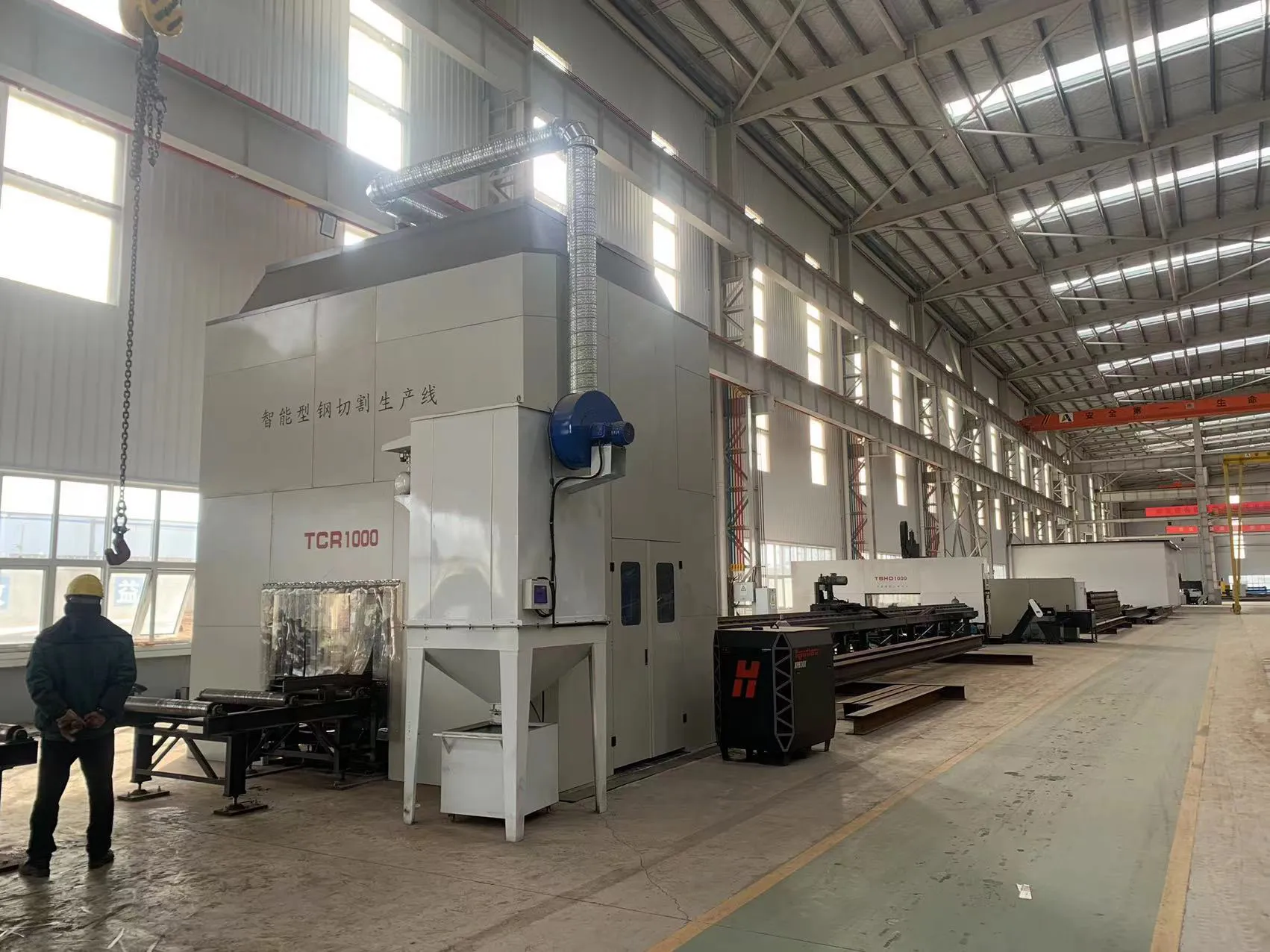
The 12kW 3D Processing Center is not merely a cutting head but a comprehensive material handling system. In Pune’s large-scale facilities, the synergy between the laser source and the automated chuck system is vital.
6.1 Four-Chuck Support Dynamics
To process structural steel lengths of up to 12 meters (common for tower internal supports), the system utilizes a four-chuck configuration. This minimizes “pipe whip” and vibration. When the 12kW laser is cutting at high speeds, even micro-vibrations can ruin the kerf. The synchronized movement of the chucks ensures the material is perfectly centered, allowing the Infinite Rotation head to maintain a constant focal point on the material surface.
6.2 Real-time Compensation Algorithms
Structural steel is rarely perfectly straight. The 3D head is equipped with capacitive sensing and laser profiling to map the material’s actual shape. The 12kW laser’s focus is then adjusted dynamically. In Pune’s heavy fab shops, where raw material might be stored in variable outdoor conditions, this ability to compensate for material “bow” or “twist” is essential for maintaining the tolerances required for wind turbine components.
7.0 Conclusion
The deployment of a 12kW 3D Structural Steel Processing Center with Infinite Rotation represents the current zenith of heavy steel fabrication technology. For the wind turbine sector in Pune, the benefits are quantifiable: a reduction in downstream welding time, the elimination of manual grinding, and the ability to process complex 3D geometries with aerospace-level precision. As wind tower heights continue to increase, the necessity for such high-power, high-mobility laser systems becomes not just an advantage, but a prerequisite for industrial competitiveness. The infinite rotation capability, specifically, solves the bottleneck of complex beveling, positioning Pune-based fabricators at the forefront of the global renewable energy supply chain.