The Industrial Context: Hamburg’s Rail Renaissance
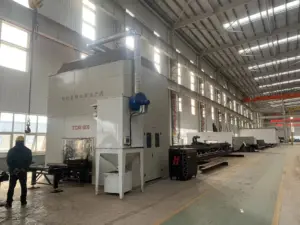
Hamburg has long been the logistical heartbeat of Europe, but as Germany pivots toward “Starke Schiene” (Strong Rail) initiatives, the demand for modernized infrastructure has surged. The challenge lies in the sheer scale and durability required for railway components. Traditional fabrication methods for structural steel are labor-intensive and prone to human error. Enter the 12kW 3D Structural Steel Processing Center.
Located strategically near the Port of Hamburg, this center serves as a technological lighthouse. In the context of rail infrastructure, precision is not a luxury—it is a safety requirement. Whether it is the fabrication of catenary supports for high-speed ICE lines or the structural ribbing of a new rail bridge over the Elbe, the components must withstand decades of dynamic loading and environmental stress. The 12kW fiber laser technology provides the thermal efficiency and cutting precision necessary to meet these rigorous Eurocode standards while drastically reducing lead times.
The 12kW Fiber Laser: Unleashing High-Density Energy
As a fiber laser expert, I recognize the 12kW threshold as the “sweet spot” for modern structural steel. While 6kW and 8kW lasers are sufficient for thin-to-medium sheet metal, 12kW of power changes the physics of the cut for heavy profiles. At this power level, the laser achieves a high power density that allows for “high-speed melt ejection.”
For railway infrastructure, we are often dealing with S355 or even S460 high-strength structural steels with thicknesses ranging from 15mm to 30mm. A 12kW source allows for:
1. **Increased Feed Rates:** Processing 20mm steel plate at speeds that were previously only possible for 10mm plates.
2. **Reduced Heat Affected Zone (HAZ):** The faster the laser moves, the less time heat has to dissipate into the surrounding material. This preserves the metallurgical integrity of the steel, which is critical for components subject to the fatigue cycles of passing trains.
3. **Superior Piercing:** 12kW enables “flash piercing” techniques, reducing the time spent initiating a cut in thick flanges, which significantly boosts overall throughput in a 3D environment.
The Engineering Marvel: The Infinite Rotation 3D Head
The true centerpiece of the Hamburg facility is the 3D cutting head with infinite rotation (the C-axis). Traditional 3D laser heads are often limited by internal cabling and gas hoses, requiring a “rewind” after a certain degree of rotation. In a 3D structural environment—where the laser must navigate the flanges, webs, and radii of an H-beam—these rewinds are catastrophic to cycle time and path accuracy.
The infinite rotation head utilizes advanced slip-ring technology and specialized fiber-optic coupling to allow the head to spin indefinitely. This capability is essential for:
* **Complex Beveling:** Railway components often require weld preparations (V, Y, X, and K-type bevels). The infinite rotation allows the head to maintain the correct torch angle relative to the path without stopping, ensuring a consistent bevel angle across complex contours.
* **Contour Following:** Structural beams are rarely perfectly straight. The 3D head, equipped with high-speed capacitive sensors, maintains a constant standoff distance even as it rotates around the corners of a beam, compensating for material deviations in real-time.
* **Feature Integration:** It allows for the seamless cutting of interlocking joints and “dog-bone” notches used in seismic-resistant rail structures, all in a single continuous motion.
Transforming Structural Steel for Rail Infrastructure
In railway engineering, the move from 2D plate cutting to 3D profile processing is revolutionary. Historically, an I-beam would be sawed to length, moved to a radial drill for bolt holes, and then manually ground for weld prep. Each move introduces potential for error.
The 12kW 3D center in Hamburg treats the beam as a holistic 3D object. The CNC system imports a Tekla or CAD file, and the laser executes every feature in one setup. For bridge construction, this means the large-scale girders are delivered to the site with millimeter-perfect precision, ensuring that bolt holes align perfectly across 50-meter spans.
Furthermore, the ability to cut complex apertures into electrification masts (catenary poles) allows for internal cable routing and integrated mounting points, which reduces the surface area susceptible to corrosion—a major concern for Deutsche Bahn’s maintenance cycles.
The Hamburg Advantage: Logistics and Sustainability
Choosing Hamburg for this center was a calculated move. The proximity to steel distributors reduces the “carbon footprint of the footprint.” By processing the steel near the point of entry or major rail hubs, the industry saves on heavy transport costs.
From a sustainability perspective, the 12kW fiber laser is a “green” technology compared to older CO2 lasers or plasma cutting. Fiber lasers have a wall-plug efficiency of approximately 35-40%, whereas CO2 lasers hover around 10%. Additionally, the precision of the 12kW beam results in less kerf (wasted material) and eliminates the need for chemical cleaning or heavy grinding required after plasma cutting. This creates a cleaner, safer work environment for the specialists operating the Hamburg facility.
Technical Challenges and the “Expert” Solution
Operating a 12kW 3D system is not without its challenges. The management of the “back-reflection” is paramount when cutting highly reflective or thick-scale structural steel. Modern fiber lasers in this center utilize optical isolators and advanced beam monitoring to protect the 12kW source from damage.
Another challenge is the gas dynamics. To cut 25mm steel with a 12kW laser, the nozzle design must be perfect. The Hamburg facility utilizes high-pressure nitrogen for clean cuts in stainless or oxygen-assisted cutting for carbon steel. The 3D head must manage these gas pressures while tilting at 45-degree angles, requiring sophisticated fluid dynamic modeling in the nozzle tip to prevent turbulence that could mar the cut surface.
Digital Integration: Industry 4.0 in Rail
The processing center is fully integrated into a digital twin environment. Every beam processed in Hamburg is logged with its material heat number, cutting parameters, and timestamp. This creates a “birth certificate” for every piece of the railway infrastructure.
If a bridge component shows signs of stress twenty years from now, engineers can look back at the digital record of its laser-cut fabrication. The 12kW system’s software also optimizes nesting on long profiles, reducing scrap rates to below 5%, a figure that was unthinkable with manual mechanical processing.
Conclusion: Setting the Track for the Future
The 12kW 3D Structural Steel Processing Center with Infinite Rotation in Hamburg is more than just a machine shop; it is a critical infrastructure asset. By leveraging the highest levels of laser physics and mechanical engineering, it provides the German rail network with the components needed to expand and modernize.
As a fiber laser expert, I see this as the beginning of a new era. The combination of high power and infinite 3D movement removes the shackles of traditional geometry. We are no longer limited by what a saw or a drill can do; we are limited only by the imagination of the structural engineer. Hamburg’s investment in this technology ensures that the future of European rail is built on a foundation of precision, efficiency, and uncompromising strength.