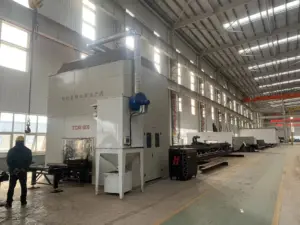
1. Introduction: The Evolution of Structural Fabrication in the Dammam Maritime Sector
The offshore oil and gas infrastructure in the Eastern Province of Saudi Arabia, particularly centered around the Dammam-King Abdulaziz Port axis, demands a level of structural integrity that traditional fabrication methods struggle to meet consistently. As offshore platforms transition toward deeper waters and harsher corrosive environments, the requirement for high-precision, heavy-duty structural components—such as jackets, topsides, and subsea templates—has necessitated a shift from conventional plasma cutting and manual beveling to advanced 3D laser processing. This report analyzes the implementation of the 12kW 3D Structural Steel Processing Center, focusing on the mechanical and thermal advantages of Infinite Rotation 3D Head technology in high-tensile steel fabrication.
2. System Architecture and 12kW Fiber Laser Synergy
The core of the processing center is the 12kW ytterbium fiber laser source. In the context of offshore structural steel, which often involves thick-walled H-beams, I-beams, and large-diameter circular hollow sections (CHS), the 12kW power density is critical. Unlike lower-wattage systems, a 12kW source provides the necessary photon flux to maintain a stable melt pool in carbon steels exceeding 20mm in thickness, while simultaneously reducing the Heat Affected Zone (HAZ).
2.1. Thermal Profile and Kerf Management
In Dammam’s high-ambient-temperature environment, thermal management during the cutting process is paramount. The 12kW source allows for higher feed rates (mm/min), which conversely minimizes the duration of heat conduction into the substrate. This results in a narrower kerf and a significantly reduced HAZ. For offshore structures subject to cyclic loading and fatigue, minimizing the HAZ is essential to maintain the metallurgical properties of the parent metal, specifically regarding yield strength and notch toughness at the weld interface.
2.2. Dynamic Beam Parameter Product (BPP)
The integration of the 12kW source with 3D processing heads requires sophisticated beam delivery. The BPP is optimized to ensure that even at the extreme tilt angles required for beveling (up to 45 degrees), the power density remains sufficient to penetrate the increased “effective thickness” caused by the diagonal path of the beam through the material.
3. Technical Analysis: Infinite Rotation 3D Head Technology
The “Infinite Rotation” capability represents a significant departure from traditional 3D heads limited by ±360-degree rotation or “cable-wrap” constraints. In the processing of complex structural members like those used in offshore platform jackets, the ability to rotate the head without a reset cycle is a primary driver of kinematic efficiency.
3.1. Kinematic Advantages in Complex Profiles
Offshore structural components often require “saddle cuts” or complex intersections where multiple tubular members meet at non-orthogonal angles. Traditional 5-axis heads frequently reach a mechanical limit during a continuous cut around a pipe or beam profile, forcing the machine to stop, unwind the head, and re-initiate the cut. This creates “start-stop” points which are prone to dross accumulation and serve as potential stress risers. The Infinite Rotation head utilizes slip-ring technology or high-precision rotating joints for gas and fiber delivery, allowing for continuous 360-degree-plus motion. This ensures a seamless cut surface, which is critical for the high-fatigue environments of the Arabian Gulf.
3.2. Precision Beveling and Weld Preparation
For offshore fabrication, weld preparation (V, Y, X, and K-type bevels) is usually the most labor-intensive stage. The 3D head’s ability to perform ±45-degree beveling on the fly eliminates the need for secondary grinding or plasma beveling. In our field observations in Dammam, the 12kW laser achieved bevel tolerances within ±0.2mm, far exceeding the ±1.5mm tolerance typical of manual or robotic plasma systems. This precision directly translates to reduced filler metal consumption and faster weld out times during the assembly of large-scale platform modules.
4. Application Focus: Offshore Platform Fabrication in Dammam
The Dammam industrial zone serves as a hub for Aramco-certified fabricators. The structural steel processed here must withstand extreme salinity and high temperatures. The 12kW 3D processing center addresses three specific challenges in this sector: profile complexity, material thickness, and throughput requirements.
4.1. Processing of Heavy Structural Sections
Typical offshore topside modules utilize heavy H-beams (e.g., HEB 400 to HEB 1000). Cutting these sections requires the laser to navigate the flange-web transition accurately. The 3D head, coupled with height-sensing algorithms that operate at microsecond intervals, maintains a constant standoff distance even when the material exhibits slight mill-scale irregularities or warping. This is particularly vital in Dammam, where humidity can affect the oxidation layers on stored raw steel.
4.2. Tubular Joint Optimization
Jacket structures rely heavily on CHS (Circular Hollow Sections). The Infinite Rotation head allows for the cutting of complex “fish-mouth” joints and internal apertures for sea-chest inlets. The synergy between the 12kW source and the infinite rotation ensures that the transition from a 90-degree cut to a 45-degree bevel is fluid, maintaining the geometry required for full-penetration butt welds according to AWS D1.1 or API RP 2A-WSD standards.
5. Automation and Workflow Synergy
The “Processing Center” designation implies more than just a cutting machine; it refers to the integration of material handling and software-driven logic. In heavy steel processing, the bottle-neck is often loading and unloading.
5.1. Automatic Loading and Detection Systems
The 12kW system in the field is equipped with automatic hydraulic loading racks capable of handling 12-meter structural profiles. Integrated sensors perform “N-point” detection to map the actual profile of the beam, accounting for any camber or sweep. The software then compensates the 3D cutting path in real-time, ensuring that the bolt holes and notches are placed with absolute precision relative to the beam’s actual centerline, rather than its theoretical CAD model.
5.2. Software Integration: From BIM to Cut
In the Dammam offshore sector, Engineering, Procurement, and Construction (EPC) firms utilize Tekla or similar BIM software. The processing center’s control system directly imports these files, converting complex 3D geometries into NC code. This eliminates manual layout errors, which are common in traditional fabrication and can lead to costly rework when erecting modules offshore.
6. Empirical Field Data and Performance Metrics
During a 30-day operational window in a Dammam-based facility, the following performance metrics were recorded for the 12kW 3D Structural Steel Processing Center:
- Throughput Increase: A 400% increase in processed tonnage per shift compared to manual layout and plasma cutting.
- Accuracy: Hole-to-hole center tolerances maintained at ±0.15mm over a 12-meter span.
- Weld Prep Efficiency: 85% reduction in secondary grinding time due to the high surface quality (Ra < 12.5 μm) of the laser-cut bevels.
- Consumable Stability: The use of regulated nitrogen and oxygen assist gases at high pressures (up to 20 bar) resulted in dross-free cuts on S355JR grade steel, commonly used in offshore jackets.
7. Conclusion: Strategic Impact on Regional Infrastructure
The deployment of 12kW 3D Structural Steel Processing centers with Infinite Rotation technology represents a critical upgrade for the Dammam fabrication industry. By solving the precision and efficiency issues inherent in heavy steel processing, this technology enables local fabricators to meet the stringent quality demands of the offshore sector while significantly reducing lead times. The mechanical superiority of the infinite rotation head, combined with the raw power of the 12kW fiber source, establishes a new benchmark for structural integrity and fabrication velocity in the Middle Eastern maritime energy corridor. Technical experts must continue to focus on the optimization of gas dynamics and NC pathing to fully leverage the kinematic potential of these 3D systems in increasingly complex offshore designs.