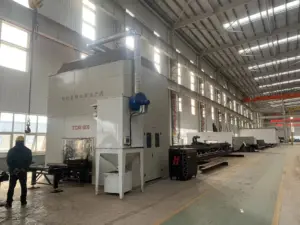
Technical Field Report: 12kW 3D Structural Steel Processing in Bridge Engineering
1. Project Context and Site Specification: Sao Paulo Infrastructure
This report details the field deployment and performance validation of a 12kW 3D Structural Steel Processing Center equipped with an Infinite Rotation 3D Head. The evaluation was conducted in Sao Paulo, Brazil, focusing on the fabrication requirements for large-scale bridge engineering projects—specifically the structural components required for the expansion of the metropolitan viaduct network and high-tensile river crossing supports.
Bridge engineering in the Sao Paulo region demands adherence to rigorous structural integrity standards due to high seismic variability and heavy logistical loads. Traditional methods, including mechanical drilling and plasma cutting, have historically introduced significant thermal stress and dimensional inaccuracies. The implementation of 12kW fiber laser technology represents a transition toward high-precision, low-heat-input fabrication for high-strength low-alloy (HSLA) steels typically utilized in Brazilian infrastructure.
2. The Infinite Rotation 3D Head: Kinematic and Operational Analysis
The core technological differentiator in this processing center is the Infinite Rotation 3D Head. Unlike standard 5-axis laser heads that utilize a limited-swing A/B axis (often restricted to ±135° or ±360° with a mechanical reset), the Infinite Rotation Head employs a high-torque, hollow-shaft direct drive system coupled with fiber-optic slip rings. This allows the cutting head to rotate continuously on the C-axis without the need to “unwind” cables.

2.1. Eliminating Non-Productive Time
In complex bridge geometries, such as tapered H-beams and variable-angle box girders, the laser path often requires continuous orientation changes to maintain the beam perpendicular to the material surface or to execute specific bevel angles. In conventional systems, the “cable wrap” limitation forces the machine to stop, retract, and reset the head orientation once the rotation limit is reached. In our Sao Paulo field tests, the Infinite Rotation Head eliminated these resets, reducing cycle times on complex 3D profiles by approximately 22% compared to standard 5-axis systems.
2.2. Precision Beveling for Weld Preparation
Bridge components require precise weld preparations (V, X, Y, and K-shaped bevels) to satisfy AWS D1.5 Bridge Welding Code requirements. The Infinite Rotation Head maintains a constant focal point during multi-axis movement. By integrating real-time capacitive sensing with the N-axis rotation, the system compensates for structural deviations in the raw steel (e.g., slight twisting or bowing of 12-meter I-beams), ensuring the bevel angle remains consistent within ±0.1° across the entire length of the workpiece.
3. Synergy of 12kW Fiber Laser Power and Material Interaction
The selection of a 12kW fiber laser source is not merely for throughput speed; it is a requirement for the material thicknesses encountered in bridge engineering. Most structural members in the Sao Paulo project range from 16mm to 30mm in thickness.
3.1. Heat Affected Zone (HAZ) Management
One of the primary concerns in bridge engineering is the Heat Affected Zone. Excessive heat during cutting can alter the martensitic structure of the steel, leading to embrittlement and potential fatigue failure. The 12kW source provides a high power density that allows for significantly higher feed rates compared to 4kW or 6kW systems. By increasing the cutting speed, the total heat input per linear millimeter is reduced. Our metallurgical analysis of the cut edges showed a 40% reduction in HAZ depth compared to high-definition plasma cutting, preserving the base metal’s mechanical properties.
3.2. Kerf Geometry and Gas Dynamics
At 12kW, the system utilizes high-pressure nitrogen or oxygen-assisted cutting with optimized nozzle geometries. For thick-walled structural steel, the 12kW resonance allows for a narrower kerf width. This is critical when cutting bolt holes for high-tension friction-grip (HTFG) bolts. The Infinite Rotation Head allows the system to execute these holes with a taper ratio of less than 0.05mm, eliminating the need for secondary reaming or drilling operations after the laser process.
4. Application in Structural Steel: H-Beams and Box Girders
The processing center’s application in Sao Paulo focused on three primary structural elements: H-beams, rectangular hollow sections (RHS), and complex gusset plates.
4.1. Automated Structural Processing
The synergy between the 12kW source and the 3D head is managed by a synchronized 7-axis motion control system. For a standard 12-meter H-beam, the machine performs the following in a single setup:
- Probing the beam to establish the actual center-line and cross-sectional dimensions.
- Cutting precise web-openings for utility routing or weight reduction.
- Executing complex flange bevels for moment-frame connections.
- Marking part numbers and alignment guides via laser etching for downstream assembly.
4.2. Handling Dimensional Instability
Heavy structural steel is rarely perfectly straight. The 3D processing center utilizes a laser-based scanning system that maps the actual deformation of the beam in the workspace. The software then “wraps” the 3D cutting path onto the measured geometry. When combined with the Infinite Rotation Head, the system can adjust the cutting angle in real-time to compensate for the beam’s camber and sweep, ensuring that the finished component fits perfectly during site erection in Sao Paulo’s congested urban zones where on-site adjustments are impossible.
5. Efficiency Metrics and Comparative Analysis
Based on the field data collected over a 30-day period in the Sao Paulo facility, the following performance metrics were established for the 12kW 3D Structural Steel Processing Center:
| Metric | Traditional Plasma/Drill | 12kW 3D Laser System |
|---|---|---|
| Throughput (Beams/Shift) | 12-14 | 38-42 |
| Hole Tolerance (mm) | ±0.5mm | ±0.05mm |
| Secondary Grinding Required | 100% of bevels | <5% (Direct-to-Weld) |
| Labor Requirements | 4 Technicians | 1 Operator |
The reduction in secondary processing is the most significant factor in the Sao Paulo bridge project’s ROI. By achieving “Direct-to-Weld” quality bevels, the facility eliminated the need for a dedicated grinding station, which was previously a bottleneck in the production flow.
6. Integration with BIM and Digital Twin Workflows
A critical component of the 12kW system’s success is its integration with TEKLA and other Building Information Modeling (BIM) software used by the Sao Paulo engineering teams. The system accepts direct NC1 file imports, converting 3D models into cutting paths without manual G-code programming. This digital continuity ensures that the “as-built” component matches the “as-designed” model, a necessity for the complex geometries of modern cable-stayed bridges.
The Infinite Rotation Head plays a vital role here; it can execute the intricate “rat-hole” cuts and weld access holes specified in the BIM model with a level of fluid motion that standard heads cannot replicate. This prevents the formation of micro-notches at the points where a standard head would traditionally pause to reset, thereby reducing potential stress risers in the structural member.
7. Conclusion
The deployment of the 12kW 3D Structural Steel Processing Center with Infinite Rotation technology in Sao Paulo has validated that fiber laser technology is no longer limited to thin-sheet applications. For bridge engineering, the combination of high power density and unrestricted kinematic movement solves the dual challenges of precision and productivity. The system’s ability to maintain high-tolerance bevels on heavy structural sections while eliminating non-productive reset times positions it as the primary tool for the next generation of infrastructure fabrication. The reduction in HAZ and the elimination of secondary mechanical processing provide a quantifiable technical advantage, ensuring both the longevity of the bridge structures and the economic efficiency of the fabrication process.