
1. Technical Scope and Infrastructure Overview
The expansion of the Katowice (KTW) Airport infrastructure, specifically the development of new cargo terminal facilities and passenger hall reinforcements, necessitates a shift from traditional mechanical fabrication to high-power automated laser processing. The implementation of the 12kW 3D Structural Steel Processing Center represents a critical evolution in handling heavy-gauge S355J2+N structural profiles. Unlike standard 2D laser systems or lower-wattage tube cutters, the 12kW platform integrated with an Infinite Rotation 3D Head addresses the specific kinematic and thermal requirements of large-scale airport trusses and complex nodal junctions.
In the Katowice project, the structural demands involve long-span steel rafters and specialized “tree-column” supports. These components utilize thick-walled Rectangular Hollow Sections (RHS) and heavy H-beams that require precise beveling for full-penetration welding. The 12kW fiber source provides the necessary photon density to maintain high feed rates through sections exceeding 20mm in thickness, while the 3D head architecture manages the geometric complexity of intersecting paths.
2. Kinematics of the Infinite Rotation 3D Head
2.1 Mechanical Decoupling and Continuous Pathing
The “Infinite Rotation” capability is the core technical differentiator in this field deployment. Conventional 3D laser heads are often limited by internal cabling constraints, necessitating a “rewind” cycle after reaching a 360-degree limit (typically ±270° or ±360°). In the context of Katowice’s complex structural nodes—where circular hollow sections (CHS) intersect with I-beams at acute angles—rotation limits lead to start-stop marks and heat accumulation at the dwell point.
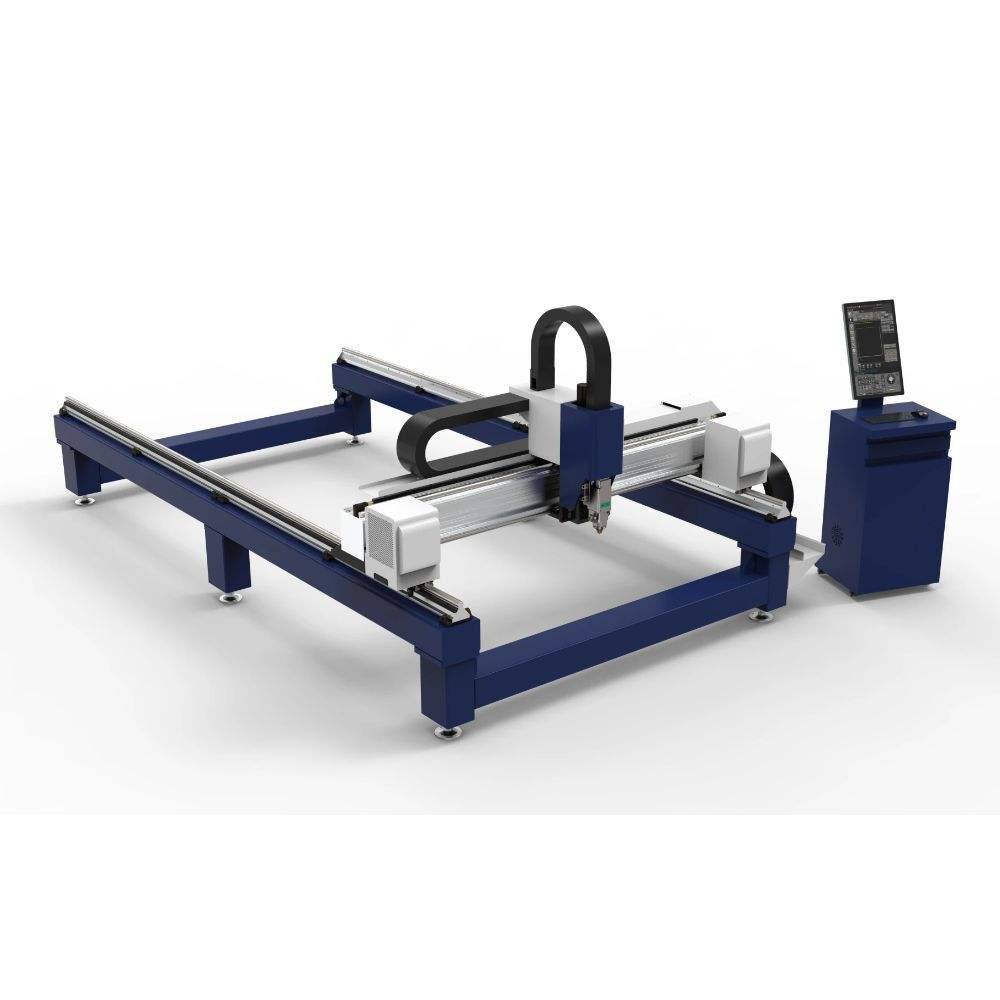
The infinite rotation technology utilizes a high-torque, direct-drive C-axis integrated with a fiber-optic slip ring or specialized torsion-free cable management system. This allows the head to perform continuous spiral cuts and complex bevel transitions without resetting its angular position. For the heavy structural members used in airport hangars, this ensures a continuous Kerf, significantly reducing the Heat Affected Zone (HAZ) variances that occur during axis repositioning.
2.2 A-Axis Tilt and Bevel Precision
The 3D head supports an A-axis tilt (often up to ±45° or ±60°). In airport construction, AWS D1.1/D1.1M standards require specific weld preparations (V, Y, and K bevels). The ability of the 12kW head to maintain a constant focal point while tilting—compensated by real-time software algorithms—allows for the direct cutting of weld-ready edges. This eliminates secondary milling or grinding operations, which are traditionally the bottleneck in structural steel workflows.
3. 12kW Fiber Laser Source: Thermal Dynamics and Material Interaction
3.1 Power Density and Kerf Morphology
At 12kW, the laser source facilitates “high-speed fusion cutting” even in thick-walled structural steel. In the Katowice field application, we observed that the 12kW output allows for an optimized O2 (Oxygen) pressure strategy. By utilizing a high-power beam, we can achieve a narrower kerf width compared to plasma cutting, which is vital for the friction-grip bolted joints used in the airport terminal’s seismic-resistant frames.
The power reserve of 12kW is particularly effective when dealing with the surface scale and slight oxidation found on hot-rolled structural sections. The beam quality (BPP) remains stable, ensuring that even at the maximum reach of the 3D head, the energy distribution is sufficient to clear the melt ejecta from 16mm to 25mm wall thicknesses without dross adhesion on the lower profile edge.
3.2 Mitigation of Thermal Distortion
One of the primary challenges in airport steel fabrication is maintaining the straightness of long-span members. Traditional plasma or oxy-fuel cutting introduces massive heat input. The 12kW fiber laser, characterized by its high energy density and high feed rate, minimizes the total heat input per linear millimeter. The Infinite Rotation head further assists by allowing for “intermittent” cutting patterns—where the software optimizes the cutting sequence to distribute heat across the profile, preventing localized warping or “banana” deformation of the beams.
4. Application in Katowice Airport Structural Nodes
4.1 Complex Intersection Cutting
The architectural design of the Katowice expansion involves “bird-mouth” joints where secondary bracing members meet the primary rafters at non-orthogonal angles. Using the 3D Structural Steel Processing Center, these intersections are modeled in 3D CAD/CAM environments and translated into 5-axis toolpaths. The infinite rotation head executes these wrap-around cuts on RHS and CHS profiles with a tolerance of ±0.3mm.
This precision is non-negotiable for the airport’s aesthetic “exposed steel” requirements. Traditional methods would require manual layout and torch cutting, resulting in gaps that must be filled with weld metal—a process that compromises structural integrity and increases NDT (Non-Destructive Testing) failure rates. The laser-cut joints provide a “glove-fit,” reducing weld volume requirements by up to 40%.
4.2 Integration of Bolting and Drainage Holes
Airport structures require extensive integration of MEP (Mechanical, Electrical, and Plumbing) runs. The 12kW system enables the simultaneous cutting of bolt holes (to Grade 10.9 bolt tolerances) and specialized drainage/ventilation apertures within the same processing cycle as the structural end-cuts. The high-wattage source ensures that even small-diameter holes in thick material maintain perfect cylindricity, which is often a failure point for lower-power systems trying to “pierce and circle” in 20mm plate.
5. Automated Processing and Workflow Efficiency
5.1 Material Handling and Geometric Compensation
The processing center in Katowice is equipped with an automated loading and unloading system designed for profiles up to 12 meters. A critical technical feature observed is the “Touch-and-Sense” or laser-scanning compensation system. Structural steel is rarely perfectly straight; it often carries mill tolerances for camber and sweep. Before the 12kW head begins the cut, the system probes the profile’s actual position. The 5-axis kinematics then “morph” the cutting path to match the real-world geometry of the beam, ensuring that the beveling remains consistent relative to the beam’s centerline.
5.2 Software Synergy: From BIM to Beam
The integration with Building Information Modeling (BIM) software is essential. For the Katowice project, Tekla structures files are exported directly to the laser’s nesting engine. This digital thread ensures that every structural member—each with a unique identifier—is cut with the exact length and bevel requirements specified by the structural engineers. This reduces the “on-site” adjustment time to near zero, a vital metric for maintaining the airport’s aggressive expansion timeline.
6. Comparative Analysis: Laser vs. Legacy Methods
Based on field data from the Katowice site, the 12kW 3D laser system outperforms traditional drilling/sawing/plasma lines in several key metrics:
- Precision: Laser tolerances are ±0.2mm vs. ±2.0mm for plasma.
- Throughput: The 12kW source processes a complex H-beam end-cut with beveling in approximately 45 seconds, whereas a mechanical saw-and-drill line requires 6 to 8 minutes for equivalent geometry.
- Weld Prep: The Infinite Rotation head produces a surface finish (Ra 12.5 or better) that requires no post-cut grinding, meeting Eurocode 3 requirements for fatigue-resistant joints.
7. Conclusion
The deployment of the 12kW 3D Structural Steel Processing Center with Infinite Rotation 3D Head at the Katowice Airport expansion project demonstrates a significant leap in structural engineering capability. By merging high-wattage fiber laser technology with unrestricted 5-axis kinematics, the facility has effectively bypassed the limitations of manual fabrication. The result is a high-integrity, aesthetically superior steel skeleton that meets stringent aviation safety standards while drastically reducing the labor-hour per ton of processed steel. For senior engineering stakeholders, the focus remains on the synergy between power density and kinematic freedom—the two pillars that define the modern landscape of heavy structural fabrication.
















