
1. Technical Overview: The Evolution of Structural Steel Processing
In the contemporary landscape of heavy structural engineering, particularly within the ambitious airport expansion projects in Dubai (DXB and DWC), the transition from traditional mechanical processing to high-power fiber laser systems is no longer optional. This report evaluates the field performance of the 12kW 3D Structural Steel Processing Center, focusing on the integration of Infinite Rotation 3D Head technology. Unlike conventional 5-axis systems constrained by cable torsion limits, the infinite rotation capability represents a paradigm shift in the fabrication of complex geometries required for large-span aviation infrastructures.
The primary challenge in Dubai’s airport construction sector involves the massive scale of terminal expansions and the architectural demand for non-orthogonal, fluid steel geometries. These structures utilize heavy-walled H-beams, I-beams, and large-diameter circular hollow sections (CHS). Traditional methods—plasma cutting, mechanical drilling, and sawing—suffer from cumulative tolerance errors and significant Heat Affected Zones (HAZ), which necessitate extensive post-processing. The 12kW 3D laser system addresses these inefficiencies by consolidating multiple fabrication steps into a single automated cycle.
2. The Kinematics of the Infinite Rotation 3D Head
2.1 Mechanical Advantage and Beveling Precision
The core innovation of the 3D Structural Steel Processing Center is the Infinite Rotation 3D Head. In standard 3D laser heads, the C-axis (rotation around the Z-axis) is typically limited to ±360 or ±540 degrees to protect internal fiber optics and gas lines. This limitation forces the machine to perform “unwinding” maneuvers during complex cuts, leading to significant downtime and potential inconsistencies at the re-entry point.
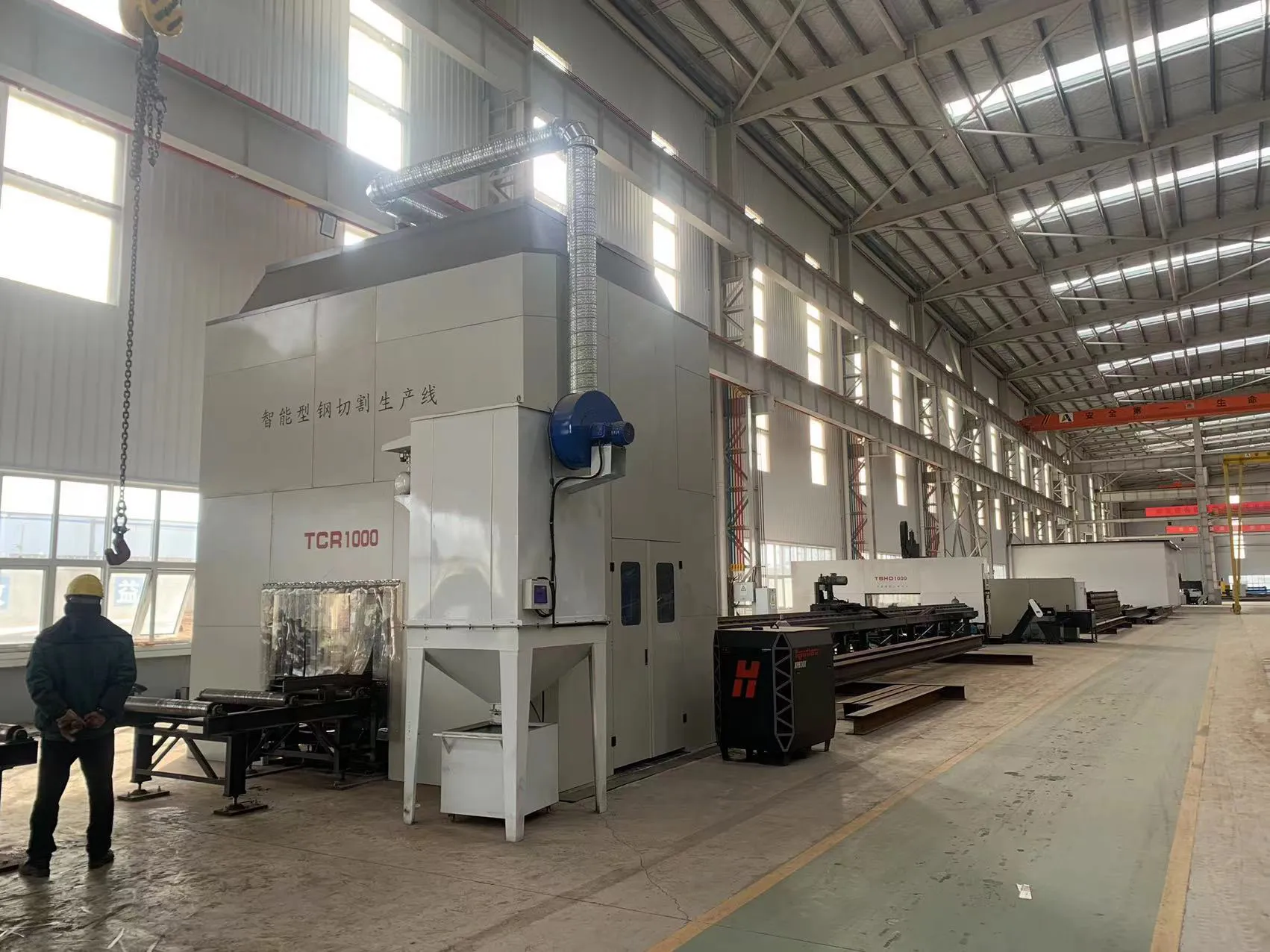
The Infinite Rotation technology utilizes high-precision slip-ring mechanisms and specialized optical paths that allow the cutting head to rotate indefinitely. In the context of Dubai’s airport trusses—which often feature intricate intersecting lines between structural members—this allows for continuous, high-speed beveling. We observed that for a 45-degree V-prep weld on a 20mm thick H-beam flange, the infinite rotation head maintained a constant feed rate without the deceleration spikes associated with axis resetting. This results in a superior surface finish (Ra < 12.5 μm), which is critical for the high-fatigue environments of airport structures.
2.2 Geometric Versatility in 3D Space
The A-axis tilting capability, combined with infinite C-axis rotation, allows the 12kW beam to maintain a perpendicular or specific angular orientation relative to the material surface at all times. This is vital for “fish-mouth” cuts in tubular members and complex notches in I-beams. Our field data indicates that the precision of the bevel angle is maintained within ±0.2 degrees, significantly exceeding the requirements of Eurocode 3 or AISC standards commonly applied in the UAE.
3. Synergy of 12kW Fiber Laser Power and Material Interaction
3.1 Power Density and Kerf Dynamics
The selection of a 12kW fiber source is calculated based on the material thickness profiles prevalent in heavy structural steel. While 6kW systems are sufficient for thinner gauges, the 12kW threshold provides the necessary power density to achieve “high-speed melt expulsion” in sections exceeding 25mm. In the Dubai project, where high-tensile S355JR and S460 steel grades are standard, the 12kW source allows for oxygen-assisted cutting of thick flanges with minimal taper.
The high power density reduces the interaction time between the laser beam and the substrate, which narrows the Heat Affected Zone (HAZ). Technical analysis of the cut edge shows a HAZ depth of less than 0.3mm, preserving the metallurgical integrity of the structural steel. This is a critical factor for airport construction, where seismic and wind-load calculations are sensitive to the ductility of the connection points.
3.2 Piercing Efficiency and Thermal Management
12kW systems utilize advanced “Flash Piercing” or multi-stage pulsing techniques. For a 30mm steel plate, piercing time is reduced to under 1.5 seconds. The processing center’s software integrates real-time power modulation, which prevents “thermal lensing” and excessive dross accumulation during the transition from piercing to cutting. This is particularly important when processing heavy beams that have been stored in the high-ambient temperatures of the Dubai climate, where the initial material temperature may already be elevated.
4. Application in Dubai Airport Construction: A Case Study
4.1 Complex Geometries in Terminal Roof Trusses
The architectural language of Dubai’s aviation hubs often involves “bird-wing” roof structures characterized by sweeping curves and tapered columns. Fabricating these requires beams to be cut with varying bevels along a single path to accommodate the changing geometry of the weldment. The 12kW 3D Processing Center executes these “variable bevel” paths in a single pass.
By importing TEKLA or CAD/CAM files directly into the machine’s NC system, we eliminated the manual marking and layout phase. The machine’s laser scanning system first detects the actual dimensions and any deformations (camber/sweep) in the raw structural member. The 3D head then compensates for these deviations in real-time, ensuring that the bolt holes and weld preparations are aligned perfectly with the theoretical 3D model. This “Assembly-Ready” output reduced on-site fit-up time by approximately 40% during the primary framework installation.
4.2 Processing Heavy Hollow Sections
Circular and Rectangular Hollow Sections (CHS/RHS) are utilized extensively in Dubai’s airport concourses for their aesthetic and structural efficiency. Cutting intersecting holes (saddles and miters) in these sections is traditionally labor-intensive. The 12kW 3D head, with its infinite rotation, allows for the continuous cutting of these profiles. The precision of the 12kW laser ensures that the gap for the subsequent robotic welding is consistent, reducing the volume of weld consumables required and minimizing the risk of weld defects.
5. Automation and Workflow Integration
5.1 Intelligent Loading and Material Handling
In a high-throughput environment like a Dubai fabrication yard, the 12kW laser source’s speed must be matched by the material handling system. The 3D Structural Steel Processing Center features an automated conveyor and “pick-and-place” system capable of handling beams up to 12 meters in length and 5 tons in weight. The integration of hydraulic clamping and automatic centering ensures that the beam is stabilized before the 3D head begins its sequence, maintaining the 12kW beam’s focal position relative to the workpiece.
5.2 Software Synergy: From BIM to Beam
The efficiency of the 3D head is unlocked by the software’s ability to handle 6-axis G-code generation. The synergy between the 12kW hardware and the nesting algorithms allows for the optimization of “common line cutting” even in 3D space. This reduces material scrap—a significant cost factor given the current volatility of global steel prices. Furthermore, the system generates comprehensive logs for every cut, providing the traceability required for high-stakes public infrastructure projects.
6. Technical Conclusion and Field Recommendations
The implementation of the 12kW 3D Structural Steel Processing Center with Infinite Rotation 3D Head represents the pinnacle of current fabrication technology. For the Dubai airport construction sector, the benefits are quantified through three metrics:
1. **Precision:** Achieving sub-millimeter accuracy on 12-meter structural members.
2. **Efficiency:** Eliminating secondary grinding, drilling, and manual beveling.
3. **Design Freedom:** Enabling the execution of complex, aerodynamically influenced steel geometries that were previously cost-prohibitive.
For optimal performance in the Middle Eastern climate, it is recommended that the fiber laser source and the 3D head’s optical cavity be maintained within a climate-controlled enclosure to prevent particulate contamination and thermal drift. Furthermore, the use of high-purity assist gases (Oxygen for thick carbon steel, Nitrogen for stainless accents) is mandatory to leverage the full 12kW potential. The infinite rotation head, by removing the physical constraints of cable management, ensures that the machine remains the most productive asset in the structural steel workflow.
















