The Rise of High-Power Fiber Lasers in Dubai’s Modular Sector
Dubai has long been a global testing ground for architectural innovation. As the city shifts its focus toward the Dubai 2040 Urban Master Plan, the demand for sustainable, rapid, and high-quality construction has never been higher. Modular construction—the process of fabricating large-scale building components in a controlled factory environment—has emerged as the solution. However, the success of modularity hinges on the precision of the steel skeleton.
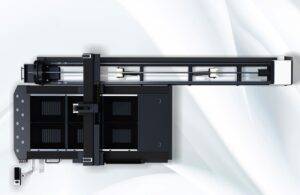
The introduction of the 12kW 3D Structural Steel Processing Center is a direct response to this need. While 3kW or 6kW systems were sufficient for thin-walled tubes, the 12kW power source allows for the effortless cutting of thick-walled structural members used in high-rise modules and industrial frameworks. In an environment where the ambient temperature can impact material behavior, the localized heat-affected zone (HAZ) of a fiber laser ensures that the structural integrity of the steel remains uncompromised, a critical factor for the safety-conscious UAE market.
The 12kW Advantage: Penetration and Productivity
From a technical standpoint, the “12kW” designation is not merely a number—it is a threshold for industrial capability. At this power level, the fiber laser achieves a high energy density that allows for “vaporization cutting” on thicker materials. For structural steel fabricators in Dubai, this means the ability to cut through carbon steel up to 25mm or 30mm with clean, weld-ready edges.
The 12kW source provides the “overcapacity” needed to maintain high feed rates even when performing complex 3D maneuvers. When the laser head must tilt to create a bevel for a weld preparation, the effective thickness of the material increases. A lower-power laser would have to slow down significantly, but the 12kW system maintains its momentum, ensuring that the production line never stagnates. This speed is essential for Dubai’s “just-in-time” construction schedules, where a delay in the factory can halt assembly on-site at the Dubai South or Expo City developments.
3D Processing: Beyond Simple Cutting
Traditional structural steel processing involves a multi-step journey: a beam is sawed to length, moved to a drill line for bolt holes, and then to a manual station for coping and notches. The 3D laser processing center collapses these steps into one.
Equipped with a 5-axis or 6-axis cutting head, the machine can move around the profile of a beam—be it a C-channel, an I-beam, or an L-angle—performing complex geometries in a single setup. This includes:
- Bevel Cutting: Creating precise 45-degree angles for high-strength weld joints.
- Coping: Cutting out sections of a beam so it can fit flush against another.
- Flow Drilling/Hole Cutting: Creating bolt holes with tolerances of +/- 0.1mm, far exceeding the capabilities of mechanical drills.
- Marking: Etching part numbers and assembly guides directly onto the steel to facilitate rapid onsite modular assembly.
This “3D” capability means that the digital twin designed in BIM (Building Information Modeling) software is translated perfectly into the physical world, ensuring that when the modular units arrive on a Dubai construction site, they bolt together with zero onsite modification.
The Critical Role of Automatic Unloading
In high-power laser cutting, the bottleneck is rarely the laser itself; it is the material handling. A 12kW laser can process a 12-meter I-beam in a matter of minutes. Without an automatic unloading system, the machine would sit idle while a crane or forklift operator manually clears the finished part.
The integrated automatic unloading system in these centers utilizes a series of synchronized conveyors and hydraulic lifters. As the laser completes its final cut, the unloading arms support the piece, preventing it from dropping and damaging the edges. The system then transports the finished component to a sorting area.
In the context of Dubai’s labor market and safety regulations, automation reduces the reliance on manual labor in the harsh, hot warehouse environments. It also ensures 24/7 operation capabilities. For modular construction firms, this means they can run “lights-out” shifts, doubling their output without a linear increase in overhead.
Precision Engineering for Modular Accuracy
Modular construction is often described as “Lego at scale.” For this to work, the tolerances must be exceptionally tight. If a steel frame is out of square by even 3 millimeters, that error is compounded as modules are stacked ten stories high.
The 12kW 3D processing center utilizes advanced “chuck” systems—often a three-chuck or four-chuck configuration—to hold the structural steel. These chucks provide maximum stability and can rotate the heavy beams with extreme precision. The four-chuck system, in particular, allows for “zero-tailing” cutting, meaning the machine can process the very end of the beam without wasting material. Given the high cost of imported steel in the UAE, reducing scrap rates by even 5% can result in hundreds of thousands of dirhams in annual savings.
Thermal Management in the Middle East
Operating a 12kW fiber laser in Dubai presents unique environmental challenges. The high ambient temperatures and humidity require a robust cooling strategy. Modern processing centers are equipped with dual-circuit industrial chillers that independently regulate the temperature of the laser source and the cutting head.
Furthermore, the “Smart Factory” setup in Dubai often involves placing these machines in climate-controlled enclosures. As an expert, I emphasize the importance of dust extraction and filtration systems. Structural steel processing generates significant particulate matter; a high-efficiency fume extraction system is not just a safety requirement by Dubai Municipality, but a necessity to protect the sensitive optics of the 12kW laser head from contamination.
Integration with BIM and Industry 4.0
The true power of a 12kW 3D laser center is realized when it is integrated into the digital supply chain. In Dubai’s modular construction industry, projects start as highly detailed BIM models. The processing center’s software can directly import IFC or TEKLA files, automatically nesting the parts to minimize waste and generating the G-code for the laser.
This connectivity allows for real-time tracking. A project manager in an office at Dubai Marina can see exactly how many beams have been cut at a facility in JAFZA (Jebel Ali Free Zone) in real-time. This transparency is vital for the complex logistics of modular construction, where the timing of steel fabrication must be perfectly synchronized with the pouring of concrete foundations and the installation of MEP (Mechanical, Electrical, and Plumbing) systems.
Economic Impact and Sustainability
The shift to 12kW laser processing is also a win for sustainability—a key pillar of the UAE’s “Net Zero by 2050” initiative. Fiber lasers are significantly more energy-efficient than older CO2 lasers or plasma cutters. Moreover, the precision of laser cutting reduces the need for secondary grinding and finishing, which saves energy and reduces the consumption of abrasives.
By enabling modular construction, this technology contributes to a reduction in onsite waste. Traditional construction sites are notorious for scrap and debris; modular construction, powered by laser precision, ensures that only the necessary material is delivered to the site, and what is delivered fits perfectly.
Conclusion: The Future of the Dubai Skyline
The 12kW 3D structural steel processing center with automatic unloading is more than just a piece of machinery; it is an industrial catalyst. For Dubai to continue its trajectory as a leader in smart city infrastructure, its construction sector must move away from the inefficiencies of the past.
As modular construction becomes the standard for hotels, residential towers, and hospitals, the demand for “laser-perfect” steel will only grow. By investing in 12kW fiber technology, UAE fabricators are not just buying a cutter; they are buying the ability to compete on a global stage, delivering projects faster, safer, and with a level of precision that was once thought impossible in the world of heavy structural steel. The future of Dubai is modular, and that modularity is being cut by the power of the fiber laser.