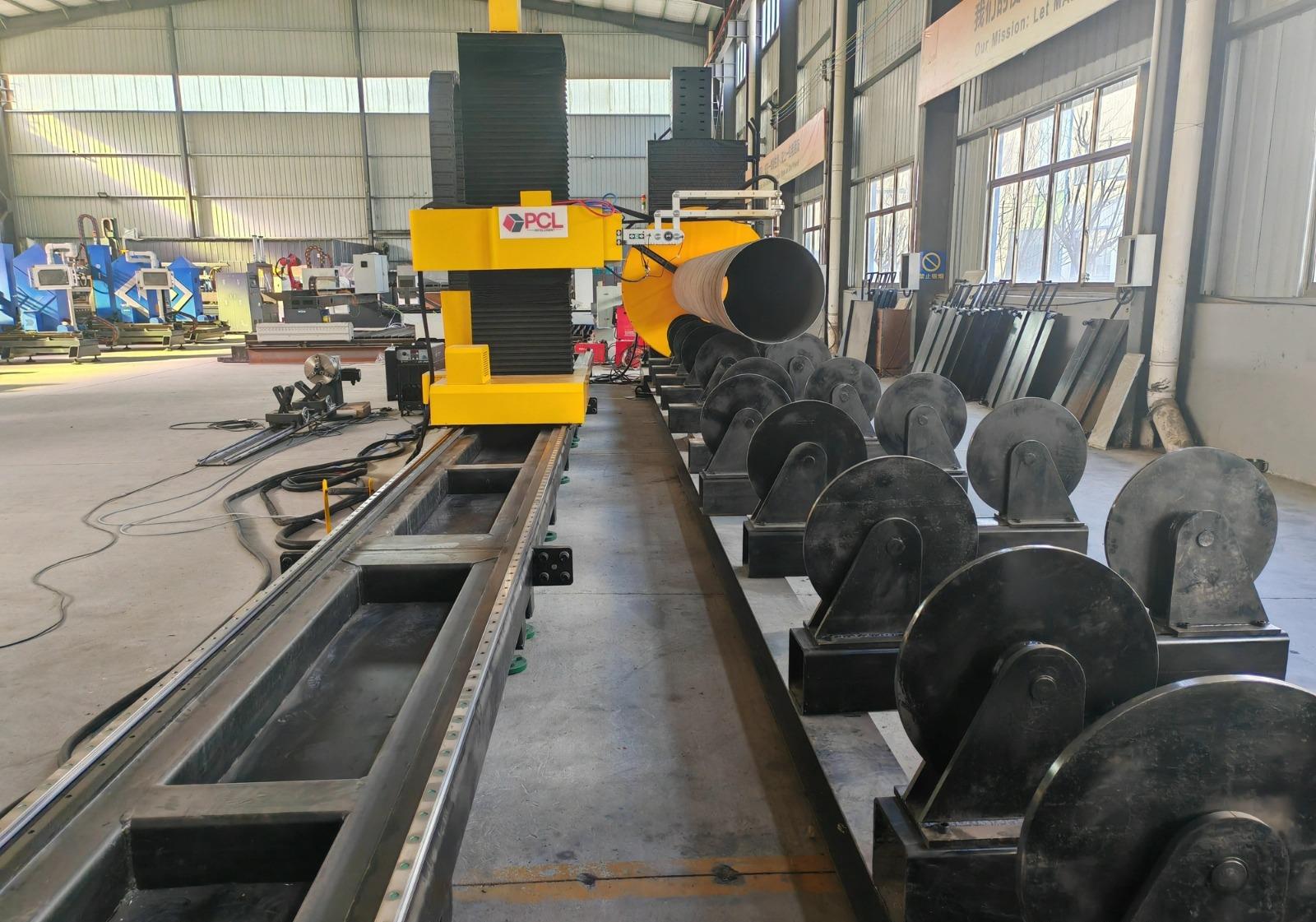
The Evolution of Structural Steel Fabrication in the Rayong Industrial Corridor
Rayong has long been the heartbeat of Thailand’s heavy industry, serving as a critical hub for the Eastern Economic Corridor (EEC). As the region pivots toward advanced manufacturing and renewable energy infrastructure, the demand for sophisticated structural steel fabrication has skyrocketed. The construction of high-voltage power transmission towers, which must withstand extreme environmental stressors and heavy mechanical loads, requires a level of precision that traditional plasma cutting and manual fabrication can no longer profitably provide.
The introduction of the 12kW 3D Structural Steel Processing Center is a direct response to this need. Unlike flatbed lasers, these 3D systems are designed to handle the diverse geometries of structural steel—including H-beams, I-beams, channels, and heavy-duty angle iron. In the context of Rayong’s industrial landscape, this technology allows local fabricators to compete on a global scale, offering shorter lead times and higher structural integrity for the massive “Power Tower” projects that anchor the national grid.
The Power of 12kW: Redefining Throughput and Thickness
In the world of fiber lasers, the leap to 12kW is transformative. For structural steel, power is not just about speed; it is about the ability to maintain a stable, high-quality kerf through thick-walled sections. Power towers often utilize high-tensile steel with thicknesses ranging from 10mm to over 25mm.
At 12kW, the fiber laser achieves a power density that allows for “high-speed nitrogen cutting” or “high-efficiency oxygen cutting” depending on the finish required. This wattage ensures that the heat-affected zone (HAZ) remains minimal, preserving the metallurgical properties of the steel—a non-negotiable requirement for structures that must support kilometers of heavy conductive cabling. Furthermore, the 12kW source provides the “brute force” necessary to maintain consistent cutting speeds even when navigating the transitions between the web and the flange of an H-beam, where material thickness effectively doubles during certain angles of approach.
Precision 3D Kinematics and the ±45° Bevel Advantage
The most significant bottleneck in traditional power tower fabrication is weld preparation. Traditionally, after a beam or angle is cut to length, it is moved to a separate station where workers use handheld grinders or specialized milling tools to create a bevel. This is both labor-intensive and prone to human error.
The 12kW 3D system utilizes a sophisticated 5-axis or 6-axis cutting head. The ability to tilt the laser head up to ±45° during the cutting process means that the machine can perform a “V-prep,” “Y-prep,” or “K-prep” joint in a single pass. This is revolutionary for power tower fabrication. When the lattice members of a tower meet at a central gusset plate, the fit-up must be perfect to ensure the strength of the weld. By automating the beveling process with laser precision, the gap between components is minimized to microns, leading to stronger welds, reduced consumption of filler wire, and a significant decrease in welding time.
Optimizing Power Tower Fabrication: From Angle Iron to Gusset Plates
Power towers are primarily comprised of L-shaped angle iron and flat gusset plates, interconnected by thousands of bolts. Accuracy in hole placement is paramount; a deviation of even two millimeters can prevent a 50-meter tower from being assembled correctly in the field.
The 3D Structural Steel Processing Center integrates the cutting of the profile and the “drilling” of the bolt holes into one operation. Using the 12kW laser to “bore” holes is significantly faster than mechanical drilling and eliminates the cost of consumable drill bits. Because the system is CNC-controlled, the spatial relationship between every hole in a 12-meter beam is maintained with absolute fidelity. In Rayong’s fabrication yards, this means that the “dry-fit” phase of production—where towers are pre-assembled to check for errors—becomes a formality rather than a stressful necessity.
The Role of Advanced Software and Nesting in Material Economy
With the high cost of structural steel, minimizing scrap is essential for profitability. The software suites accompanying 12kW 3D processors utilize complex nesting algorithms specifically designed for linear profiles. These programs can “mesh” different parts from the same project—or even different projects—onto a single length of steel.
For power tower fabrication, where many components have slanted ends or specialized bevels, 3D nesting can “common-cut” the edge between two parts. This not only saves material but also reduces the total distance the laser head must travel, further increasing throughput. In an environment like Rayong, where logistics and material costs are influenced by global markets, the ability to squeeze an extra 5% to 10% of usable parts out of a shipment of steel provides a massive competitive edge.
Rayong’s Strategic Advantage in the ASEAN Energy Market
The deployment of this technology in Rayong is not a coincidence. As Thailand leads the way in the “ASEAN Power Grid” initiative, which aims to link the electricity markets of Southeast Asian nations, the demand for transmission infrastructure is projected to grow for the next two decades.
By housing a 12kW 3D Structural Steel Processing Center in Rayong, fabricators are strategically located near major ports like Laem Chabang and Map Ta Phut. This allows for the easy import of raw materials and the rapid export of finished, “kit-form” power towers to neighboring markets like Vietnam, Cambodia, and Malaysia. The “Made in Thailand” brand, backed by high-end laser technology, signifies a shift from low-cost labor to high-tech value-add.
Operational Reliability: Overcoming the Challenges of a Tropical Climate
Operating a 12kW fiber laser in the humid, coastal environment of Rayong presents unique engineering challenges. High-power lasers are sensitive to temperature fluctuations and humidity, which can lead to condensation on optical components.
Modern 12kW systems are equipped with environmentally sealed “clean room” cabinets for the laser source and advanced chilling systems that maintain a constant temperature for both the resonator and the cutting head. Additionally, the use of high-purity assist gases—often generated on-site using nitrogen membranes—ensures that the cutting process is not contaminated by the salty, humid air of the Gulf of Thailand. This level of environmental control ensures 24/7 operational readiness, allowing Rayong’s fabricators to meet the tight deadlines typical of national infrastructure tenders.
Conclusion: The Future of Infrastructure is Laser-Cut
The 12kW 3D Structural Steel Processing Center is more than just a machine; it is a fundamental shift in how we build the world. For the power tower fabrication industry in Rayong, it represents the end of the “measure twice, cut once” era of manual labor and the beginning of a digital, automated future.
By integrating ±45° bevel cutting, 3D kinematics, and ultra-high-power fiber laser technology, fabricators are producing towers that are safer, cheaper, and faster to assemble. As the energy landscape continues to evolve toward more complex and decentralized grids, the precision offered by these systems will be the bedrock upon which the next generation of power infrastructure is built. In the heart of Thailand’s industrial zone, the 12kW fiber laser is not just cutting steel—it is shaping the future of the regional economy.