The Dawn of High-Power 3D Laser Processing in Istanbul
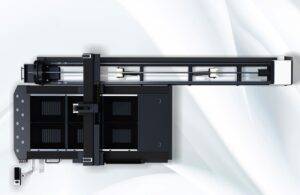
Istanbul has long stood at the crossroads of global trade, but in recent years, it has transformed into a sophisticated manufacturing epicenter. The introduction of the 12kW 3D Structural Steel Processing Center specifically designed for Power Tower fabrication is a testament to this evolution. In the world of structural engineering, power towers (transmission towers) are the silent sentinels of our energy grid. Their construction requires massive quantities of angled steel, channels, and heavy-wall tubing.
Historically, these components were processed using mechanical drilling, punching, and plasma cutting. However, as the demand for renewable energy integration grows, the complexity and scale of these towers have increased. The 12kW fiber laser source provides the necessary photon density to slice through thick carbon steel with a heat-affected zone (HAZ) so minimal that it preserves the metallurgical integrity of the structural steel—a critical requirement for towers that must withstand extreme wind loads and environmental stress.
Why 12kW? Redefining Speed and Thickness
In the fiber laser hierarchy, 12kW is often considered the “sweet spot” for heavy structural applications. While lower power levels like 4kW or 6kW are excellent for thin sheet metal, they struggle with the 16mm to 25mm thickness ranges common in power transmission components. At 12kW, the laser doesn’t just cut; it vaporizes the material with high-velocity assistance from oxygen or nitrogen.
For a 3D structural center, power is not just about thickness—it is about the “bevel factor.” When a laser cuts at a 45-degree angle, the effective thickness of the material increases significantly. For instance, a 20mm plate becomes nearly 28mm of material for the beam to penetrate when tilted at 45°. A 12kW source ensures that the feed rate remains economically viable even during these complex bevel maneuvers, preventing the dross accumulation and thermal deformation that plague lower-powered systems.
The Mechanics of ±45° Bevel Cutting
The centerpiece of this technology is the 5-axis 3D cutting head. Unlike traditional 2D lasers that move on an X-Y plane, the 3D head utilizes sophisticated kinematics to tilt and rotate. The ±45° beveling capability is transformative for weld preparation.
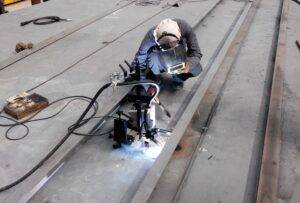
In power tower fabrication, components must be joined with high-strength welds. Traditionally, after a piece was cut to length, it would be moved to a separate station where a technician would manually grind a bevel (V, Y, K, or X-type joints) to allow for full-penetration welding. This secondary process is labor-intensive and prone to human error. The 12kW 3D laser performs the cut and the bevel simultaneously. By programming the bevel directly into the nesting software, the edges come off the machine perfectly chamfered and ready for the robotic welding cell. This “Single-Pass Fabrication” reduces lead times by up to 40%.
Engineering for Power Tower Fabrication
Power towers are not monolithic; they are complex assemblies of lattice structures or tapered tubular poles. This requires a processing center that can handle a variety of profiles:
- Angle Steel: The primary component of lattice towers. The laser can precisely cut bolt holes and cope ends for interlocking joints.
- H and I Beams: Used in heavy substation support structures. 3D processing allows for “passing through” the web and flanges in a single setup.
- Circular and Square Tubing: Increasingly popular for aesthetic and aerodynamic transmission poles. The 12kW system utilizes a rotary axis to treat these as “unrolled” surfaces, cutting complex intersections (saddles and fish-mouths) where two tubes meet.
The accuracy of the laser—often within ±0.1mm—ensures that when these massive structures are moved to the field for assembly, every bolt hole aligns perfectly. This is vital in Istanbul’s mountainous hinterlands or across the Bosphorus, where on-site modifications are costly and dangerous.
Istanbul: A Strategic Hub for Infrastructure Tech
The deployment of a 12kW 3D system in Istanbul is a calculated strategic move. The city serves as the manufacturing base for projects spanning the Middle East, North Africa, and the European Union. Turkish fabricators are increasingly being tapped for international power grid expansions. By adopting 12kW fiber technology, Istanbul-based firms can compete with lower-cost markets by offering higher quality and faster delivery.
Furthermore, the local ecosystem in Istanbul provides the necessary technical support. High-power fiber lasers require stabilized power grids, specialized cooling systems, and a supply of high-purity industrial gases. The industrial zones surrounding the city have evolved to support these high-tech requirements, creating a cluster of excellence in laser metalworking.
Integration with BIM and Industry 4.0
A 12kW 3D Processing Center is only as smart as the software driving it. These machines are now fully integrated into Building Information Modeling (BIM) workflows. Engineers designing power towers in software like TEKLA Structures can export their models directly into the laser’s nesting engine.
The software automatically accounts for the “kerf” (the width of the laser cut) and the specific angles required for the ±45° bevels. This digital thread from design to finished part eliminates manual data entry and the potential for error. In the context of Industry 4.0, these machines provide real-time data on gas consumption, cutting time, and nozzle wear, allowing Istanbul’s plant managers to optimize their production cycles with surgical precision.
Environmental Impact and Energy Efficiency
One might assume a 12kW laser is an energy hog, but the reality is the opposite when compared to legacy technology. Fiber lasers have a “plug-to-optical” efficiency of about 35-40%, whereas CO2 lasers hover around 10%. Furthermore, the speed of the 12kW laser means the machine is running for a shorter duration per part.
For Power Tower fabrication, the reduction in scrap is also significant. Advanced nesting algorithms for 3D profiles ensure that the maximum number of parts are harvested from each beam or tube. In an era where “Green Steel” and sustainable manufacturing are becoming tender requirements for energy projects, the fiber laser provides a documented path toward lower carbon-footprint fabrication.
The Future: Beyond the 12kW Horizon
As we look toward the future of structural steel processing in Istanbul, we can expect the power levels to climb even higher—20kW and 30kW systems are already entering the market. However, the 12kW 3D system remains the current benchmark for reliability and ROI in the power transmission sector. It represents a shift from “mass production” to “mass customization,” where every beam in a power tower can be uniquely cut and beveled without slowing down the production line.
The ±45° beveling capability, combined with the sheer force of 12,000 watts of light, has turned the traditional steel yard into a high-tech laboratory. For the power grids of tomorrow, this means stronger towers, faster deployment, and a more resilient infrastructure. Istanbul’s embrace of this technology ensures its place at the forefront of the global industrial landscape, proving that when it comes to the future of steel, the laser is the sharpest tool in the shed.