
1.0 Introduction: The Industrial Transition in Jakarta’s Infrastructure
The rapid expansion of Jakarta’s urban infrastructure, characterized by high-density vertical modular housing and seismic-resilient commercial frameworks, has necessitated a paradigm shift in steel fabrication. Traditional methods involving manual layout, plasma cutting, and mechanical drilling are increasingly viewed as bottlenecks. This report evaluates the deployment of a 12kW 3D Structural Steel Processing Center equipped with ±45° beveling capabilities. By transitioning to a unified laser-based structural processing workflow, fabrication facilities in the Jabodetabek region are addressing the dual challenges of labor scarcity and the stringent tolerances required for modular “plug-and-play” steel construction.
2.0 Technical Specification of the 12kW Fiber Source in Heavy Structural Context
The integration of a 12kW ytterbium fiber laser source represents a significant leap in power density over the previous 6kW industry standards for structural steel. In the context of heavy-gauge H-beams, I-beams, and hollow structural sections (HSS), the 12kW output allows for a substantial increase in feed rates while maintaining a narrow Kerf width.
2.1 Energy Density and Material Interaction
At 12kW, the laser maintains a high energy density that ensures the molten pool remains fluid enough to be expelled by high-pressure assist gases (typically O2 for carbon steel or N2 for stainless components). This is critical for thick-walled structural members (16mm to 25mm), where maintaining a consistent dross-free finish is essential for modular fit-up. The high-power source minimizes the Heat Affected Zone (HAZ), preserving the metallurgical integrity of the S355 or ASTM A36 steel commonly utilized in Jakarta’s modular frames.
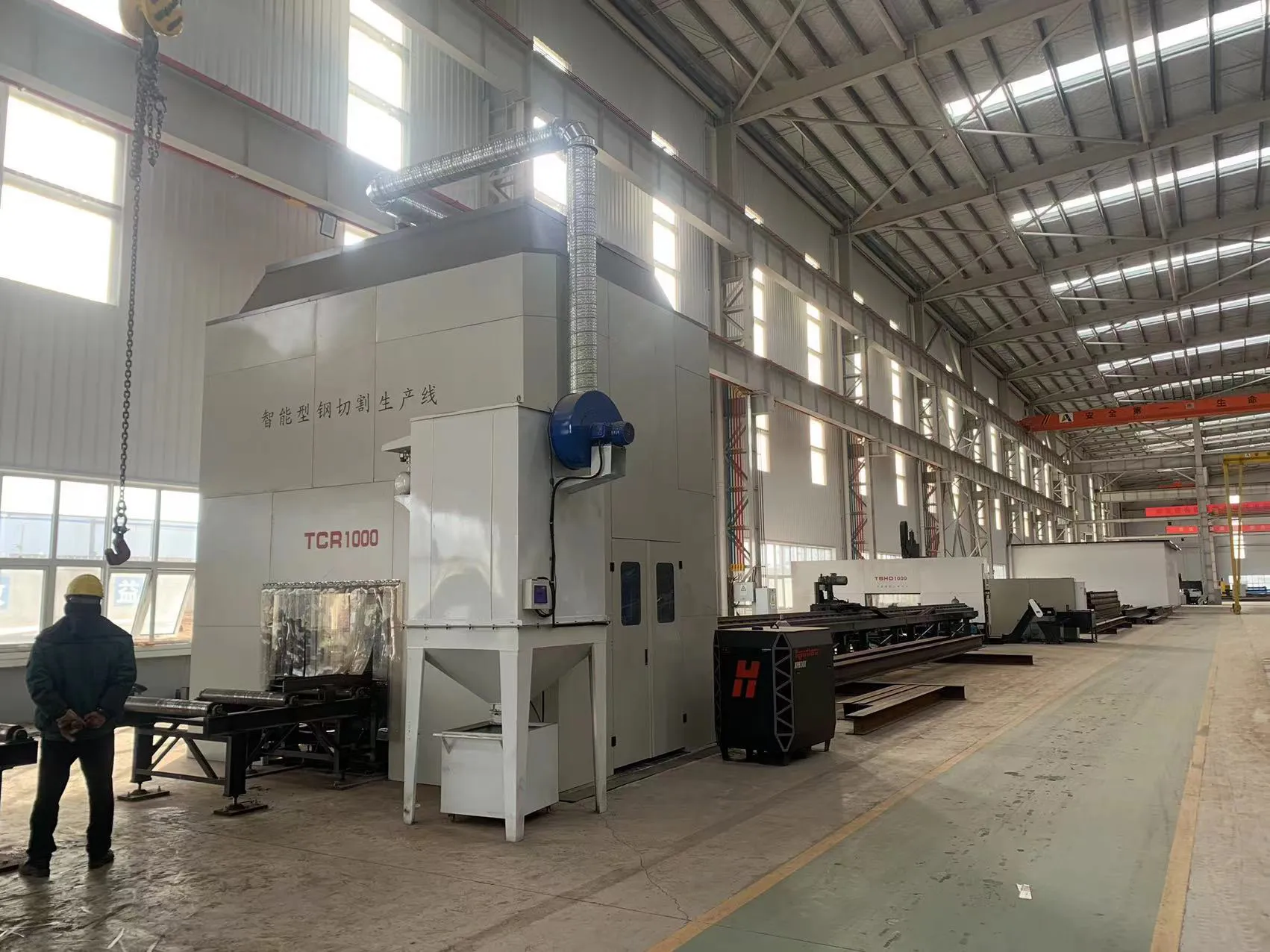
2.2 Processing Speed and Throughput
Empirical field data indicates that the 12kW system achieves a 40-60% increase in linear cutting speed on 20mm structural plates compared to 8kW systems. In a modular construction environment, where thousands of standardized beam segments must be produced with identical hole patterns and end-preps, this throughput increase directly translates to reduced lead times for onsite assembly.
3.0 Kinematics of ±45° Bevel Cutting: Solving the Weld Preparation Dilemma
The core innovation of the 3D Structural Steel Processing Center lies in its 5-axis kinematic head, capable of achieving ±45° beveling. In traditional structural steel processing, beveling for weld preparation is a secondary, often manual, operation. This leads to inconsistencies that complicate automated welding or high-tolerance bolting.
3.1 Precision Geometry for Weld Penetration
For modular construction, where structural integrity relies on Full Penetration (CJP) or Partial Penetration (PJP) welds, the accuracy of the bevel angle is paramount. The ±45° beveling head allows for the creation of V, X, and Y-shaped grooves directly during the primary cutting cycle. The laser’s ability to maintain a constant focal point while tilting ensures that the bevel angle remains consistent across the entire length of a flange or web. This precision eliminates the need for secondary grinding, which is often a source of geometric error and excessive labor cost in Jakarta’s fabrication shops.
3.2 Complex Intersections and Saddle Cuts
Modular units often utilize HSS (Hollow Structural Sections) for bracing. The 3D processing center excels at “saddle cuts” and complex miter joints. By applying a ±45° bevel to these intersections, the system creates an optimized “root gap” for welding, ensuring that modular connections meet the seismic requirements (Ductile Moment Frames) mandated by Indonesian building codes (SNI 1726:2019).
4.0 Application in Modular Construction: The Jakarta Case Study
Modular construction in Jakarta relies on the rapid assembly of pre-fabricated steel chassis. These modules must be perfectly orthogonal to ensure stackability and alignment of utility risers. The 12kW 3D processing center serves as the foundational technology for this precision.
4.1 Eliminating “Cumulative Error”
In a typical 10-story modular build, a 2mm error in a single beam can result in a significant lean at the top of the structure. The 3D laser system utilizes integrated laser scanning to detect the actual dimensions of the raw steel (compensating for mill tolerances and beam camber). The software then adjusts the cutting path in real-time. This ensures that every bolt hole and every mitered edge is positioned relative to the actual geometry of the beam, reducing cumulative error to near-zero levels.
4.2 Integration with Building Information Modeling (BIM)
The processing center facilitates a direct “BIM-to-Machine” workflow. Engineers in Jakarta can export Tekla or Revit models directly into the laser’s nesting software. This eliminates manual data entry and the risk of misinterpretation of shop drawings. The 12kW laser then executes complex notchings and cut-outs that would be impossible with mechanical saws, allowing for innovative interlocking modular designs that “self-jig” during assembly.
5.0 Synergy Between Power and Automation
The efficiency of the 12kW source is only fully realized when coupled with an automated structural processing environment. This involves advanced material handling and real-time sensing.
5.1 Automatic Loading and In-feed Systems
Heavy structural profiles (up to 12 meters) require robust mechanical handling. The 3D processing center utilizes a series of hydraulic chucks and conveyors that stabilize the beam during high-speed laser movements. The synergy here is found in the reduction of “air-cut” time. While the 12kW laser is performing a high-speed bevel, the next beam is already being staged, ensuring a continuous duty cycle.
5.2 Real-time Compensation for Beam Deformations
Raw steel beams are rarely perfectly straight. Thermal stresses from the rolling mill often result in “bow” or “twist.” The 3D processing center employs non-contact capacitive sensors that map the beam’s surface before and during the cut. In Jakarta’s humid environment, where thermal expansion of steel must be accounted for in large-scale factories, this real-time compensation ensures that the ±45° bevel remains accurate relative to the beam’s centerline, not just its surface.
6.0 Environmental and Economic Impact
The transition to 12kW 3D laser processing offers a significant reduction in the environmental footprint of steel fabrication—a key concern for new developments in Jakarta’s “Green Building” initiatives.
6.1 Material Utilization and Scrap Reduction
The precision of laser cutting allows for tighter nesting of parts compared to mechanical sawing. Furthermore, the ability to cut complex shapes and holes in a single pass reduces the “drop” (waste) produced during fabrication. When dealing with high-tonnage modular projects, a 5% increase in material utilization represents a substantial cost saving and a reduction in the carbon footprint of the project.
6.2 Energy Efficiency per Cut
While a 12kW source consumes more power per hour than a 4kW source, its dramatically faster cutting speed means the energy consumed *per meter of cut* is significantly lower. This efficiency is critical in Jakarta, where industrial electricity tariffs and grid stability are constant considerations for factory management.
7.0 Conclusion: The Standard for Modern Structural Fabrication
The deployment of the 12kW 3D Structural Steel Processing Center with ±45° beveling technology is no longer an optional upgrade for fabricators in the Jakarta modular sector; it is a technical necessity. The system effectively bridges the gap between raw industrial materials and the high-precision requirements of modular engineering. By consolidating cutting, drilling, and beveling into a single automated process, the technology ensures that the structural components of Jakarta’s future skyline are produced with the highest levels of safety, efficiency, and geometric fidelity. The field data confirms that the ±45° beveling capability, in particular, is the critical factor in enabling high-quality, high-speed welding—the backbone of any successful modular steel project.
















