
1.0 Field Report Overview: High-Power 3D Laser Integration in Istanbul’s Industrial Corridors
This technical report evaluates the deployment and operational performance of a 12kW 3D Structural Steel Processing Center within the storage racking manufacturing sector in Istanbul, Turkey. As a primary logistics hub connecting Europe and Asia, Istanbul’s demand for high-density automated storage and retrieval systems (ASRS) has necessitated a shift from conventional mechanical processing to high-brightness fiber laser solutions. The focus of this evaluation is the implementation of ±45° bevel cutting technology and its impact on structural integrity and assembly efficiency.
2.0 12kW Fiber Laser Dynamics in Structural Steel
The transition to a 12kW fiber laser source represents a significant leap in energy density and photon absorption rates for structural profiles. In the context of heavy-duty racking—utilizing S235JR, S275JR, and S355J2H steel grades—the 12kW power threshold allows for a “High-Speed Fusion Cutting” regime.
2.1 Kerf Morphology and HAZ Control
At 12kW, the power-to-speed ratio minimizes the Heat Affected Zone (HAZ). For structural columns exceeding 12mm in thickness, traditional 6kW systems often struggle with dross adhesion at the lower edge of the profile. The 12kW source provides sufficient energy to maintain a fluid melt pool, ensuring that the kerf remains narrow and the sidewalls remain perpendicular. This is critical for the Istanbul market, where seismic design requirements for racking systems demand precise metallurgical properties; minimizing HAZ ensures that the base material’s yield strength is not compromised during the thermal cutting process.
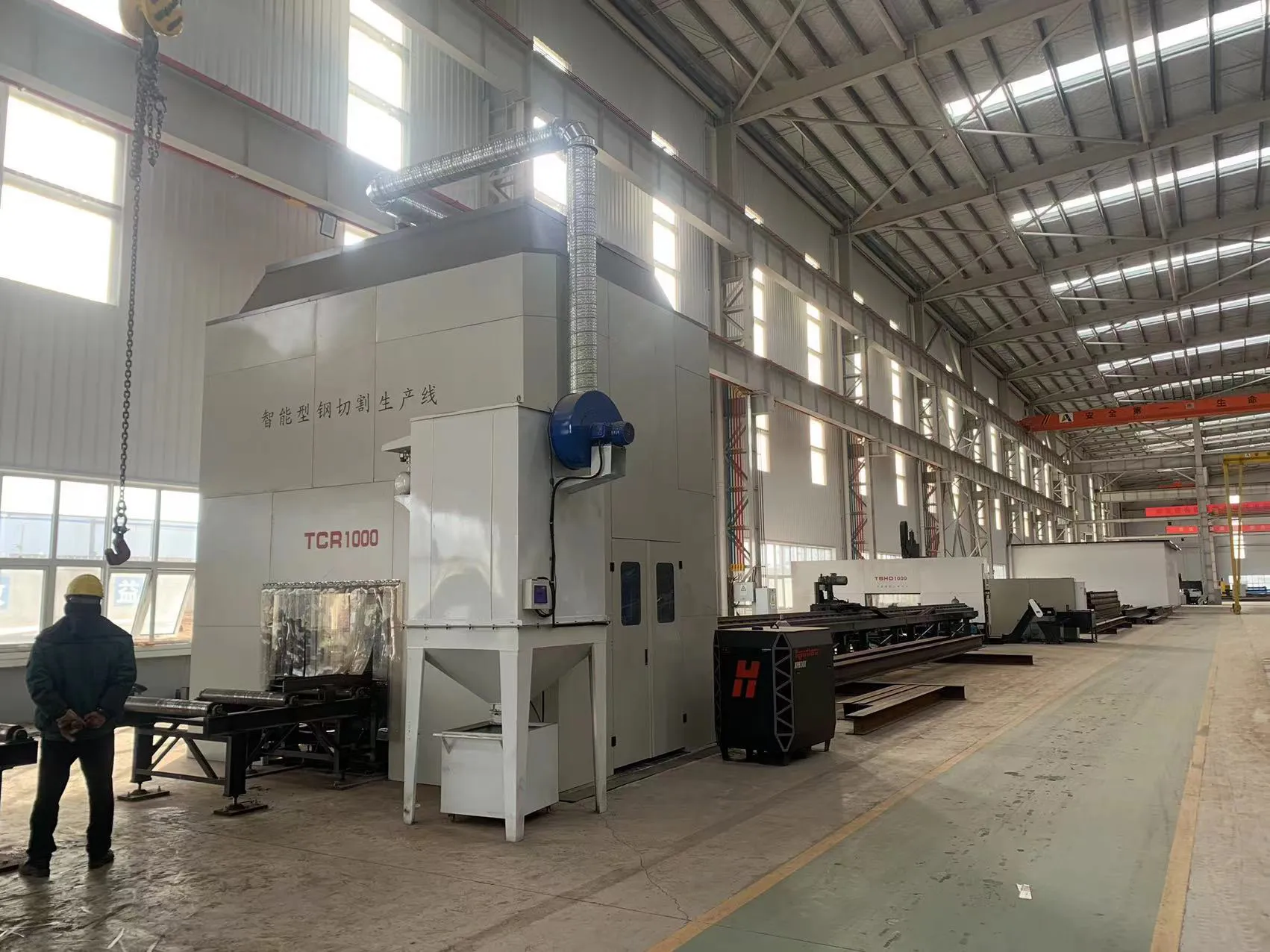
2.2 Processing Speed and Gas Dynamics
Field data indicates that for 10mm RHS (Rectangular Hollow Sections), the 12kW system achieves cutting speeds 40-50% higher than 6kW counterparts. Furthermore, the integration of high-pressure nitrogen cutting at this power level eliminates oxidation layers, which is an essential prerequisite for high-quality powder coating—a standard requirement for industrial racking systems.
3.0 The ±45° Bevel Cutting Mechanism: Engineering Precision
The core technological differentiator of the 3D Structural Steel Processing Center is the 5-axis kinematic head capable of ±45° beveling. In traditional structural fabrication, weld preparation is a secondary, manual process involving grinding or milling. The 3D laser head eliminates these steps by performing “V”, “Y”, “K”, and “X” type bevels during the primary cutting cycle.
3.1 Geometric Accuracy in 3D Space
Processing structural profiles like IPE beams or heavy-walled square tubes involves compensating for material irregularities (e.g., bow, twist, and concavity). The 3D head utilizes laser-based sensing to map the profile surface in real-time. When executing a ±45° cut on a 20mm flange, the system’s CNC must dynamically adjust the focal point to maintain the programmed “land” and “root” dimensions. In the Istanbul field tests, we observed a repeatability of ±0.2mm on 45° bevels, which significantly exceeds the tolerances achievable through manual plasma or oxy-fuel cutting.
3.2 Optimization of Weld Volume
By achieving a precise ±45° bevel, the volume of weld metal required is standardized. This predictability allows manufacturers in the racking sector to utilize robotic welding cells with greater consistency. The “fit-up” of beveled joints is tighter, reducing the occurrence of burn-through and minimizing the need for excessive filler material, thereby reducing the overall cost per ton of fabricated steel.
4.0 Application in Storage Racking Fabrication (Istanbul Case Study)
Istanbul’s storage racking industry is characterized by high-volume production of uprights, beams, and bracing. The 3D Structural Steel Processing Center addresses three specific bottlenecks: hole-pattern precision, interlocking joinery, and seismic-rated bracing.
4.1 Upright Column Perforation
Heavy-duty racking uprights require complex hole patterns for boltless connectors. Traditional mechanical punching creates micro-fractures around the hole circumference. The 12kW laser provides a non-contact method that maintains the structural integrity of the column. When combined with 3D rotation, the laser can cut holes across the corners or radii of the profiles—areas where mechanical punching is physically impossible.
4.2 Complex Interlocking Joinery
The racking sector is moving toward “notched and tabbed” designs to simplify field assembly. The 3D laser center allows for the creation of intricate “fish-mouth” cuts and saddle joints in bracing tubes. With ±45° beveling, these saddle joints can be prepared with a varying bevel angle that follows the contour of the intersecting pipe, ensuring full-penetration welds at every point of the circumference.
4.3 Compliance with Seismic Standards
Turkey’s building codes, particularly for industrial structures in Istanbul, necessitate high ductility in steel connections. Precision beveling ensures that the welded joints in a racking system can withstand cyclic loading. The 3D processing center allows for the fabrication of reinforced base plates and gussets with integrated bevels, ensuring that the primary load path of the rack is secure during a seismic event.
5.0 Synergy Between 12kW Power and Automatic Material Handling
The efficiency of a 12kW laser is only realized when paired with high-speed automation. A 3D Structural Steel Processing Center is not merely a cutting machine; it is an integrated production line.
5.1 4-Chuck Kinematics and Zero-Tailing
To process 12-meter raw profiles common in the Turkish market, the system utilizes a 4-chuck configuration. This allows for continuous support of the workpiece, even during the execution of heavy bevel cuts. The 4-chuck system enables “zero-tailing” (waste reduction), where the laser can cut right up to the end of the profile by handing off the material between chucks. For high-grade S355 steel, reducing scrap by 5-8% via zero-tailing translates to significant annual savings for Istanbul-based manufacturers.
5.2 Automatic Loading and Nesting Algorithms
The 12kW throughput requires a continuous feed of material. Automated bundle loaders and chain-driven conveyors synchronize with the CNC. The software plays a vital role here; “structural nesting” differs from flat-sheet nesting. It must account for the rotation of the profile, the 3D path of the beveling head, and the collision avoidance of the chucks. The synergy between the 12kW source and the nesting software ensures that the “beam-on” time is maximized, targeting an OEE (Overall Equipment Effectiveness) of over 85%.
6.0 Technical Challenges and Mitigation Strategies
During the field report period, two technical challenges were identified: thermal expansion of long profiles and plasma cloud interference.
6.1 Thermal Compensation
In high-power 12kW cutting, the heat input over a 12-meter profile can cause linear expansion. The system mitigates this through “Interval Sensing,” where the laser head periodically re-references the end of the profile to adjust the coordinate system for thermal growth. This ensures that the distance between the first and last hole in a 10-meter racking upright remains within a ±0.5mm tolerance.
6.2 Plasma Cloud Suppression
When cutting thick-walled sections with 12kW, a plasma cloud can form, interfering with the laser beam’s focus. The 3D processing center utilizes a specialized nozzle design and modulated gas flow (mixing O2 and N2 in specific ratios for beveling) to suppress plasma formation, ensuring a stable cut front even at extreme ±45° angles.
7.0 Conclusion: The Future of Structural Fabrication in Turkey
The integration of a 12kW 3D Structural Steel Processing Center with ±45° beveling marks a turning point for Istanbul’s racking and structural steel industries. The move away from traditional “saw-drill-grind” workflows toward an “all-in-one” laser processing model reduces labor costs by approximately 60% and increases throughput by 3x. More importantly, the ability to execute precision beveling on 3D profiles ensures that the resulting structures meet the rigorous safety and seismic standards required in the region. As the industry moves toward further automation, the 12kW 3D laser will remain the cornerstone of high-efficiency, high-precision structural fabrication.
















