
Introduction to 1.5kW Tube laser cutting in Guadalajara’s Industrial Landscape
Guadalajara, often referred to as the “Silicon Valley of Mexico,” has evolved into a powerhouse for advanced manufacturing and metal fabrication. As the capital of Jalisco, it serves as a critical hub for the automotive, aerospace, and furniture industries. Central to this industrial growth is the adoption of high-precision fiber laser technology. The 1.5kW tube laser cutter has emerged as the definitive standard for small to medium enterprises (SMEs) in the region, offering a perfect balance between capital investment and processing capability, specifically when working with carbon steel.
The transition from traditional mechanical sawing and plasma cutting to fiber laser cutting represents a paradigm shift in how local workshops approach structural components. For Guadalajara’s engineers, the ability to process round, square, and rectangular carbon steel profiles with sub-millimeter accuracy is no longer a luxury but a competitive necessity in the North American supply chain.
 laser cutting machine” style=”width: 100%; max-width: 800px; height: auto; margin: 20px 0;”>
Technical Specifications of the 1.5kW Fiber Laser Source
A 1.5kW fiber laser source is engineered to provide a high-density beam that is ideal for the absorption characteristics of ferrous metals. Unlike CO2 lasers, fiber technology utilizes an optical fiber doped with rare-earth elements to amplify light, resulting in a wavelength of approximately 1.06 microns. This wavelength is highly absorbed by carbon steel, allowing for efficient energy transfer and rapid melting of the material.
Beam Quality and Power Density
In the context of tube processing, beam quality (often measured by the M2 factor) is paramount. A 1.5kW system delivers a concentrated spot size that enables high power density at the focal point. This allows the laser cutting process to achieve a narrow kerf width, which is essential for complex geometries such as interlocking joints, “fish-mouth” cuts, and intricate perforations in structural tubing.
Energy Efficiency and Operational Costs
For fabricators in Guadalajara, where energy costs are a significant factor in overhead, the wall-plug efficiency of a 1.5kW fiber laser is a major advantage. These systems typically convert over 30% of electrical input into laser power, compared to the 5-10% efficiency of older technologies. This reduced power consumption, combined with a maintenance-free laser source (no internal mirrors or gas refills), ensures a lower cost-per-part for carbon steel components.
Optimizing Carbon Steel Processing with 1.5kW Power
Carbon steel is the “bread and butter” of the Guadalajara construction and automotive sectors. While a 1.5kW laser can cut carbon steel up to 12mm or 14mm in thickness, its peak performance—where speed and edge quality intersect—is found in the 1mm to 6mm range. This range covers the vast majority of structural tubing used in furniture frames, automotive chassis, and industrial racking.
Assist Gas Dynamics: Oxygen vs. Nitrogen
The choice of assist gas is critical when laser cutting carbon steel. Oxygen (O2) is the most common choice for 1.5kW systems. The oxygen reacts exothermically with the heated carbon steel, adding thermal energy to the cut and allowing for faster processing of thicker walls. However, this results in a thin oxide layer on the cut edge. For high-end applications in Guadalajara’s furniture industry, where parts may be powder-coated, this oxide layer must be removed, or nitrogen (N2) must be used as a high-pressure assist gas to achieve a clean, weld-ready finish.
Heat-Affected Zone (HAZ) Management
Engineering precision requires minimizing the Heat-Affected Zone (HAZ). The 1.5kW fiber laser’s ability to move at high speeds through carbon steel limits the time the material is exposed to extreme temperatures. This preserves the structural integrity of the tube and prevents warping, which is particularly vital for thin-walled sections used in Guadalajara’s bicycle and medical equipment manufacturing sectors.
Mechanical Considerations for Tube Fabrication
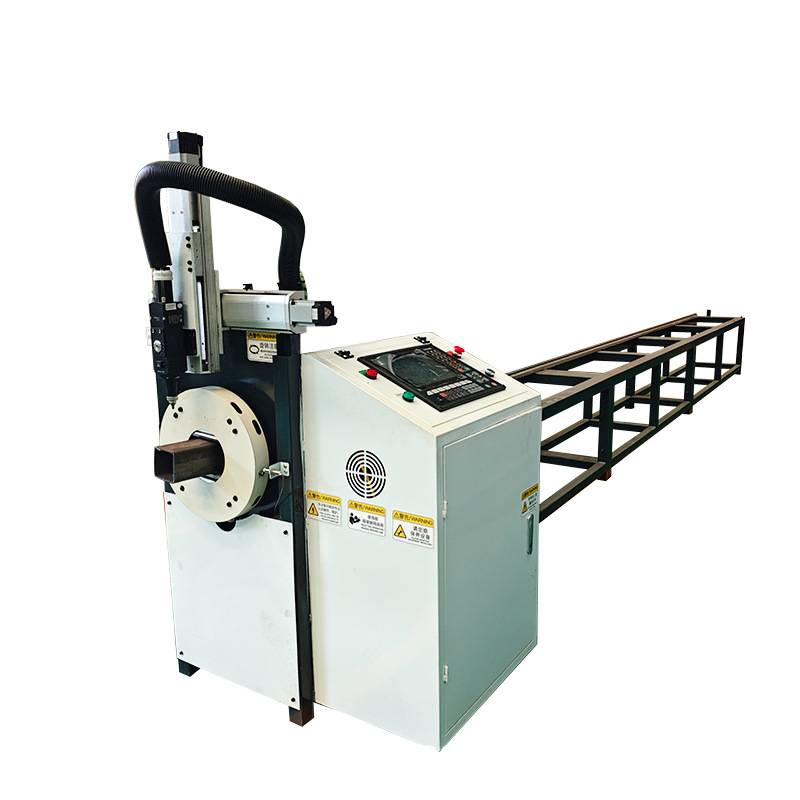
Laser cutting tubes involves more than just the laser source; the mechanical handling of the profile is equally important. A dedicated tube laser cutter features a rotary chuck system that synchronizes with the laser head’s movement.
Chuck Precision and Centering
In Guadalajara’s competitive landscape, precision is everything. Modern 1.5kW machines utilize pneumatic or electric self-centering chucks. These ensure that the carbon steel tube remains perfectly aligned during rotation. Any deviation in centering would result in “walk-off,” where holes on one side of the tube do not align with holes on the opposite side. High-quality systems incorporate compensation software that detects tube deformation (bowing or twisting) and adjusts the laser path in real-time.
Nesting and Material Utilization
With the fluctuating price of carbon steel in the Mexican market, material waste reduction is a priority. Advanced CAD/CAM software integrated with the laser cutting system allows for “common line cutting” and sophisticated nesting. By placing parts as close as possible on a 6-meter length of tubing, manufacturers can achieve material utilization rates exceeding 95%.
Applications in Guadalajara’s Key Industries
The versatility of the 1.5kW tube laser makes it an indispensable tool across various sectors in Jalisco.
Automotive Tier 2 and Tier 3 Suppliers
Guadalajara is a vital link in the North American automotive supply chain. 1.5kW machines are used to produce exhaust components, seat frames, and structural supports. The ability to laser cut complex notches allows for easier assembly and welding, reducing the need for expensive manual jigs.
Commercial Furniture and Architectural Design
The local furniture industry has embraced laser cutting to create modern, minimalist designs. Square carbon steel tubing can be cut with mitered corners that fold perfectly, or with decorative patterns that would be impossible to achieve with traditional drilling or sawing. This has allowed Guadalajara-based designers to compete on a global scale with high-quality, precision-engineered products.
Maintenance and Environmental Factors in Jalisco
Operating a high-tech laser in Guadalajara requires attention to local environmental conditions. The region’s climate, characterized by a distinct rainy season and moderate temperatures, necessitates specific maintenance protocols.
Chiller Systems and Temperature Control
The fiber laser source and the cutting head require constant cooling. A dual-circuit water chiller is standard. In the warmer months in Jalisco, it is crucial to ensure the chiller is sized correctly to prevent condensation on the optics and to maintain the laser source at a stable operating temperature. Using deionized water and regularly checking for algae growth is a standard engineering requirement.
Dust Extraction and Filtration
Laser cutting carbon steel produces a significant amount of fine metallic dust and sparks. A robust dust extraction system is mandatory. This not only protects the operator’s health but also prevents the accumulation of conductive dust on the machine’s electronic components and linear guides, which could lead to short circuits or premature wear in the abrasive environment of a busy fabrication shop.
The Economic Impact: ROI for Guadalajara Fabricators
The investment in a 1.5kW tube laser cutter is often recovered within 12 to 18 months for shops currently outsourcing their cutting or using manual methods. By consolidating multiple processes—sawing, drilling, notching, and deburring—into a single laser cutting operation, labor costs are slashed and throughput is increased. Furthermore, the high precision of the laser reduces the time required for downstream welding and assembly, as parts fit together perfectly every time.
Technical Support and Local Expertise
One of the advantages of being in Guadalajara is the growing ecosystem of technical support. Many global laser manufacturers have established service centers or authorized distributors in the Bajío region. This ensures that spare parts, such as nozzles, protective windows, and ceramic rings, are readily available, minimizing downtime for carbon steel production lines.
Conclusion: The Future of Metal Fabrication in Jalisco
The 1.5kW tube laser cutter is more than just a tool; it is a catalyst for industrial modernization in Guadalajara. By providing the precision of fiber laser cutting to the processing of carbon steel, local manufacturers can elevate their production standards to meet international requirements. As the region continues to attract foreign investment and expand its manufacturing base, the integration of such advanced CNC technologies will remain the cornerstone of Jalisco’s engineering excellence. Whether for automotive components, structural building frames, or designer furniture, the fiber laser is the key to unlocking new levels of efficiency and creativity in the heart of Mexico’s industrial landscape.
















