
The Strategic Integration of 1.5kW Fiber Laser Technology in Tijuana’s Agricultural Manufacturing Sector
The industrial landscape of Tijuana has undergone a significant transformation, evolving from a traditional assembly hub into a sophisticated center for high-precision engineering. For factory owners and engineers within the agricultural sector—ranging from the fertile valleys of San Quintín to the specialized equipment manufacturers near the border—the adoption of the 1.5kW Sheet Metal Fiber Laser represents a critical shift in production capability. This guide examines the technical architecture of the 1.5kW system, focusing specifically on the structural advantages of the tube-welded standard bed and its optimized performance for carbon steel fabrication.
In the context of agricultural machinery, where components must withstand high mechanical stress and environmental exposure, the precision of the initial cut dictates the integrity of the final assembly. The 1.5kW power rating has emerged as the industry standard for manufacturers processing carbon steel between 1mm and 14mm, offering an ideal balance between capital investment, operational cost, and cutting speed.
Structural Integrity: The Engineering Behind the Tube-Welded Standard Bed
The foundation of any high-precision CNC machine is its bed. In the 1.5kW class, the tube-welded standard bed is engineered to provide superior vibration damping and thermal stability. Unlike lighter aluminum frames or overly rigid cast iron beds that may be prone to cracking under thermal cycles, the tube-welded structure utilizes high-quality rectangular steel tubes that are strategically reinforced with internal stiffeners.
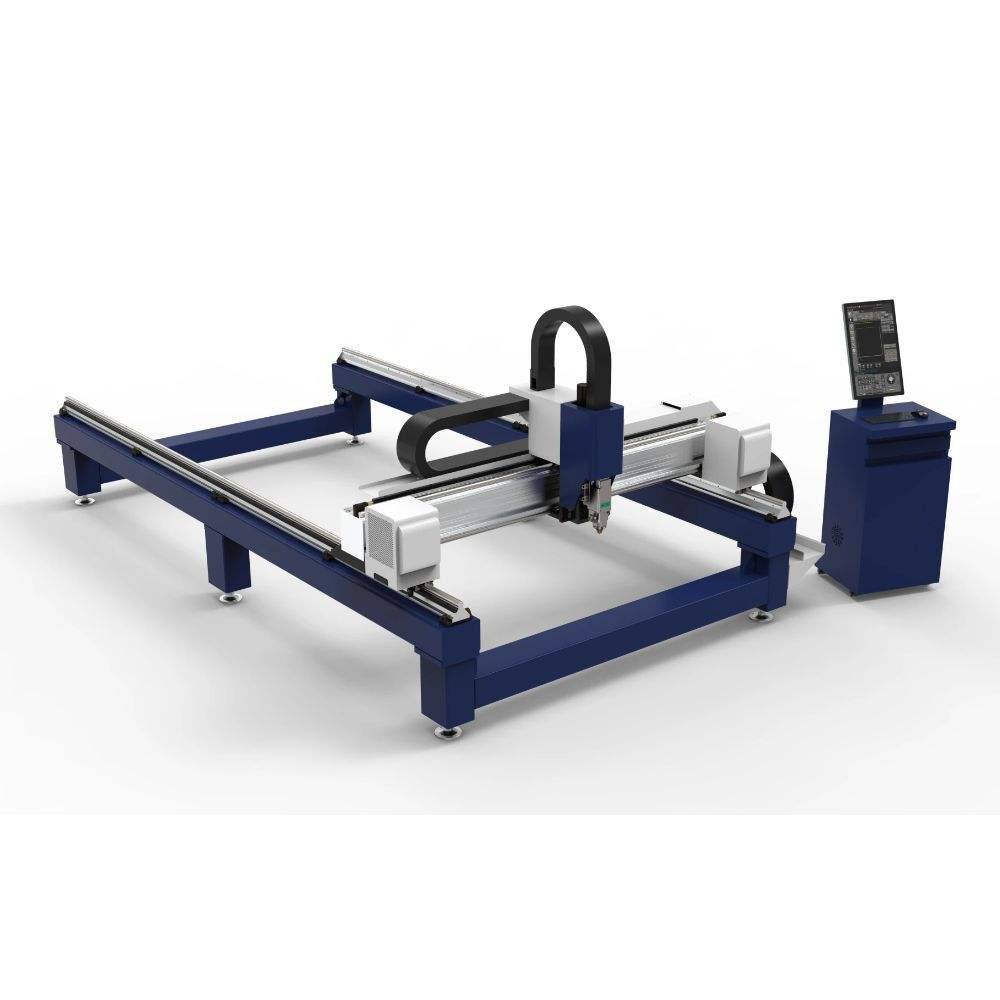
From an engineering perspective, the manufacturing process of these beds involves a rigorous stress-relief protocol. After welding, the bed undergoes high-temperature annealing to eliminate internal residual stresses. This is followed by natural aging and precision machining on large-scale gantry milling machines. For a Tijuana-based factory, this translates to a machine that maintains its geometric accuracy (within ±0.02mm) over a decade of operation, even in environments with fluctuating ambient temperatures. The “Standard Bed” configuration ensures that the gantry’s dynamic response is optimized, preventing the “ghosting” or “jitter” effects often seen in lower-quality frames when cutting complex geometries at high speeds.
Optimizing Carbon Steel Cutting: Material Science and Gas Dynamics
Carbon steel is the backbone of agricultural engineering, used in everything from seeder plates to heavy-duty chassis brackets. The 1.5kW fiber laser excels in processing this material due to the specific wavelength of the fiber source (typically around 1.064 microns), which is highly absorbed by carbon steel.
When cutting carbon steel, the process is primarily an exothermic reaction facilitated by oxygen (O2) as the assist gas. The 1.5kW beam provides sufficient energy density to maintain a stable kerf while the oxygen reacts with the iron to generate additional heat, allowing for clean cuts in thicker sections. Engineers must calibrate the nozzle height and gas pressure to manage the “heat-affected zone” (HAZ). A well-tuned 1.5kW system minimizes the HAZ, ensuring that the metallurgical properties of the carbon steel—such as its hardness and ductility—remain intact near the cut edge. This is vital for parts that will later undergo welding or heat treatment, as it prevents brittleness and premature failure in the field.
Data-Driven Performance Metrics for the 1.5kW System
To justify the integration of a 1.5kW laser into a Tijuana production line, engineers must analyze the performance data. For standard A36 or 1018 carbon steel, the following benchmarks are typical for a high-precision 1.5kW unit:
1. Cutting Speed: At 1mm thickness, speeds can reach 30-35 m/min. At 6mm, the speed stabilizes around 2.2-2.8 m/min. At the upper limit of 12-14mm, the machine maintains a steady 0.6-0.8 m/min.
2. Positional Accuracy: ±0.03mm over the entire working area (typically 3000mm x 1500mm).
3. Repeatability: ±0.02mm, ensuring that batch production of agricultural fasteners or brackets is perfectly consistent.
4. Surface Roughness: Cut edges on carbon steel up to 8mm thickness typically achieve an Ra of 12.5 or better, often eliminating the need for secondary grinding.
These metrics demonstrate that the 1.5kW laser is not merely a tool for cutting, but a precision instrument that reduces downstream labor costs. In a market like Tijuana, where skilled labor for secondary finishing is becoming increasingly expensive, the ability to move a part directly from the laser bed to the assembly line is a significant competitive advantage.
Versatility in Agricultural Applications
The agricultural industry requires a unique mix of high-volume small parts and low-volume large components. The 1.5kW sheet metal laser, particularly when equipped with a versatile gantry system, meets these needs efficiently.

Common applications include:
– Irrigation System Components: Precision-cut flanges and brackets for water distribution networks.
– Harvesting Equipment: Perforated screens and specialized blades that require high-carbon steel processing.
– Structural Brackets: Heavy-duty mounting plates for tractors and implements that require high load-bearing capacity and exact bolt-hole alignment.
The high-precision nature of the laser allows for “nesting” strategies that are far superior to traditional stamping or plasma cutting. Advanced nesting software can reduce material waste by up to 20%, a critical factor when carbon steel prices fluctuate in the North American market. For a Tijuana factory, this reduction in scrap directly improves the bottom line.
Operational Considerations for the Tijuana Market
Operating a fiber laser in the Tijuana industrial corridor presents specific environmental and logistical considerations. The region’s proximity to the coast can introduce humidity and salinity, which are detrimental to sensitive optical components. Therefore, the 1.5kW systems recommended for this market feature sealed electrical cabinets and high-efficiency dust extraction systems.
Furthermore, the power stability in some industrial zones can vary. Engineers should ensure that the laser system is paired with a high-precision voltage stabilizer and a dual-temperature industrial chiller. The chiller is essential for maintaining the laser source and the cutting head at constant temperatures, preventing thermal drift which can compromise cutting precision during long production shifts.
Maintenance in the Tijuana region is also facilitated by the modular design of the 1.5kW fiber source. Unlike older CO2 lasers that required complex mirror alignments and gas refills, fiber lasers are virtually maintenance-free for the first 50,000 to 100,000 hours of operation. The primary consumables are limited to nozzles, protective windows, and ceramic rings—all of which are easily stocked locally.
Economic Impact and Return on Investment (ROI)
For an agriculture factory owner, the transition to a 1.5kW fiber laser is an economic decision as much as a technical one. The ROI is driven by three primary factors: speed, precision, and utility costs.
A 1.5kW fiber laser is approximately 3 to 4 times faster than a plasma cutter on thin-to-medium carbon steel and significantly more precise. This speed increases the daily throughput of the factory without increasing the headcount. Secondly, the precision of the cut reduces the “cost of quality”—the expenses associated with rejected parts or rework. Finally, the wall-plug efficiency of fiber technology is roughly 30%, compared to 10% for CO2 lasers, leading to substantially lower electricity bills.
In the competitive landscape of Tijuana’s manufacturing sector, where companies often compete for contracts from both domestic Mexican agricultural firms and US-based distributors, the ability to provide high-precision, clean-cut carbon steel parts at a lower lead time is a decisive factor for growth.
Conclusion: Engineering the Future of Agriculture
The 1.5kW sheet metal laser with a tube-welded standard bed represents the pinnacle of “appropriate technology” for the modern agricultural equipment manufacturer in Tijuana. It provides the necessary power to handle the rigors of carbon steel while maintaining the high precision required for modern mechanical assemblies. By investing in a platform that prioritizes structural stability and data-driven performance, factory owners can ensure their operations remain resilient, efficient, and capable of meeting the evolving demands of the global agricultural market.
As we move toward more automated manufacturing environments, the 1.5kW laser stands as a reliable, high-performance workhorse, bridging the gap between traditional fabrication and the future of smart industrial production. For the engineers and owners in Tijuana, the choice is clear: precision-engineered laser technology is the key to unlocking new levels of productivity and quality in carbon steel fabrication.
















