
Precision Engineering Guide: Optimizing Carbon Steel Fabrication with 1.5kW Fiber Laser Technology in the Queretaro Aerospace Cluster
The industrial landscape of Queretaro has evolved into one of the most sophisticated aerospace hubs in North America. As Tier 1 and Tier 2 suppliers face increasing pressure to deliver high-precision components with shorter lead times, the selection of fabrication machinery becomes a critical strategic decision. For facilities specializing in carbon steel components—ranging from structural brackets to specialized tooling—the 1.5kW fiber laser cutting system, built on a tube-welded standard bed, represents the optimal balance of capital investment and technical performance.
This guide explores the engineering specifications, structural advantages, and operational efficiencies of 1.5kW fiber laser systems tailored for the Queretaro market, focusing on the rigorous demands of the aerospace and high-tech manufacturing sectors.
The Strategic Role of 1.5kW Power in Carbon Steel Processing
In the context of carbon steel fabrication, power density is often more critical than raw wattage. While 10kW+ machines dominate the heavy plate industry, the 1.5kW fiber laser is the “precision instrument” of the sheet metal world. For carbon steel thicknesses ranging from 0.5mm to 12mm, a 1.5kW source provides a beam quality (M²) that allows for a tighter focus spot.
In Queretaro’s aerospace supply chain, where many components are manufactured from cold-rolled carbon steel for ground support equipment or internal structural jigs, the 1.5kW system offers a narrower kerf width. This precision minimizes the Heat Affected Zone (HAZ), a vital metric for maintaining the metallurgical integrity of the steel. When cutting carbon steel, the 1.5kW laser utilizes oxygen as an assist gas to trigger an exothermic reaction, allowing for clean, dross-free edges that often require zero post-processing before welding or painting.
Engineering Excellence: The Tube-welded Standard Bed
The foundation of any high-precision CNC machine is its bed. In the aerospace sector, where tolerances are measured in microns, thermal stability and vibration damping are non-negotiable. The tube-welded standard bed is engineered to address these specific challenges.
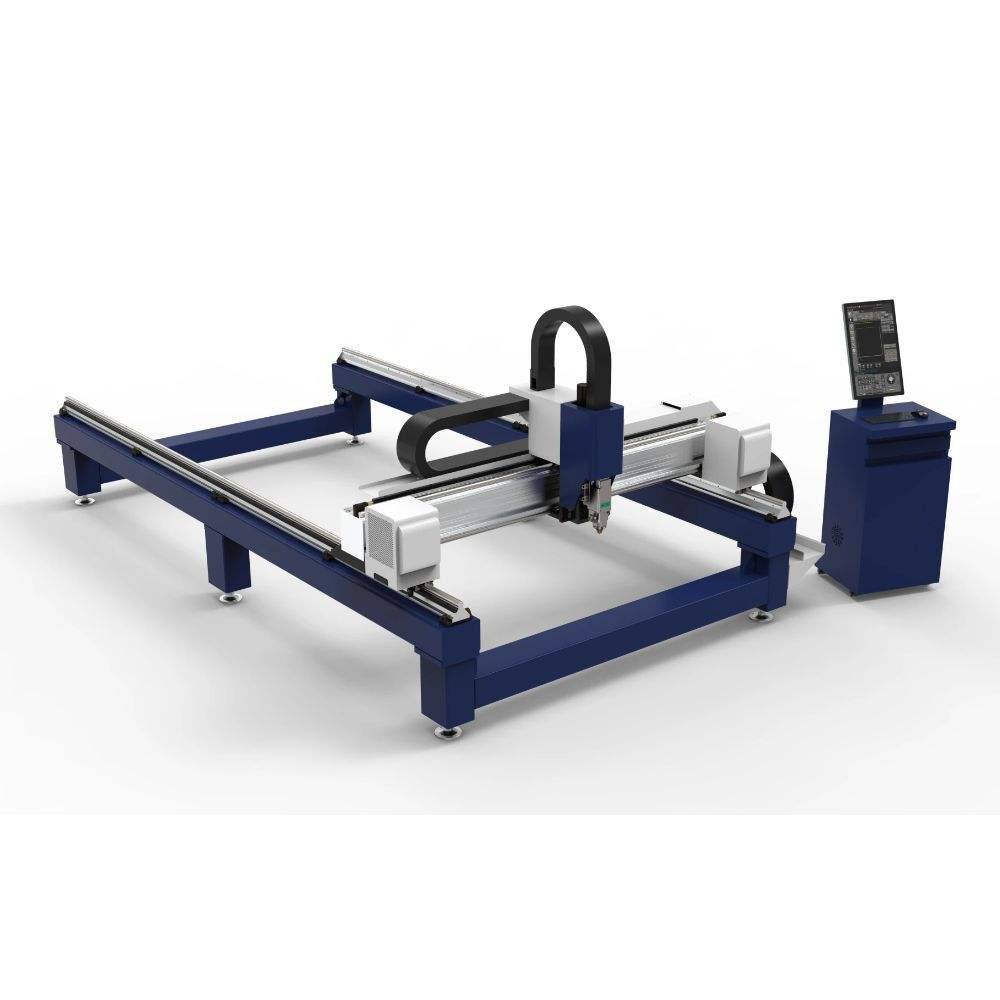
Unlike cast iron beds which can be brittle or simple plate-welded frames that may warp under thermal stress, the tube-welded structure utilizes high-strength rectangular steel tubes. These tubes are strategically reinforced with internal stiffeners. The engineering advantage lies in the “triangulation” of the frame, which provides a high strength-to-weight ratio.
For a 1.5kW system operating at high acceleration speeds (often up to 1.2G), the bed must absorb the kinetic energy generated by the gantry’s rapid direction changes. The tube-welded design undergoes a rigorous stress-relief annealing process. By heating the frame to over 600°C and cooling it slowly, internal residual stresses from the welding process are eliminated. This ensures that the machine maintains its geometric alignment over a 10-to-15-year lifespan, even in the fluctuating ambient temperatures of central Mexico’s industrial parks.
High-Precision Cutting Dynamics for Carbon Steel
Carbon steel presents unique challenges compared to stainless steel or aluminum. Its carbon content makes it highly reactive to the laser beam’s thermal profile. To achieve high-precision results in Queretaro’s demanding environment, the 1.5kW system employs several advanced technical features:
1. Automatic Focusing Heads: The system utilizes sensors to maintain a constant distance between the nozzle and the material. Even if a sheet of carbon steel has slight surface irregularities, the laser head adjusts in real-time (capacitive sensing), ensuring the focal point remains perfectly positioned within the material thickness.
2. Pulse Piercing Technology: To prevent “cratering” or excessive slag during the initial entry of the laser, high-frequency pulse piercing is used. This allows for smaller entry holes, which is essential when nesting parts closely together to save material costs—a key KPI for Queretaro’s lean manufacturing facilities.
3. Corner Energy Control: When the laser approaches a sharp corner, the CNC controller automatically reduces the power output and gas pressure. This prevents “over-burning” of the corner, ensuring that the finished part matches the CAD drawing with a tolerance of ±0.03mm.
Structural Integrity and Vibration Mitigation
In aerospace engineering, the resonance of a machine can lead to “striations” or wavy patterns on the cut edge of the steel. The tube-welded bed’s hollow sections are often filled with specialized damping materials or designed with specific geometries that break harmonic vibrations. This is particularly important when the 1.5kW laser is cutting thin-gauge carbon steel (1mm – 3mm), where high-speed vibrations are most likely to affect edge quality.
The gantry, typically constructed from aerospace-grade extruded aluminum, complements the tube-welded bed. By pairing a lightweight, rigid gantry with a heavy, stable bed, the machine achieves the dynamic response required for intricate geometries without sacrificing the stability needed for thicker carbon steel plates.

Operational Efficiency in the Queretaro Market
Queretaro’s industrial sector is characterized by high electricity costs and a push toward sustainable manufacturing (Industry 4.0). The 1.5kW fiber laser is significantly more efficient than older CO2 technology.
– Wall-plug Efficiency: Fiber lasers convert approximately 30-35% of electrical energy into laser light, compared to the 8-10% seen in CO2 lasers. For a factory owner in the El Marqués or Balvanera industrial parks, this translates to thousands of dollars in annual utility savings.
– Maintenance Cycles: The 1.5kW fiber source has no moving parts and no mirrors to align. This “solid-state” design reduces downtime, a critical factor for aerospace suppliers who must adhere to strict Just-In-Time (JIT) delivery schedules.
– Gas Consumption: By optimizing the nozzle design and using high-precision proportional valves, the 1.5kW system minimizes oxygen consumption during carbon steel cutting, further reducing the cost-per-part.
Technical Specifications for Aerospace-Grade Carbon Steel Processing
When evaluating a 1.5kW system for carbon steel, engineers should prioritize the following data points:
– Positioning Accuracy: ±0.03mm/m.
– Repositioning Accuracy: ±0.02mm.
– Maximum Cutting Speed (2mm Carbon Steel): 18-22 m/min.
– Maximum Cutting Thickness (Carbon Steel): 14mm (Production limit: 12mm).
– Acceleration: 1.0G – 1.2G.
These specifications ensure that the machine can handle the complexity of aerospace components, such as perforated ventilation panels, mounting brackets, and specialized assembly fixtures, with the repeatability required by AS9100 standards.
Integration with Local Supply Chains and Standards
For factory owners in Queretaro, the transition to 1.5kW fiber laser technology is supported by a robust local ecosystem. The ability to process carbon steel with high precision allows local shops to move up the value chain, transitioning from simple fabrication to becoming qualified aerospace vendors.
The use of a tube-welded standard bed also simplifies the installation and leveling process. In many Queretaro facilities, floor vibrations from neighboring heavy stamping presses can interfere with laser precision. The inherent damping properties of the annealed tube-welded frame act as a buffer, protecting the cutting process from external mechanical noise.
Furthermore, the software integration of these machines allows for seamless compatibility with standard aerospace CAD/CAM platforms. This ensures that the digital twin of a part is translated into physical reality with 100% fidelity, including the management of lead-ins, lead-outs, and micro-joints.
Conclusion: The Future of Fabrication in Queretaro
The 1.5kW sheet metal laser, characterized by its tube-welded bed and carbon steel specialization, is more than just a cutting tool; it is a strategic asset for Queretaro’s aerospace engineers. By prioritizing structural rigidity and high-precision beam delivery, manufacturers can achieve the tight tolerances and edge qualities demanded by global aviation standards.
As the region continues to grow as a global manufacturing powerhouse, the adoption of data-driven, structurally superior machinery will be the defining factor for companies looking to maintain a competitive edge. The 1.5kW fiber laser offers the reliability, efficiency, and precision necessary to transform carbon steel into high-value aerospace components, ensuring long-term profitability and technical excellence in one of Mexico’s most dynamic markets.
















