
Engineering Overview: The 1.5kW Fiber Laser for Toluca’s Kitchenware Sector
The industrial landscape of Toluca, State of Mexico, has evolved into a critical hub for high-precision manufacturing, particularly in the production of premium kitchenware and architectural hardware. For factory owners and lead engineers, the transition from traditional mechanical punching or CO2 cutting to fiber laser technology is no longer a luxury but a competitive necessity. The 1.5kW Precision Laser System represents the “sweet spot” of power efficiency and capital investment for processing non-ferrous metals like brass.
This guide analyzes the technical architecture of the 1.5kW system, focusing on the structural integrity of the tube-welded standard bed and the specific metallurgical challenges of high-precision brass cutting. In an environment where Toluca’s altitude and industrial power fluctuations can affect sensitive electronics, understanding the engineering behind the machine bed and the optical path is paramount for maintaining a 24/7 production cycle.
Structural Integrity: The Technical Advantages of the Tube-welded Standard Bed
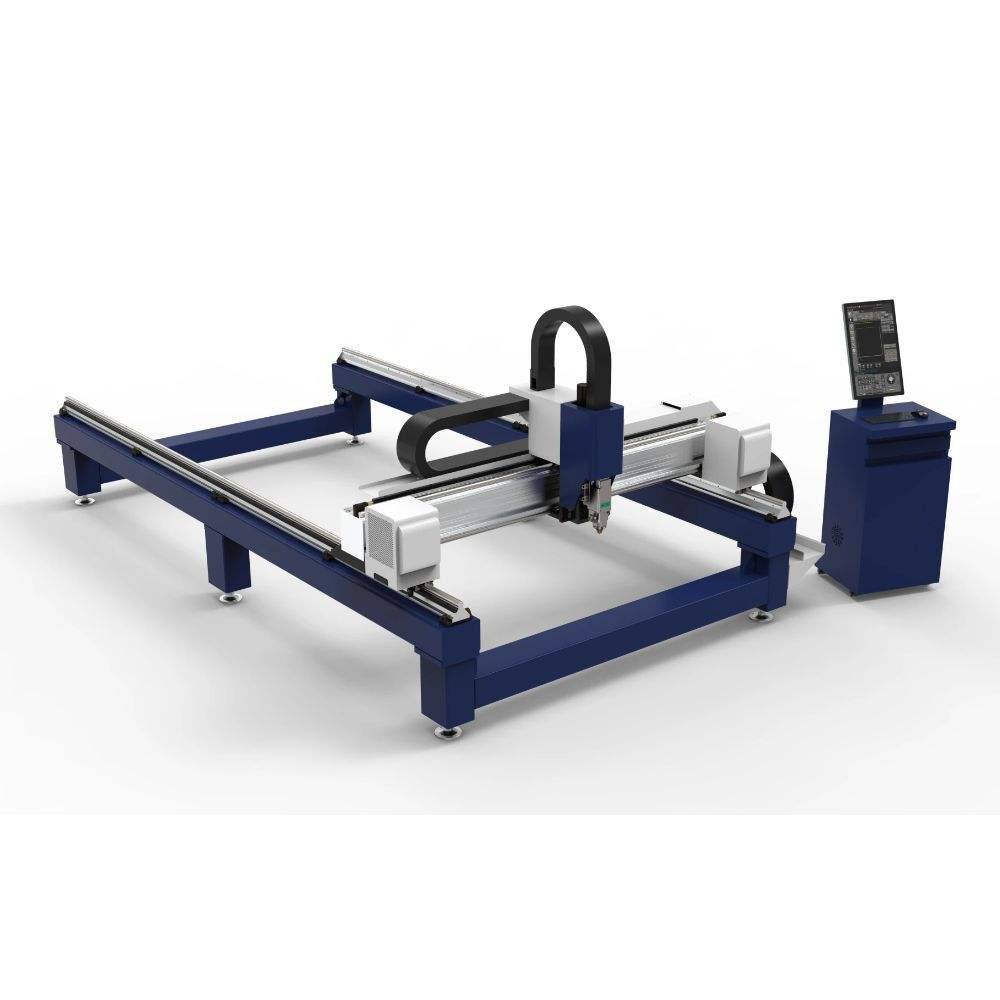
In laser physics, the quality of the cut is directly proportional to the stability of the motion platform. For a 1.5kW system, the tube-welded standard bed offers a balanced ratio of rigidity to vibration damping. Unlike cast iron beds which are significantly heavier and more expensive, or plate-welded beds that can be prone to internal stresses, the tube-welded structure is engineered for high-speed dynamics.
The bed is constructed using high-strength rectangular industrial tubes. During the manufacturing process, these tubes undergo a rigorous stress-relief annealing process. This involves heating the structure to approximately 600°C and cooling it slowly to eliminate internal residual stresses caused by welding. For a kitchenware factory in Toluca, this ensures that the machine maintains its geometric accuracy (within ±0.02mm) despite the ambient temperature shifts common in the region.
The “Standard Bed” configuration refers to a modular design that facilitates easy maintenance and high-speed acceleration. With a 1.5kW source, the gantry must move at high velocities to prevent heat accumulation in thin brass sheets. The tube-welded design provides the necessary structural resonance frequency to handle accelerations of up to 1.0G without inducing “chatter” marks on the workpiece. This stability is critical when cutting intricate patterns in brass handles or decorative ventilation grilles where aesthetic finish is as important as dimensional accuracy.
High-Precision Cutting of Brass: Overcoming Reflectivity
Brass is a highly reflective and thermally conductive alloy, making it one of the most challenging materials to process with a laser. At a 1070nm wavelength, a significant portion of the initial laser energy can be reflected back into the cutting head, potentially damaging the fiber source. The 1.5kW precision system addresses this through advanced optical isolation and specific beam parameters.
To achieve high-precision results in brass (typically ranging from 0.5mm to 4mm in kitchenware applications), the system utilizes a high-brightness fiber source. The energy density at the focal point must exceed the material’s melting threshold instantly to initiate the “keyhole” effect.
Key technical parameters for brass cutting include:
1. **Back-Reflection Protection:** The 1.5kW oscillators are equipped with sensors that detect reflected light. If the reflection exceeds a safety threshold, the system modulates the pulse or shuts down to protect the feeding fiber.
2. **Gas Dynamics:** Using high-pressure Nitrogen (N2) is essential for brass. Nitrogen acts as a shielding gas that prevents oxidation, ensuring the cut edge remains bright and weld-ready without the need for secondary polishing. For a Toluca-based factory, optimizing N2 consumption is a primary factor in reducing the cost per part.
3. **Frequency Modulation:** High-frequency pulsing (up to 5000Hz) allows for cleaner entry points (piercing) without creating “blow-outs” or slag on the underside of the brass sheet.
Toluca Market Context: Power Stability and Environmental Factors
Operating high-precision machinery in Toluca presents unique environmental variables. The altitude (approximately 2,660 meters) affects the density of the air and the cooling efficiency of the chiller systems. A 1.5kW system must be paired with an oversized dual-circuit water chiller to ensure that both the laser source and the cutting head maintain a constant temperature of 22°C-25°C.
Furthermore, the industrial power grid in the Toluca-Lerma corridor can experience voltage fluctuations. The 1.5kW system is engineered with integrated voltage stabilizers and high-grade Siemens or Schneider electrical components to prevent logic errors in the CNC. For kitchenware engineers, this means fewer scrapped sheets of expensive brass (C26000 or C36000 series) due to mid-cut power surges.

Data-Driven Performance: Speed and Tolerance Specifications
For a kitchenware factory owner, the ROI is driven by throughput. Below are the empirical performance metrics for a 1.5kW system processing brass:
– **1.0mm Brass:** Cutting speeds of 18-22 m/min with a kerf width of 0.1mm.
– **2.0mm Brass:** Cutting speeds of 6-8 m/min, maintaining a perpendicularity tolerance of less than 0.05mm.
– **3.0mm Brass:** Cutting speeds of 2-3 m/min, optimized for high-pressure Nitrogen (1.2 – 1.5 MPa).
The precision of the 1.5kW system allows for the nesting of parts with a gap as small as 2mm, significantly reducing material waste. In the context of brass, which has a high market value per kilogram, a 5% increase in nesting efficiency can save a medium-sized factory thousands of dollars annually.
Engineering the Optical Path for Kitchenware Detail
Kitchenware often requires intricate logos, textures, or complex geometries for ergonomic handles. The 1.5kW system utilizes an autofocus cutting head. This technology uses a capacitive sensor to maintain a constant distance between the nozzle and the brass sheet, even if the sheet has slight mechanical warping.
The focal length selection is also critical. For the thin-to-medium gauge brass used in kitchenware, a 125mm or 150mm focal lens is standard. This provides a small spot size (approx. 100 microns), which concentrates the 1.5kW of power to a point where it can vaporize the metal instantly. This “cold cutting” effect minimizes the Heat Affected Zone (HAZ), ensuring that the structural properties of the brass remain intact and the edges do not become brittle.
Maintenance Protocols for High-Altitude Industrial Hubs
In Toluca’s industrial parks, dust and particulate matter can be an issue. The 1.5kW system features a fully enclosed rack and pinion drive system with automatic lubrication. The tube-welded bed includes integrated dust extraction channels that pull fumes and metallic dust away from the optical path.
Engineers should follow a strict maintenance schedule:
– **Daily:** Clean the protective lens and check the nozzle for brass splatter.
– **Weekly:** Inspect the chiller water levels and conductivity (deionized water is mandatory).
– **Monthly:** Check the alignment of the gantry and the tension of the drive belts or the engagement of the gear racks.
Economic Feasibility and Competitive Advantage
The transition to a 1.5kW fiber laser with a tube-welded bed offers a significant reduction in “Cost Per Part.” Traditional methods like waterjet cutting are too slow and messy for high-volume kitchenware, while higher power lasers (6kW+) are often overkill for the gauges of brass typically used, leading to unnecessary energy consumption and higher maintenance costs.
By investing in a system specifically tuned for brass, Toluca manufacturers can achieve a superior surface finish that meets international export standards. The 1.5kW system’s ability to produce clean, burr-free edges directly reduces the labor costs associated with manual deburring and finishing.
Conclusion: Future-Proofing Production
The 1.5kW Precision Laser System is a strategic asset for the Toluca kitchenware industry. By combining the structural reliability of a stress-relieved tube-welded bed with the specialized optical requirements for cutting brass, factories can achieve a level of precision that was previously unattainable. For the engineer, it provides a stable, data-driven platform for innovation; for the owner, it provides the efficiency required to dominate the local and international markets. As the industry moves toward more complex designs and tighter tolerances, this system stands as the foundation of modern metallic fabrication.
















