Weld Access Holes, Beam Copes and Zero-Remnant Cutting on an H-Beam Laser
Our 5-axis H-beam laser cuts the weld access hole (rat hole), the cope and the flange bevel in one program, then cuts the last part on the bar to the very end. The beam is never clamped in a chuck, so there is no 100 to 300 mm offcut left on each length.
At a glance
- A weld access hole (rat hole) is a radiused cut in the beam web next to the flange that lets the flange groove weld run across the full width.
- For seismic moment connections AWS D1.8 sets a 10 mm minimum radius, a height of 3/4 tbf to tbf + 6 mm and a length of 3 tbf ± 12 mm.
- The PCL 5-axis H-beam laser cuts the cope, access hole, ±45° bevel, bolt holes and marking in one setup from Tekla DSTV files.
- The beam is not clamped in a chuck, so the last part is cut to the end of the bar; chuck machines leave 100 to 300 mm per bar.

Video: weld access hole and zero-remnant cutting on a customer’s H-beam line.
On this page
What a weld access hole does
In a welded beam-to-column moment connection the beam flange is joined with a complete joint penetration (CJP) groove weld. The web is in the way of the backing bar and the weld root, so a radiused hole is cut in the web next to the flange. Fabricators call it a weld access hole, rat hole or scallop.
The hole has two jobs. It gives the welder room to weld across the full flange width, and it separates the flange groove weld from the web-to-flange weld so the two do not cross. Because it sits in the most highly stressed part of the connection, its shape and the condition of its cut edge matter as much as its size.
Geometry the standards ask for
AISC 360 Section J1.6 covers weld access holes in general steel construction. For seismic moment connections, AWS D1.8 clause 6.11.1.2 gives a specific profile. The main AWS D1.8 values are:
| Feature | AWS D1.8 requirement |
|---|---|
| Radius | 3/8 in (10 mm) minimum |
| Height | at least 3/4 tbf or 3/4 in (20 mm), whichever is greater; at most tbf + 1/4 in (6 mm) |
| Length | 3 tbf ± 1/2 in (12 mm) |
| Cut angle to flange | tolerances may not add up to more than 25° |
| Surface | roughness limit per clause 6.11.2.1 |
tbf = beam flange thickness. Always work to the edition and clauses named in your project specification.
How the laser cuts it
On a saw-and-drill line or with a hand torch, the access hole is usually a separate step: mark the web, cut the hole, then grind the radius and remove notches. On the H-beam laser the hole is part of the cutting program, and the profile comes straight from the Tekla or DSTV file.
- Load and calibrate. The beam lies on the bed and the machine calibrates its real position before cutting, since rolled beams are never perfectly straight.
- Cope the end. The web and flanges are cut to the connection profile, with the head tilting to follow the flange.
- Cut the access hole. The radiused hole is cut in one continuous path, so there is no start-stop notch at the tangent point.
- Bevel the flange. The head tilts up to ±45° and cuts the V, Y or K bevel for the groove weld in the same program.
- Holes and marking. Bolt holes, slotted holes and layout marks for assembly are added before the beam moves on.
The 5-axis TCP head rotates 360° on the A axis and 180° on the C axis, which lets it cut the cope, the access hole and the bevel in one setup without turning the beam over. See beam bevel cutting for V, Y and K bevel types and angles.
Zero-remnant cutting: why there is no tail
Tube and profile lasers that hold the bar in a chuck need a clamping length at the end. The last 100 to 300 mm of each bar stays in the chuck and becomes scrap. The H-beam laser works the other way round: the beam rests on the bed and the cutting head travels along it, so nothing has to be held. The last part is cut to the end of the bar.
| Per 12 m HEA 300 bar 88.3 kg/m | Chuck machine 100 mm tail | Chuck machine 300 mm tail | PCL H-beam laser |
|---|---|---|---|
| Offcut per bar | 8.8 kg | 26.5 kg | 0 kg |
| Offcut per 1,000 bars | 8.8 t | 26.5 t | 0 t |
The saving grows with section weight. On an HEB 600 at 212 kg/m, a 300 mm tail is 63.6 kg of steel per bar. Section weights are listed in the steel beam size chart.
Bolt holes and slotted holes in the same pass
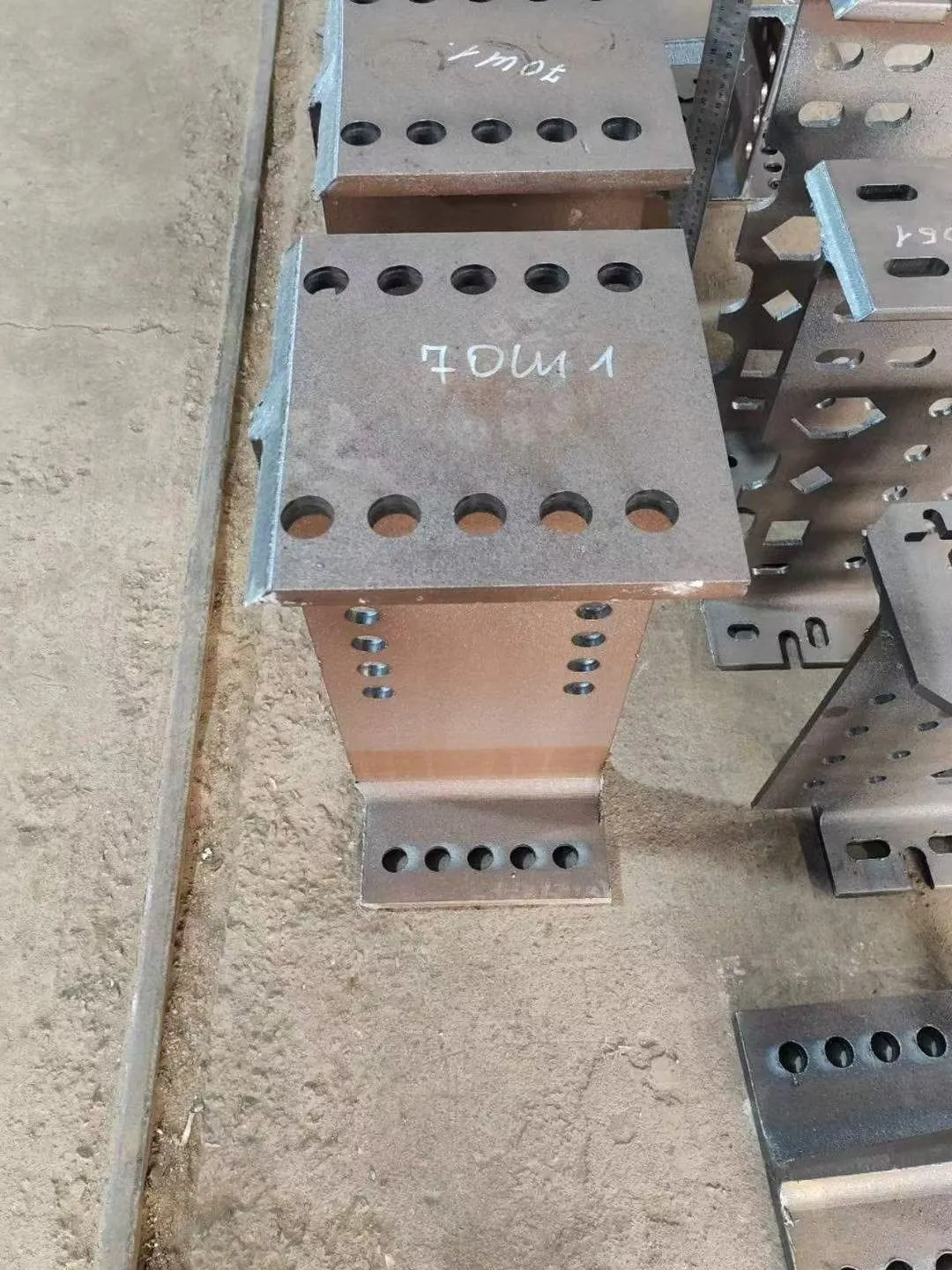
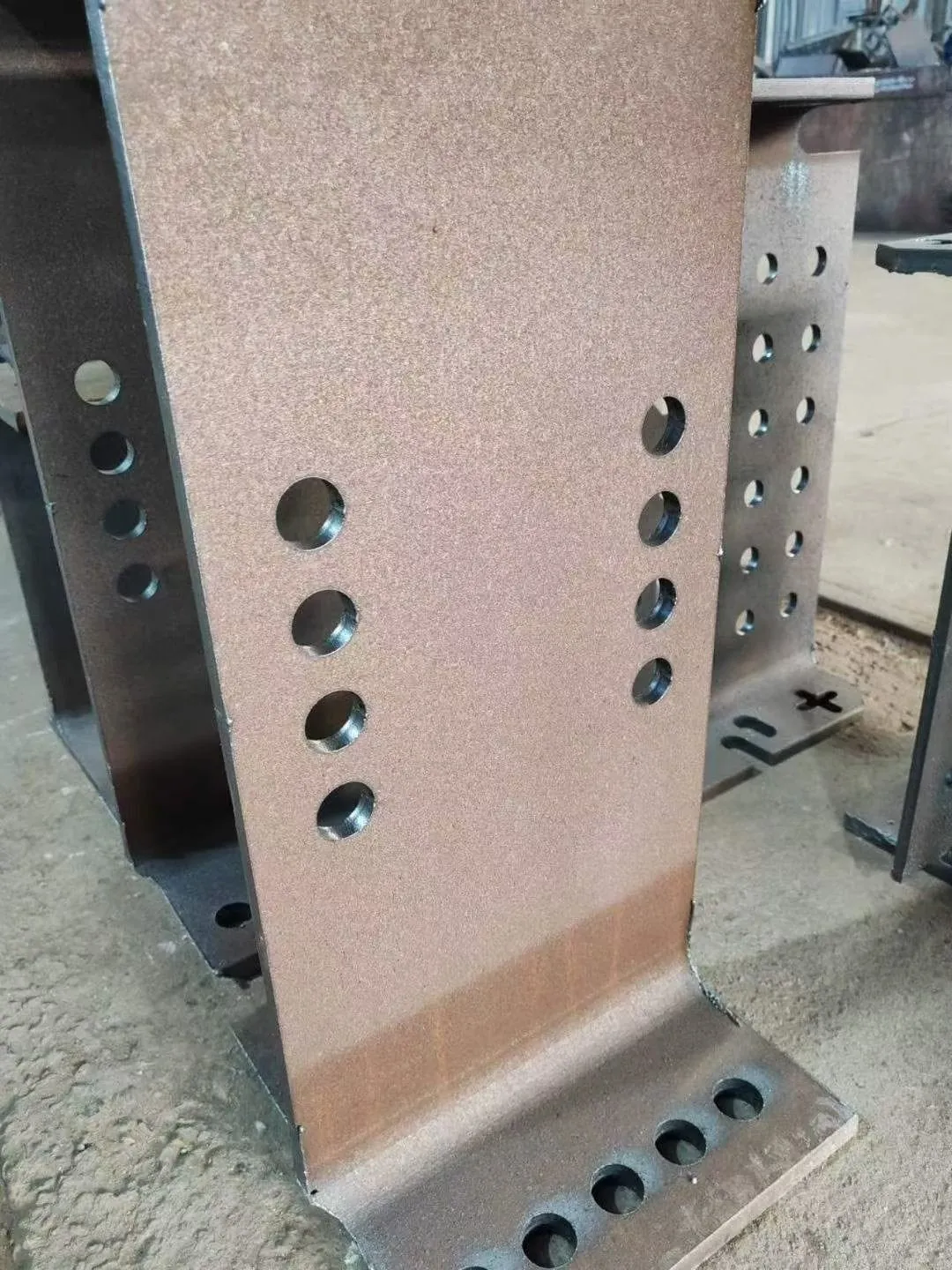
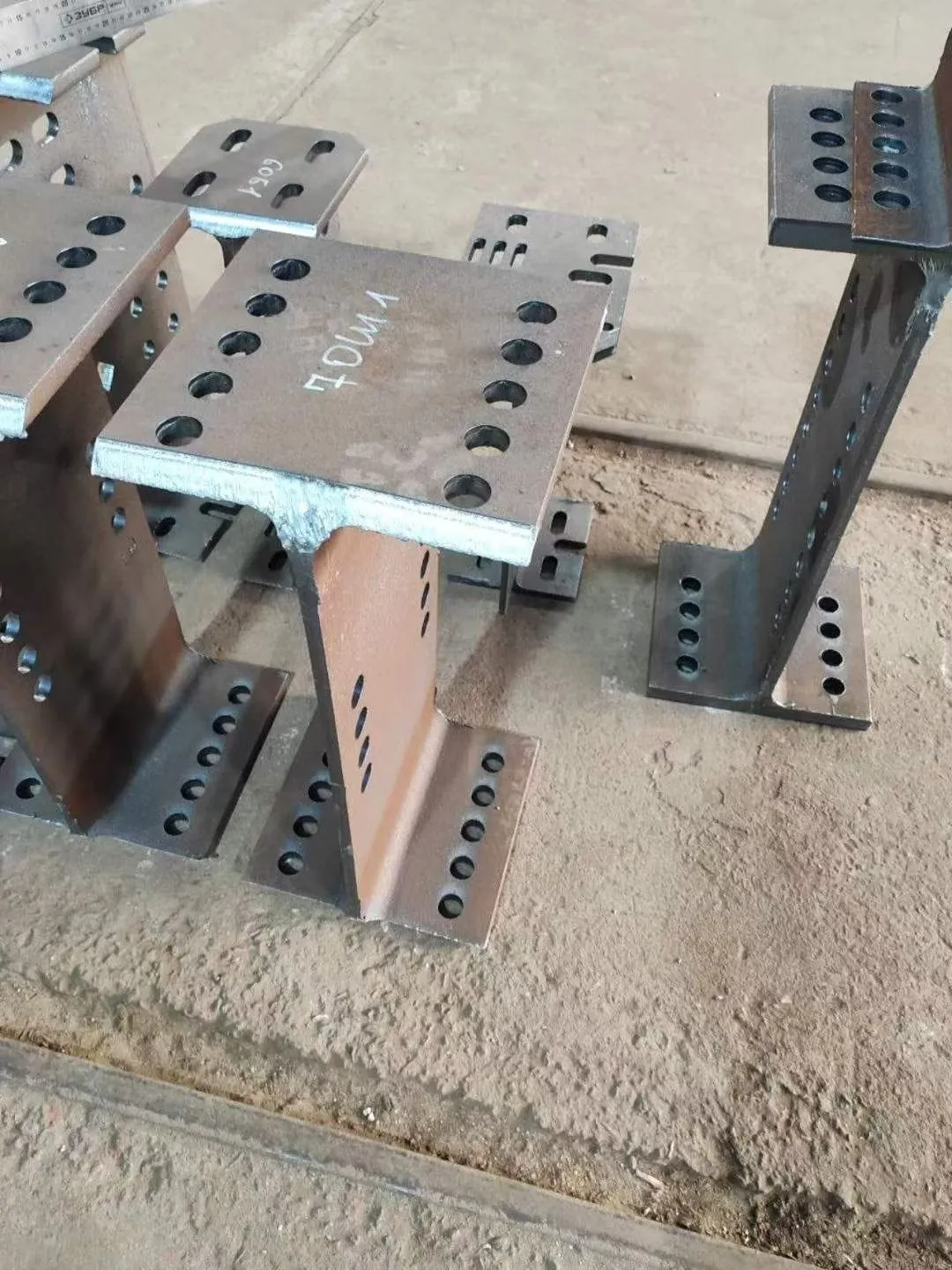
These columns were cut on the laser: end plate holes, web holes in two rows and slotted holes in the base, all in one program and with part numbers marked for assembly.
Sections the machine takes
| Item | Standard machine |
|---|---|
| H and I beams, channels | up to 1,000 mm section height |
| Angles | up to 800 mm leg length (most orders are under 300 mm) |
| Effective cutting length | 12,000 mm |
| Cutting thickness | carbon steel and stainless steel up to 40 mm |
| Bevel | ±45°, V / Y / K |
| Files | Tekla DSTV (.nc), IGES, STEP |
Check a specific section in the beam size lookup, or see the full specification on the H-beam laser cutting machine page.
Questions
What is a weld access hole?
A weld access hole, often called a rat hole, is a radiused cut in the web of a beam next to the flange. It lets the welder run a complete joint penetration weld across the full flange width and keeps that weld from crossing the web-to-flange weld.
Why does the cut quality of an access hole matter?
The access hole sits where stresses in a moment connection are highest. Notches, gouges or a sharp corner at its edge can start fatigue or brittle cracks, which is why standards set a minimum radius and a surface roughness limit for the cut.
Can a laser cut the access hole, cope and bevel in one setup?
Yes. The 5-axis head tilts and rotates around the beam, so the web cope, the radiused access hole and the flange bevel are cut in the same program without moving the beam to another station.
What does zero-remnant cutting mean?
It means the last part on a bar is cut right up to the end, so no unusable offcut is left. Our H-beam laser cutting machine does not clamp the beam in a chuck, so there is no clamping length to lose.
How much material does a chuck machine leave?
Chuck-type tube and profile lasers usually leave 100 to 300 mm at the end of each bar, because the chuck has to hold that length while the last cut is made.
Can the laser replace drilling bolt holes?
For most connection holes in carbon steel up to the machine’s 40 mm cutting limit it can, and slotted holes are cut in the same pass. Check the hole tolerance and edge requirements in your project specification before replacing drilling for slip-critical joints.