Laser Tube Cutting Machine Safety Operation Procedures
PCL Group application engineering, Jinan · Updated 20 October 2026
This is a standard operating procedure (SOP) for fiber laser tube cutting machines. It covers who may run the machine, the hazards and how each is controlled, the step-by-step routine for start-up, loading, cutting and shutdown, lockout for maintenance, material-specific risks and what to do in an emergency. Adapt it to your site and keep it with the manufacturer’s manual; where the two differ, the manual applies.
- Applies to
- Fiber laser tube cutters
- Laser class
- Class 4 source
- Wavelength
- ≈ 1,070 nm
- Revised
- 20 Oct 2026
On this page
- Ten rules for every operator
- SOP 01Scope and responsibilities
- SOP 02Terms used in this procedure
- SOP 03Hazards and controls
- SOP 04Start-up
- SOP 05Loading tubes
- SOP 06During cutting
- SOP 07Material-specific risks
- SOP 08Shutdown and housekeeping
- SOP 09Maintenance and lockout
- SOP 10Emergency response
- SOP 11Training and records
- Standards to consult
- FAQ
Ten rules for every operator
- Only trained, authorised people operate the machine.
- Never open a door or bypass an interlock while the laser can fire.
- Never reach into the chuck or support area while the axes are enabled.
- Run fume extraction whenever the laser is cutting.
- The chiller must be running and at temperature before the laser is switched on.
- Gas cylinders are secured; no oil or grease on oxygen fittings.
- Never leave the machine cutting unattended.
- Check inside cut tubes for hot slag before stacking them.
- Lock out power and gas before any maintenance inside guards or cabinets.
- Stop and report anything unusual: smoke, sparks at the head, alarms, strange noise.
In an emergency
- Fire
- Emergency stop, close gas, CO2 or powder extinguisher. No water.
- Injury
- Emergency stop, isolate power, first aid, call for help.
- Eye exposure
- Stop the laser; eye examination the same day.
- Gas leak
- Close the supply, ventilate, no sparks.
- Chiller alarm
- Stop cutting.
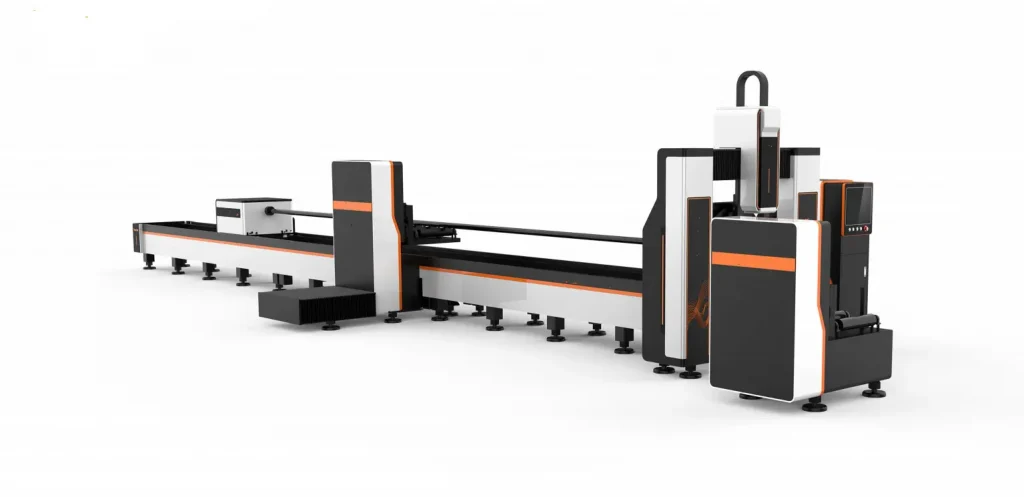
SOP 01Scope and responsibilities
| Role | Responsible for |
|---|---|
| Operator | Daily checks, safe loading and cutting, end-of-shift cleaning, reporting faults |
| Shift supervisor | Authorising operators, checking the log, stopping unsafe work |
| Maintenance technician | Optics, laser source, electrical and chiller work under lockout |
| Laser safety officer (where appointed) | Eyewear, beam-exposure procedures, training records |
SOP 02Terms used in this procedure
- Class 4 laser
- The highest laser hazard class under IEC 60825-1. Direct and scattered beams can injure eyes and skin and ignite materials. All industrial fiber cutting lasers are Class 4.
- Class 1 enclosure
- When the enclosure is closed and interlocked, the machine as a whole can be rated Class 1 in normal operation. Opening it, or service work with covers off, brings back the Class 4 hazard.
- Optical density (OD)
- How strongly laser eyewear attenuates a given wavelength. Eyewear must be marked for the laser wavelength (around 1,070 nm for fiber lasers) with enough OD for the power.
- Nominal hazard zone (NHZ)
- The area in which the beam, direct or reflected, can exceed safe exposure levels. During service with covers open, the NHZ is controlled and only authorised people are allowed in.
- Lockout/tagout (LOTO)
- Isolating and locking energy sources (electric, pneumatic, gas) so a machine cannot start during maintenance.
SOP 03Hazards and controls
Controls are listed in order of effectiveness: engineering controls first, then procedures, then personal protective equipment.
| Hazard | Engineering control | Procedure | PPE |
|---|---|---|---|
| Laser beam and reflections | Closed enclosure, interlocked doors, viewing windows rated for the laser | No interlock bypass; controlled access during service | Laser eyewear when the beam can be exposed |
| Rotating chucks | Guards, light curtains, two-hand or enabling devices | Axes disabled before reaching in | No loose sleeves, gloves away from rotating parts |
| Long tubes on supports | Supports and followers set for tube length | Keep the swing zone clear | Safety shoes |
| Metal fume | Extraction at the cutting zone | Never cut with extraction off | Respirator for cleaning filters |
| Fire | Slag tray, spark-resistant extraction, extinguisher at the machine | Clean tray and filters on schedule | — |
| Oxygen and nitrogen | Secured cylinders, regulators, leak-free lines | Leak checks; ventilation for nitrogen | — |
| Electricity | Closed cabinets, earthing | Qualified staff only, LOTO | — |
| Manual handling | Bundle loader, lifting gear | Rated slings, bundles strapped until racked | Gloves, safety shoes |
SOP 04Start-up
- Walk round the machine. Floor clear, guards closed, light curtains unobstructed, no tools left inside.
- Check gases. Cylinders secured, pressures as required for the job, no hiss at hoses or regulators.
- Start the chiller and wait until the water temperature is in the normal range.
- Switch on the main power and controller, then the laser source.
- Inspect the head. Protective window clean and undamaged; correct nozzle fitted and centred.
- Start extraction.
- Test the emergency stop and reset.
- Home the axes with everyone clear of the machine.
SOP 05Loading tubes
- Lift bundles only with rated slings or the bundle loader; keep straps on until the bundle is on the rack.
- Set supports and followers for the tube size and length before the first tube enters the chuck.
- Check tubes for oil, heavy rust or coatings that change cutting or fume conditions.
- Stand clear of the feeding path while the loader transfers a tube.
- Bent or damaged tubes can strike the head or supports: set them aside.
SOP 06During cutting
SOP 07Material-specific risks
| Material | Risk | What to do |
|---|---|---|
| Galvanised tube | Zinc fume, which can cause metal fume fever | Full extraction flow; never cut with extraction off |
| Stainless steel | Fume containing chromium and nickel compounds | Full extraction; respirator when cleaning filters and dust |
| Aluminium, brass, copper | High reflectivity; back-reflection can damage the laser source | Use the parameters and settings the manufacturer specifies for these metals |
| Painted or oiled tube | Smoke, flare-ups and fire in the extractor | Clean or degrease where possible; clean filters more often |
| Thick-wall carbon steel with oxygen | Heavy slag, hot tubes | Empty the slag tray more often; check inside tubes |
SOP 08Shutdown and housekeeping
- Finish or pause the program and park the head.
- Switch off the laser source, then the chiller, then main power, unless the manual gives another order.
- Close gas supplies at the source.
- Empty the slag tray and check inside cut tubes for hot slag.
- Clean the machine and the floor around it.
- Write faults, alarms and near misses in the machine log.
SOP 09Maintenance and lockout
Before work inside guards, in the cabinet or on the optics: switch off, isolate electrical power, close and vent gas lines, lock and tag each isolation point, and test that the machine cannot start. Each person working on the machine fits their own lock. Remove locks only when everyone is clear and guards are back in place.
| Interval | Task | Who |
|---|---|---|
| Daily | Protective window, nozzle, gas pressures, chiller level, slag tray | Operator |
| Weekly | Chuck jaws and support rollers cleaned; guide rails and lubrication checked; extractor filter inspected | Operator |
| Monthly | Chiller filter and water; cabinet filters; door switches and light curtains tested | Technician |
| As required | Lenses and optics, in a clean area under lockout | Trained technician |
Typical intervals; follow the machine manual where it differs.
SOP 10Emergency response
| Event | Immediate action | Then |
|---|---|---|
| Fire in the machine or extractor | Emergency stop, close gas, CO2 or powder extinguisher | Keep extraction off until the fire is out; inspect filter and ducts |
| Person caught or injured | Emergency stop, isolate power, first aid, call for help | Do not restart until the cause is found |
| Possible eye exposure | Stop the laser | Eye examination the same day, even with no symptoms |
| Gas leak | Close supply, ventilate, no ignition sources | Repair and leak test before restart |
| Chiller alarm | Stop cutting | Do not run the laser without cooling |
SOP 11Training and records
- Operators complete training on this procedure and the machine manual before working alone.
- New operators work under supervision until signed off by the supervisor.
- Keep a record of who is trained, on what, and when; refresh at least yearly and after any incident.
- PCL provides operator and maintenance training at commissioning.
Standards to consult
This procedure is a practical summary. For the formal requirements in your country, refer to:
- IEC 60825-1, safety of laser products: classification.
- ISO 11553-1, safety of machinery: laser processing machines.
- EN 207, eyewear for protection against laser radiation (Europe).
- ANSI Z136.1, safe use of lasers (USA).
- Your national rules on lockout of hazardous energy, fume exposure and fire safety.
FAQ
Is a fiber laser tube cutter a Class 4 laser?
The laser source is Class 4. With the enclosure closed and interlocked, the machine can operate as a Class 1 product; the Class 4 hazard returns when doors are opened or covers removed for service.
What laser safety glasses do I need for a fiber laser?
Eyewear marked for the fiber laser wavelength, around 1,070 nm, with an optical density suitable for the laser power, for example to EN 207 in Europe. Ordinary safety glasses or welding lenses do not protect against it.
Is it safe to cut galvanised or stainless tube?
Yes, with full fume extraction. Galvanised tube releases zinc fume and stainless steel releases fume containing chromium and nickel compounds, so never cut them with extraction off.
Can a fiber laser cut aluminium, brass and copper safely?
Yes, but these metals are highly reflective and back-reflection can damage the laser source. Use the parameters and settings the manufacturer specifies.
What must be done before maintenance on a tube laser?
Lockout/tagout: switch off, isolate electrical power, close and vent gas lines, lock and tag each isolation point and confirm the machine cannot start.