Free-Teaching Robot Welding: Drag Teach, Pendant or Teaching-Free?
PCL Group application engineering, Jinan · Updated 20 October 2026
“Free teaching” gets used for two different things. Sometimes it means drag teaching, where a welder guides the torch by hand and the robot remembers the path. Sometimes it means teaching-free welding, where nobody shows the robot anything and the path comes from a scan or a 3D model. Both exist to solve the same problem: on parts that change from job to job, programming a robot with a teach pendant can take longer than welding by hand.
On this page
Why the teach pendant is the bottleneck
With a pendant, the operator jogs the robot to every point of every seam and records it, then sets angles, speeds and weld parameters. For a car part made 100,000 times, that hour is nothing. For a beam with twenty stiffeners that will be made once, it is often more than the welding time. That is the gap drag teaching and teaching-free systems fill.
Drag teaching
The operator takes hold of the torch or a handle on the arm, the robot goes compliant, and the operator moves the torch along the seam. The robot records the path and the operator adds weld settings. Drag teaching is standard on collaborative robots and available on some industrial arms.
Where it helps
- Welders pick it up quickly
- A seam is recorded in about the time it takes to trace it
- Torch angles come from someone who knows the joint
- Makes small batches worth automating
Where it runs out
- Someone must be at the robot for every new part
- Hand-guided paths need tidying for smooth motion
- Large parts with many seams still take long to teach
- Accuracy depends on the operator’s hand
See also cobot welding machines and drag teaching robots compared with conventional robotic welding.
Teaching-free welding, step by step
- Load and tack the part. The assembly is fitted and tacked as usual and placed in the cell.
- Get the geometry. A laser vision system scans the part, or the seams are read from the CAD or Tekla model.
- Find the seams. Software picks out the joints: fillets, corners, stiffener ends.
- Build the program. Parametric rules for each joint type set torch angle, weld sequence and parameters. Nobody touches the pendant.
- Weld. The robot welds, using seam tracking to follow the actual joint.
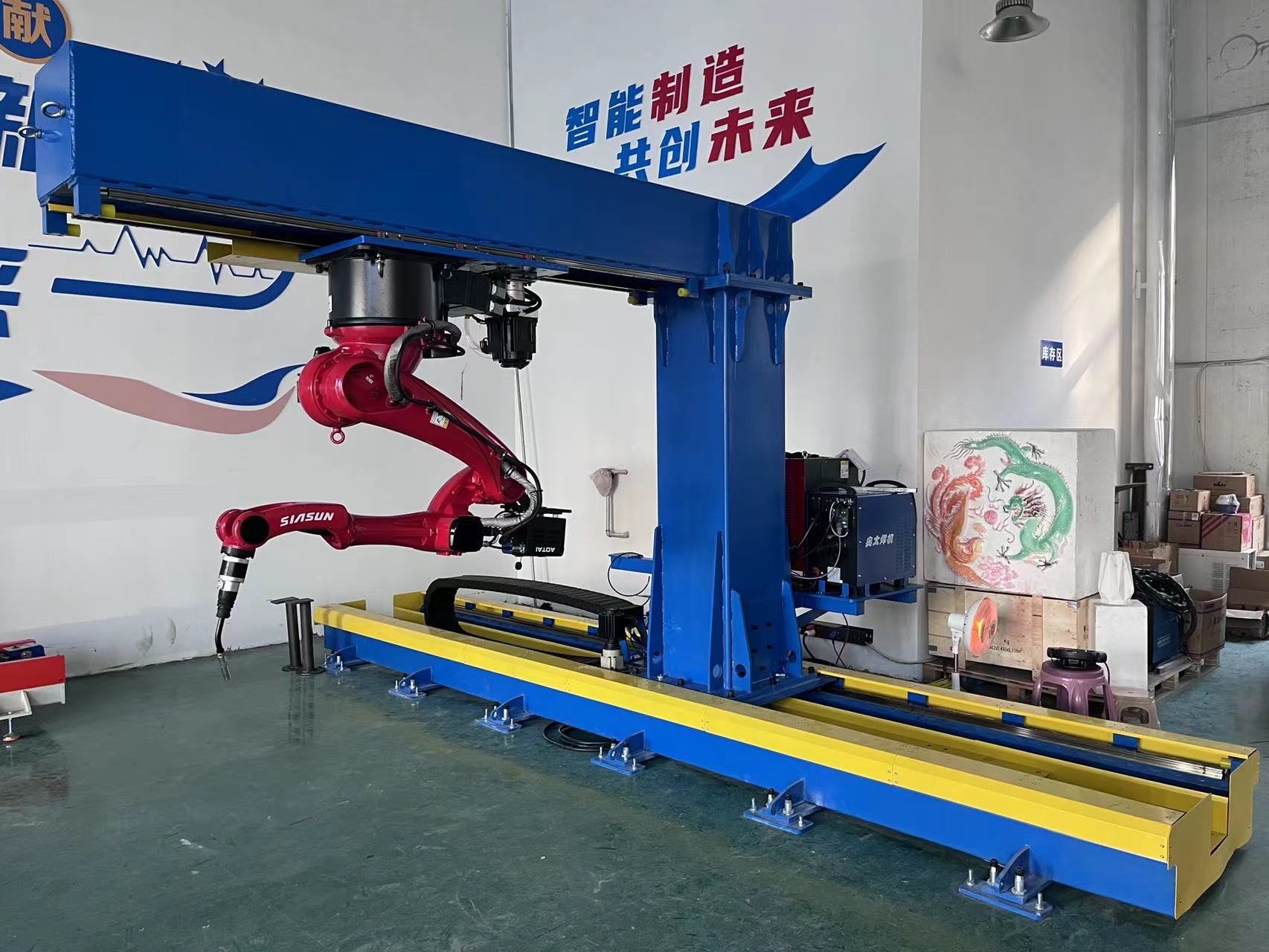
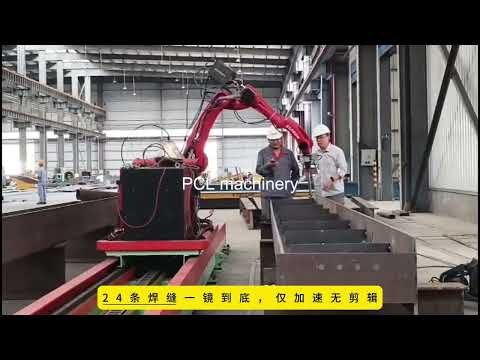
Video: the station scans the part, builds the weld paths and welds without teaching.
While one part is being welded, the next is being fitted. On one-off structural parts such as H-beams, columns, lattice girders and assemblies, this is where the time saving comes from. PCL’s teaching-free robotic welding station is built on a heavy gantry with laser vision for exactly this kind of work.
The three methods side by side
| Teach pendant | Drag teaching | Teaching-free | |
|---|---|---|---|
| Programming done | At the robot, point by point | At the robot, by hand | By software, from scan or model |
| Skill needed | Robot programmer | Welder | Welder plus model or scan set-up |
| Time per new part | Longest | Shorter | Shortest |
| Best for | Large runs of one part | Small batches, small parts | One-off and changing structural parts |
What teaching-free does not fix
These systems are good, but they weld what is in front of them. Most problems we see in practice come from the parts, not the robot:
- Fit-up gaps. Seam tracking follows a joint; it cannot fill a gap that is far wider than the procedure allows.
- Parts that do not match the model. If a stiffener is missing or moved, a model-based path will be wrong. A scan catches this; a model alone does not.
- Tacks in the wrong place. Large tacks where the robot starts or stops a weld cause defects. Agree a tacking rule with the fitters.
- Surface condition. Heavy mill scale, rust or paint can upset both the scan and the arc.
- Tight corners. Some joints are simply out of reach of a torch and are still welded by hand.
Choosing for your shop
If you make the same parts in volume, a pendant or offline programming is still the most efficient. If you make small batches of small parts, a cobot with drag teaching is the lowest-cost way in. If every beam, column or girder is different, a teaching-free station is the method that keeps the robot welding instead of waiting to be programmed. For choosing the arm itself, see 2 m reach welding robots for MAG welding.
Questions
What is a free-teaching welding robot?
The term covers drag teaching, where the welder guides the torch by hand and the robot records the path, and teaching-free welding, where the path is generated from a scan or a 3D model without teaching.
Does teaching-free welding work with Tekla models?
Yes. Seam data can be extracted from CAD or Tekla 3D models, or the part can be scanned with laser vision in the cell.
Do I still need skilled welders?
Yes: to write weld procedures, fit and tack parts correctly, and inspect results. The robot removes repetitive welding and programming time, not welding knowledge.
Is drag teaching accurate enough?
For short seams on small parts, yes, especially with seam tracking during welding. For large parts with many seams, teaching-free is faster.