Can You Cut Pipe With a Plasma Cutter? Amps, Wall Thickness and Methods
By the PCL Group engineering team, Jinan · Updated 2026-10-28
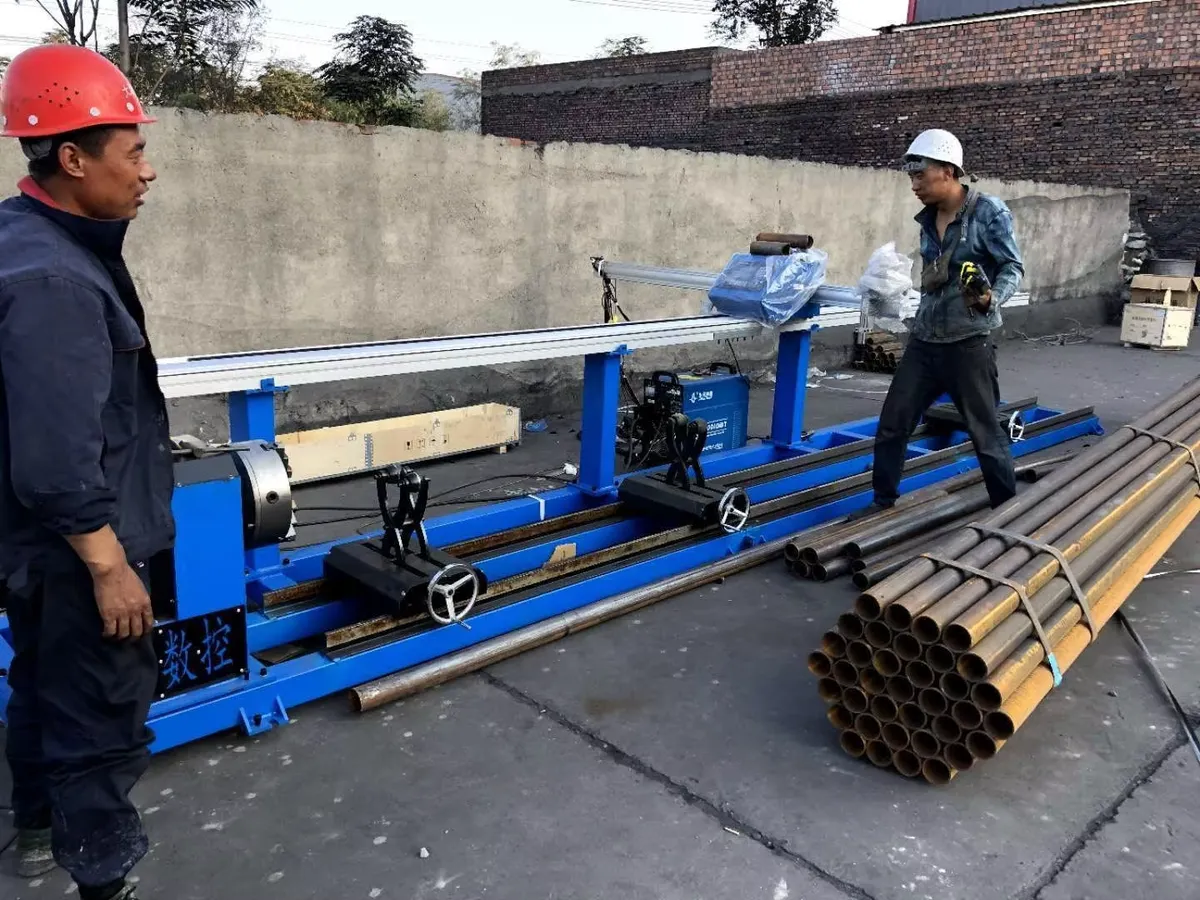
Short answer
- Yes. Any plasma cutter cuts carbon steel, stainless and aluminium pipe; the limit is wall thickness, not the round shape.
- Size the cutter on wall thickness, and remember a hole needs a pierce, which is harder than starting from the pipe end.
- By hand, the hard parts are keeping the torch square to a curved surface and following a line all the way round.
- Straight cut-offs are easy with a guide; saddles, holes and bevels are where a CNC pipe cutter saves the most time.
On this page
- Can a plasma cutter cut pipe?
- What size plasma cutter do I need to cut pipe?
- How to cut pipe straight with a plasma cutter
- How to cut a pipe at 45° (mitre cut)
- How to cut a hole in pipe with a plasma cutter
- How to cut a saddle (fish mouth) with a plasma cutter
- Can you bevel pipe with a plasma cutter?
- Cutting stainless, galvanized and aluminium pipe
- Common problems when plasma cutting pipe
- Hand torch, pipe bug or CNC pipe cutter?
- When does a CNC plasma pipe cutter pay off?
- Machines mentioned in this article
- FAQ
Can a plasma cutter cut pipe?
Yes. A plasma arc does not care whether the steel is flat or round, so a plasma cutter will cut carbon steel pipe, stainless steel pipe, galvanized pipe and aluminium tube. What makes pipe harder than plate is the geometry: the surface curves away from the torch, the cut has to run all the way round, and the arc that breaks through the top wall can carry on and mark the inside of the far wall.
So the real questions are how thick the wall is, what kind of cut you need (a square cut-off, a mitre, a hole, a saddle or a bevel) and how many of them you have to make. The sections below answer each one.
What size plasma cutter do I need to cut pipe?
Choose the cutter by the wall thickness, not the pipe diameter. A 12-inch pipe with a 10 mm wall needs the same machine as a 10 mm plate.
Wall thickness by pipe schedule (ASME B36.10M):
| Pipe size (NPS) | OD (mm) | Sch 40 wall (mm) | Sch 80 wall (mm) |
|---|---|---|---|
| 2" | 60.3 | 3.91 | 5.54 |
| 4" | 114.3 | 6.02 | 8.56 |
| 6" | 168.3 | 7.11 | 10.97 |
| 8" | 219.1 | 8.18 | 12.70 |
| 10" | 273.1 | 9.27 | 15.09 |
| 12" | 323.9 | 10.31 | 17.48 |
| 16" | 406.4 | 12.70 | 21.44 |
| 24" | 609.6 | 17.48 | 30.96 |
Typical air plasma current for a good-quality cut on mild steel:
| Plasma current | Quality cut, mild steel | Covers pipe walls of |
|---|---|---|
| 30-45 A | up to about 12 mm | Sch 40 up to 12", Sch 80 up to 6" |
| 60-65 A | up to about 20 mm | Sch 40 up to 24", Sch 80 up to 12" |
| 85 A | up to about 25 mm | Most Sch 80 pipe up to 16" |
| 105-125 A | up to about 32-38 mm | Heavy-wall and Sch 80 large bore |
Above about 40 mm of carbon steel, oxy-fuel becomes the practical process; it cuts walls of 200 mm and more, but slowly and only on carbon and low-alloy steel.
How to cut pipe straight with a plasma cutter
A square cut-off is the most common pipe cut and the easiest to get wrong by hand, because the line has to meet itself after 360°.
- Mark the line with a pipe wrap. A flexible wrap-around (a strip of gasket material or a purpose-made wrap) laid round the pipe gives a line that closes on itself. Soapstone or a paint marker shows up under the arc.
- Ground on the pipe itself, on clean metal near the cut. On a pipe that turns on rollers, use a rotary ground so the clamp does not wind up the cable.
- Keep the torch radial: pointing at the pipe centre. If it leans along the pipe, the cut end comes out bevelled; if it leans sideways, the kerf wanders.
- Cut in quarters, or turn the pipe. Cutting round a fixed pipe means changing your body position; on pipe rollers you can keep the torch still and rotate the pipe under it, which gives a much straighter line.
- Use a guide for repeat cuts. A torch holder on a chain or magnetic pipe guide, or a motorised carriage on a ring track (often called a pipe bug), holds the torch at a fixed angle and distance all the way round.
How to cut a pipe at 45° (mitre cut)
A mitre line on a pipe is not a straight line once you unroll it: it is a sine curve. On a 6" pipe (168.3 mm OD) a 45° mitre runs 168 mm along the pipe from the short side to the long side. Mark it from a printed template (the unrolled curve, cut out and wrapped round the pipe) or with a mitre template from pipe-layout software, then cut with the torch held radial. Two pieces with 45° cuts make a 90° segmented bend; a smoother 3-piece bend uses 22.5° cuts and a 4-piece bend 15° cuts.
How to cut a hole in pipe with a plasma cutter
A round hole in a pipe wall is not round when seen from above: for a branch at 90° it is longer around the pipe than along it, and the edge has to follow the curve. That is why the circle-cutting attachments used on plate struggle on pipe, especially when the hole is more than about a third of the pipe diameter.
- Pierce in the scrap. Start inside the hole area, away from the line, then run onto the line. The pierce crater stays in the piece that falls out.
- Mind the far wall. Once the arc breaks through, it can gouge the inside of the opposite wall. Keep moving, and on small pipe slip a piece of scrap flat bar inside under the cut.
- Small holes. Plasma holes look good when the diameter is at least about 1.5 times the wall thickness. Smaller bolt holes are better drilled.
How to cut a saddle (fish mouth) with a plasma cutter
A saddle is the shaped end of a branch pipe that sits on a main pipe. Its depth depends on the two diameters: a 4" branch on a 12" main drops only about 10 mm at the sides, while a size-on-size branch drops by half the main pipe diameter. By hand, the usual method is a paper template printed from the two diameters, wrapped round the branch and traced. It works for a few joints; the fit-up depends on how well the template is wrapped and how steady the torch is. The geometry is explained in more detail in our guide to pipe profile cutting and saddle geometry.
Can you bevel pipe with a plasma cutter?
Yes. Tilting the torch to the bevel angle cuts a weld preparation in the same pass, for example the 37.5° bevel used for butt welds in ASME B16.25. By hand, holding a constant angle all the way round is difficult, so most shops either use a pipe bug on a ring track for straight ends, or grind the bevel after a square cut. Bevelled saddles and branch holes, where the angle has to change around the joint, are practical only on a CNC machine with a tilting torch (5 axes or more).
Cutting stainless, galvanized and aluminium pipe
| Pipe | Plasma? | What to watch |
|---|---|---|
| Carbon steel | Yes | The standard case; oxy-fuel is the alternative above about 40 mm |
| Stainless steel | Yes | Fumes contain hexavalent chromium: use fume extraction; oxy-fuel does not cut stainless |
| Galvanized steel | Yes | Zinc oxide fume causes metal fume fever: cut outdoors or with extraction and a respirator |
| Aluminium | Yes | Cuts fast; expect a rougher edge than on steel with air plasma |
Common problems when plasma cutting pipe
| Problem | Likely cause | Fix |
|---|---|---|
| Cut ends do not meet after 360° | Line marked freehand or torch drifting | Pipe wrap for marking; rollers or a guide |
| End comes out bevelled | Torch not radial to the pipe | Point the torch at the pipe centre |
| Heavy dross inside the pipe | Too slow or current too low for the wall | Check the cut chart; clean with a flap disc |
| Marks on the far wall | Arc carrying through the bore | Keep moving; scrap bar inside small pipe |
| Saddle leaves gaps at the sides | Template wrapped loosely or wrong diameter | Measure the real OD; tape the template tight |
Hand torch, pipe bug or CNC pipe cutter?
| Method | Good for | Limits |
|---|---|---|
| Hand plasma torch | One-off cut-offs and repairs | Accuracy depends on the operator; bevels are hard |
| Pipe guide or pipe bug on a track | Repeated straight cut-offs and straight bevels | Cannot follow saddles or holes |
| Cold cutting (split-frame) machine | Machined bevels on pipe ends, no heat | Ends only; slower; no branch cuts |
| Portable CNC plasma pipe cutter | Cut-offs, holes, saddles and mitres from a program, on site | Square edges, no bevel |
| 5-axis CNC pipe cutter | All joints with the weld bevel in one pass | Workshop machine, higher investment |
When does a CNC plasma pipe cutter pay off?
Look at where the hours go. A straight cut-off by hand takes minutes; a saddle or a branch hole by hand means printing and wrapping a template, cutting, then grinding the joint until it fits, and the welder often fills the remaining gaps. A CNC pipe cutter takes the pipe sizes, cuts the joint in one go and produces the same part every time. Shops usually move to CNC when:
- they cut branch holes, saddles or mitres every week rather than now and then;
- fit-up and grinding time is holding back the welders;
- repeat orders need identical parts;
- work has to be done on site and pipe cannot be shipped to a shop.
For site work and square-edged joints on pipe from Ø50 to 600 mm, a portable CNC plasma pipe cutting machine (about 300 kg, 380 V) is the usual first step. A workshop that also cuts plate can look at the 3-axis CNC pipe cutting machine, and one that needs weld bevels on saddles at the CNC pipe cutting and beveling machines.
Have a pipe job in mind? Send the pipe size, wall and joint, and an engineer will tell you which method or machine fits.
Ask on WhatsAppMachines mentioned in this article
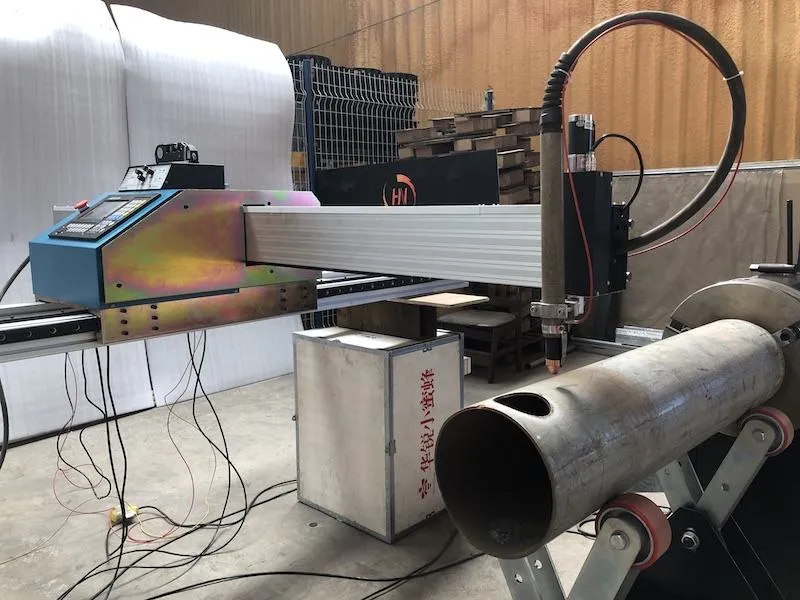
Portable CNC Plasma Pipe Cutter
300 kg, Ø50-600 mm, cuts on site.
Compare all models →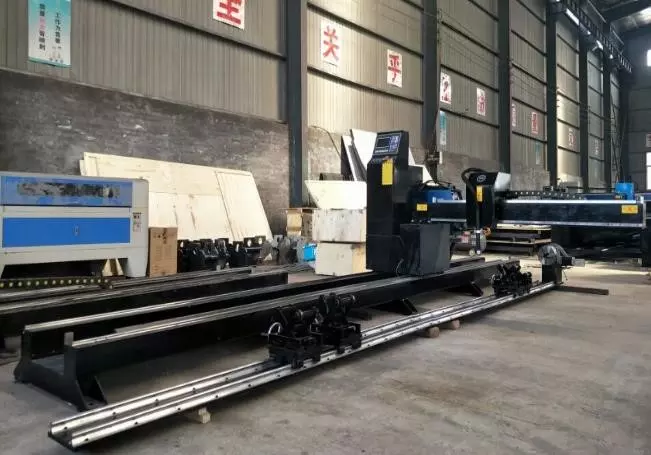
3-Axis CNC Pipe Cutting Machine
Pipe Ø50-600 mm and plate in the workshop.
View machine →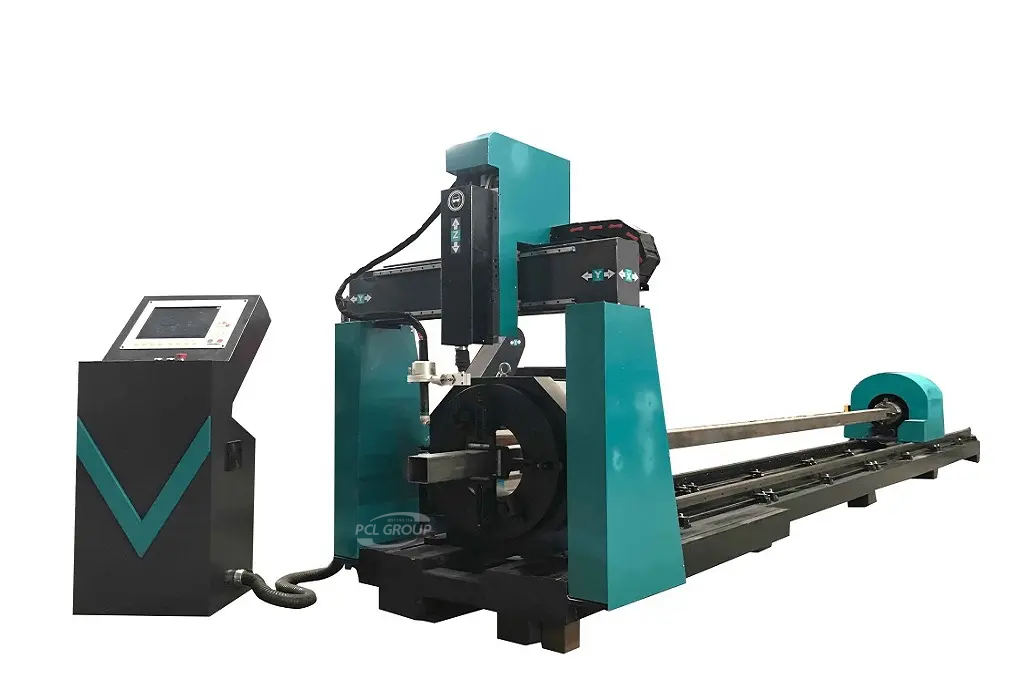
5-Axis CNC Tube Plasma Cutting Machine
Saddles and holes with the weld bevel.
View machine →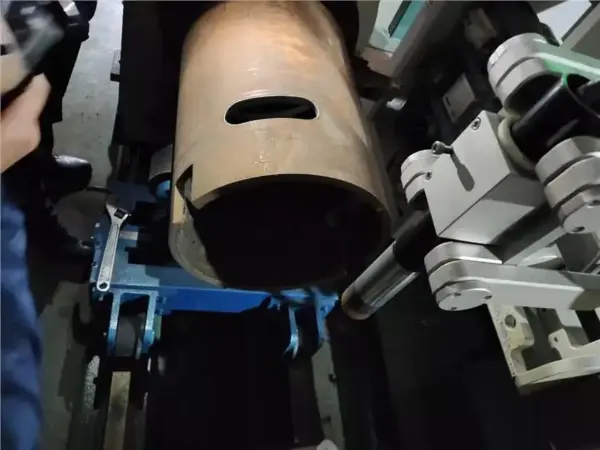
CNC Pipe Cutting and Beveling Machines
All pipe cutting models compared.
View machine →FAQ
Can a plasma cutter cut through pipe?
Yes. A plasma cutter cuts carbon steel, stainless steel, galvanized and aluminium pipe. Size the cutter on the wall thickness; the round shape only changes how you guide the torch.
How many amps do I need to cut Sch 40 pipe?
Sch 40 pipe up to 12 inch has walls of 10.3 mm or less, which a 30-45 A air plasma cutter cuts cleanly. Sch 40 up to 24 inch (17.5 mm wall) needs about 60-65 A.
How many amps do I need to cut Sch 80 pipe?
Sch 80 walls run from 5.5 mm (2 inch) to 17.5 mm (12 inch) and about 31 mm (24 inch). Plan on 60-65 A up to 12 inch and 105 A or more for large-bore Sch 80.
Can a plasma cutter cut stainless steel pipe?
Yes, and it is one of the main reasons to use plasma instead of oxy-fuel, which cannot cut stainless. Use fume extraction, because stainless fume contains hexavalent chromium.
Is it safe to plasma cut galvanized pipe?
Only with good ventilation or extraction and a respirator. The zinc coating burns off as zinc oxide fume, which causes metal fume fever.
How do you keep a plasma cut straight on round pipe?
Mark the line with a pipe wrap, keep the torch pointed at the pipe centre and either rotate the pipe on rollers under a fixed torch or use a pipe guide or pipe bug on a track.
Why does the plasma arc damage the inside of the pipe?
After breaking through the top wall, the arc can reach the far wall. Keep the torch moving and put a scrap bar inside small-diameter pipe under the cut.
Can you cut a pipe saddle with a plasma cutter?
Yes, by tracing a paper template printed from the two pipe diameters, or automatically on a CNC pipe cutter, which calculates the saddle from the sizes.
Can you cut a bevel on pipe with a plasma cutter?
Yes, by tilting the torch, usually to 37.5 degrees for butt welds. For constant bevels use a pipe bug; for bevelled saddles and branch holes use a 5-axis CNC machine.
Plasma or oxy-fuel for cutting pipe?
Plasma is faster on walls up to about 40 mm and cuts stainless and aluminium. Oxy-fuel is better for very thick carbon steel walls, up to 200 mm and beyond.