CNC Plasma Cutting I-Beams: When Plasma Is the Right Choice
By Casper Geng, Sales Manager, PCL Group · Updated 2026-10-28
Short answer
- CNC plasma is the economical process for cutting I-beams to length, coping them and cutting larger holes in thick flanges.
- Size the plasma source on the thickest flange: an IPE 600 has a 19 mm flange, a HEB 300 also 19 mm.
- Tapered flanges (IPN, American S-shapes) need a machine that measures the section before it cuts.
- Choose laser when most parts carry small bolt holes, slotted holes or weld-ready bevels.
On this page
I-beam types and why they cut differently
“I-beam” covers several families of rolled section. For CNC cutting the difference that matters is whether the inner face of the flange is parallel to the outer face or sloped.
| Section | Standard | Flange | Cutting note |
|---|---|---|---|
| IPE | EN 10365 (Europe) | Parallel | Cuts like a narrow H-beam |
| IPN | EN 10365 (Europe) | Tapered, 14% slope | Flange thickness changes across the width |
| W-shape | ASTM A6 (USA) | Parallel | Wide range of depths and weights per depth |
| S-shape | ASTM A6 (USA) | Tapered, 16.67% slope | As IPN: the inner flange face is sloped |
| UB | BS 4-1 (UK) | Parallel | Cuts like IPE and W-shapes |
On a tapered flange the torch sees a different thickness at the toe than at the root, and a hole drilled square to the outer face meets a sloped inner face. A CNC beam cutter that probes the section and follows the real surface keeps hole size and cope edges consistent. Full dimensions are in the steel beam size chart.
Typical I-beam dimensions
| Section | Height × width (mm) | Web (mm) | Flange (mm) |
|---|---|---|---|
| IPE 200 | 200 × 100 | 5.6 | 8.5 |
| IPE 300 | 300 × 150 | 7.1 | 10.7 |
| IPE 400 | 400 × 180 | 8.6 | 13.5 |
| IPE 600 | 600 × 220 | 12.0 | 19.0 |
| IPN 300 (tapered) | 300 × 125 | 10.8 | 16.2 (mean) |
| HEB 300 (for comparison) | 300 × 300 | 11.0 | 19.0 |
The flange is almost always thicker than the web, so the flange sets the plasma current, the cutting speed and the smallest hole you can cut cleanly.
Plasma current by flange thickness
| Flange thickness | Typical plasma current | Example sections |
|---|---|---|
| up to 12 mm | 80-130 A | IPE 100-330 |
| 12-25 mm | 130-200 A | IPE 400-600, HEB 220-300, many W12-W24 shapes |
| 25-40 mm | 260-400 A | Heavy HEM and jumbo W-shapes |
| over 40 mm | Oxy-fuel | Heavy columns and girders |
These are typical ranges for high-definition plasma on carbon steel; the cut chart of the source you choose sets the exact figure. Remember the pierce: starting a hole inside the flange is harder than cutting in from the edge, so check the pierce rating of the source as well as its cut rating.
Bolt holes: what plasma can and cannot do
Plasma holes are slightly tapered and have a small lead-in mark. Whether that is acceptable depends on the hole size relative to the flange and on the project specification.
- Diameter rule of thumb: plasma holes are reliably round when the diameter is at least about 1.5 times the plate thickness. A 22 mm hole in a 13.5 mm IPE 400 flange is fine; a 14 mm hole in the same flange is better drilled or laser cut.
- Clearance holes (EN 1090-2): normal round holes are the bolt diameter plus 1 mm for M12 and M14, plus 2 mm for M16 to M24, and plus 3 mm for M27 and larger. So an M20 bolt goes in a 22 mm hole.
- Clearance holes (AISC): a standard hole is the bolt diameter plus 1/16 in, so a 3/4 in bolt goes in a 13/16 in hole.
- Process permission: the execution class and project specification say which hole-making processes are allowed. Check before replacing drilling with thermal cutting on fatigue-loaded or high-class work.
Copes, notches and bevels on I-beams
| Operation | On plasma | What to watch |
|---|---|---|
| Cut to length | Square or mitred | Kerf of about 2-4 mm on thick flanges; allow for it in nesting |
| Top and bottom copes | Cut from the program | Give re-entrant corners a radius, not a sharp notch |
| Weld access holes | Yes | Size to AISC 360 J1.6 or the project detail |
| Flange bevels | Yes, with a tilting torch | Expect light grinding before welding on thick flanges |
| Part marking | Plasma marking | Shallower and less crisp than laser marking |
Plasma, laser or drill line for I-beams
| CNC plasma | Fiber laser | Saw and drill line | |
|---|---|---|---|
| Machine cost | Lower | Higher | Medium |
| Thick flanges | Good, to about 40 mm | Good to the laser power limit | Good |
| Small bolt holes | Limited by the 1.5× rule | Good | Best (drilled) |
| Copes and slots | Yes | Yes, finest edge | Needs a separate coping station |
| Weld bevels | Yes, light grinding | Ready to weld | No |
A longer comparison including throughput is in laser, plasma and saw-drill lines compared.
PCL machines for cutting I-beams
| If you cut… | Machine |
|---|---|
| Mainly H and I-beams and channels, high throughput | H-Series robotic beam coping machine (plasma and oxy-fuel, web 100-800 mm) |
| I-beams plus box sections and round pipe | 8-axis robotic plasma beam cutter |
| I-beams with many small holes and weld-ready bevels | H-beam laser cutting machine |
| Every option compared | Beam cutting machines |
Have a cutting job in mind? Send the section size, wall thickness and a drawing, and an engineer will tell you which method or machine fits.
Ask on WhatsAppMachines mentioned in this article
H-Series Robotic Beam Coping Machine
Plasma and oxy-fuel for H, I, U and L.
Compare all models →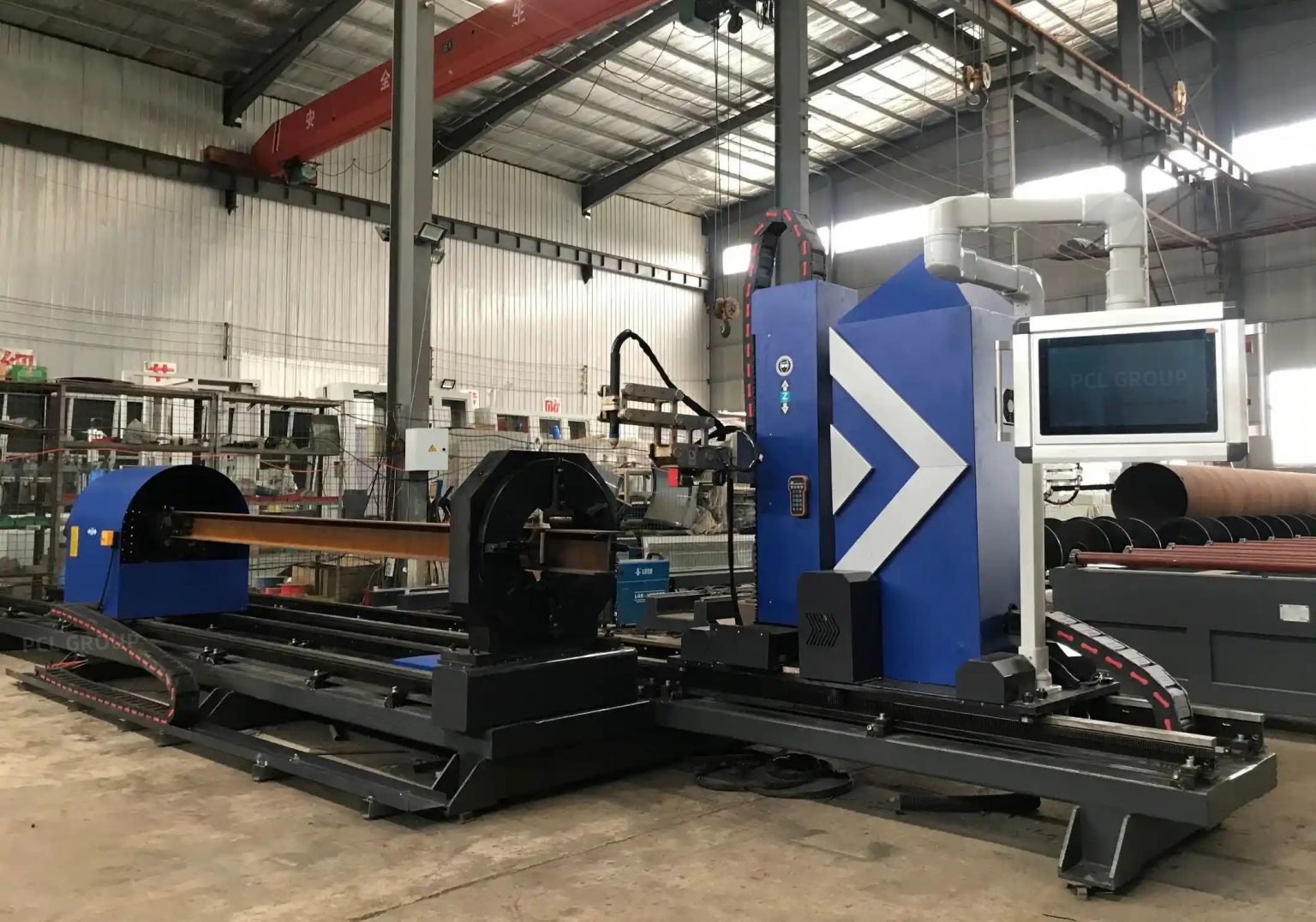
8-Axis Robotic Plasma Beam Cutter
Beams, box sections and pipe.
View machine →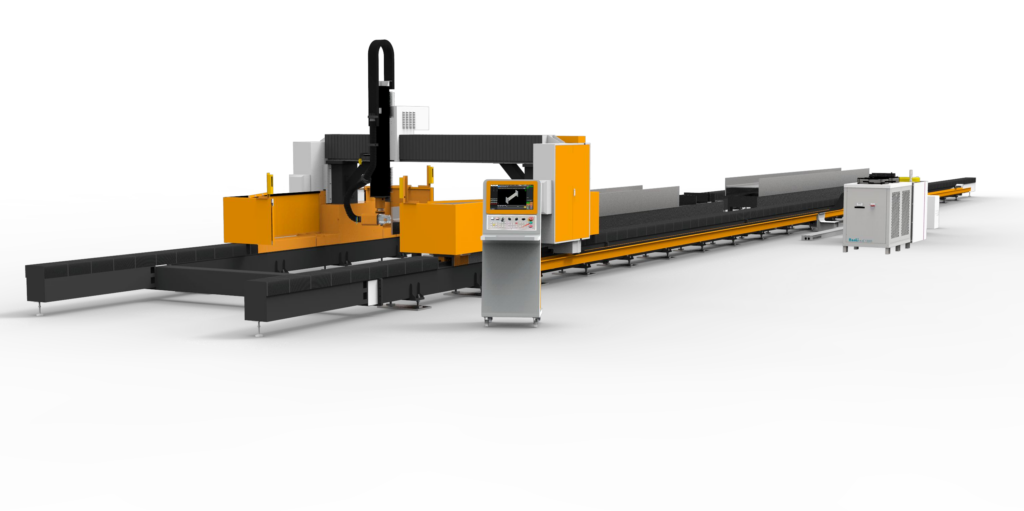
H-Beam Laser Cutting Machine
Fine holes and ready-to-weld bevels.
View machine →All Beam Cutting Machines
Laser, plasma and production lines.
View machine →FAQ
Is CNC plasma good for cutting I-beams?
Yes, for cutting to length, copes and larger holes, especially on thick flanges where plasma costs far less than a laser of the same capacity. For many small bolt holes or ready-to-weld bevels, laser is better.
What plasma current do I need to cut an IPE 400?
Its flange is 13.5 mm, so a source of about 130-200 A gives a clean production cut. Check the pierce rating if you cut holes inside the flange.
Can plasma cut bolt holes in I-beam flanges?
Yes when the hole is at least about 1.5 times the flange thickness and the project allows thermally cut holes. An M20 bolt hole (22 mm) in a 13.5 mm flange is a typical good case.
What size hole does an M20 bolt need?
Under EN 1090-2 a normal round hole for an M20 bolt is 22 mm. Under AISC, a standard hole is the bolt diameter plus 1/16 in.
Do tapered flanges cause problems?
They can. IPN and American S-shapes have a 14% and 16.67% flange slope. A machine that measures the section keeps holes and copes accurate across the slope.
What is the difference between IPE and IPN?
IPE has parallel flanges; IPN has tapered flanges with a 14% slope on the inner face. IPE is the common choice for new European construction.
How wide is a plasma kerf on a beam flange?
Typically about 2-4 mm on thick flanges, depending on current and nozzle. Nesting software allows for it automatically.
Can the same machine cut channels and angles?
Yes. CNC plasma beam cutters take channels and angles as well as I and H-beams; some also cut box sections and pipe.
When should I choose a laser instead of plasma?
When most parts need small bolt holes, slotted holes or bevels that must fit without grinding, or when edge quality on visible steel matters.
Can I send a drawing for a test cut?
Yes. Send a DSTV file or drawing of a typical I-beam and we cut it at our factory in Jinan and send the video.