HFT Pipe and Beam Laser Cutting Machine: Plate, Tube and Sections in One
The PCL HFT is a fiber laser cutting machine that cuts plate, pipe and structural sections on one machine. Round, square and rectangular tube, H-beams, channels and angles are cut with copes, holes, slots and weld bevels; flat plate is cut on the same machine. For shops that would otherwise buy a plate laser, a tube laser and a beam line, it puts all three jobs in one footprint.
What the HFT cuts
| Material | Typical parts |
|---|---|
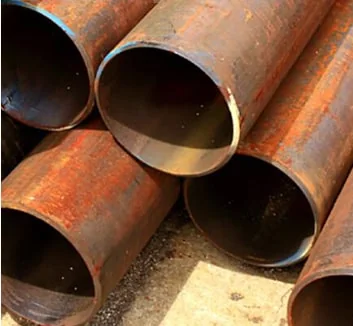
| Round pipe | Intersections (saddle cuts) for pipe-to-pipe joints, holes, slots, bevelled ends |
| Square and rectangular tube | Mitres, notches, holes and slots on all faces |
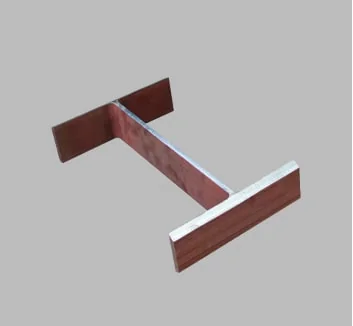
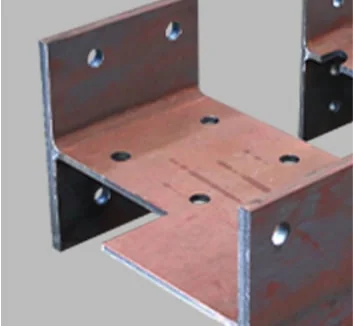
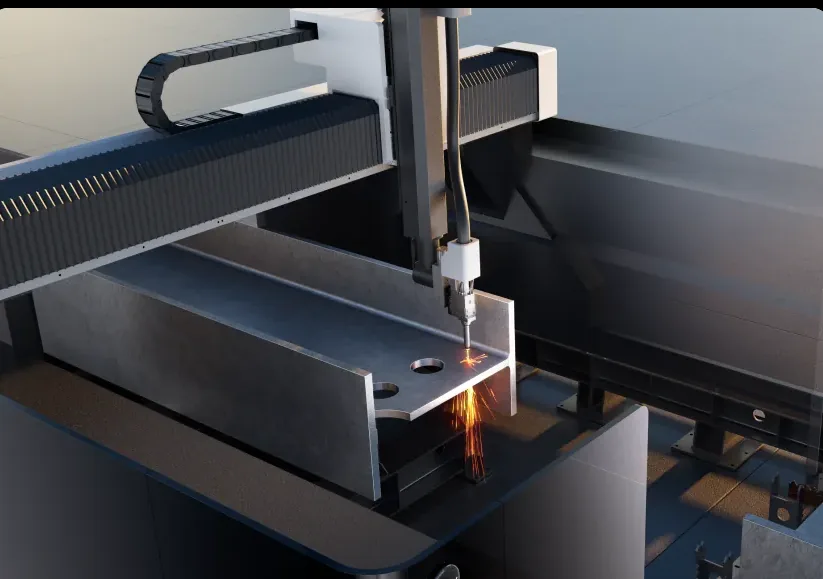
| H-beams and I-beams | Cut-to-length, copes, weld access holes, bolt holes, bevels |
| Channels and angles | Holes in flanges and legs, notches, clipped corners |
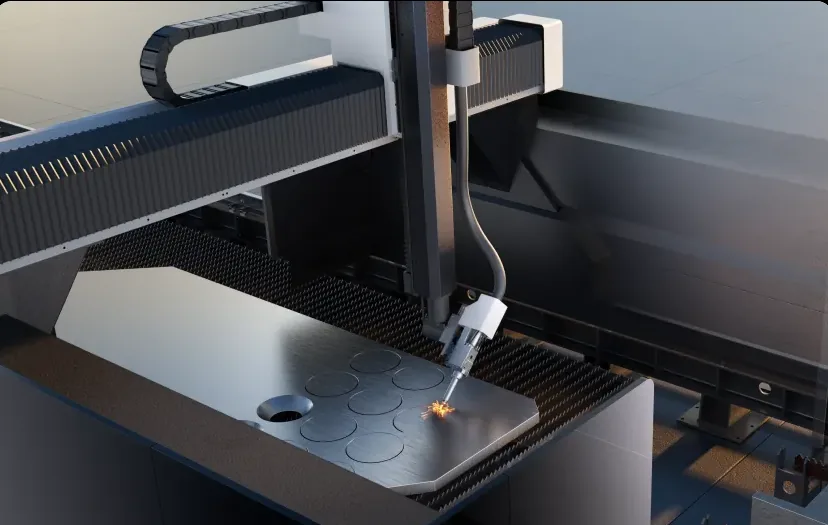
| Flat plate | Base plates, gussets, connection plates, stiffeners |
Cut samples
Specifications
| Item | HFT |
|---|---|
| H-beam range | 200 × 200 to 1,000 × 400 mm |
| Plate range | 3,000 × 27,000 mm |
| Bevel cutting area | 2,500 × 26,000 mm |
| Axis travel | X 3,100 mm · Y 27,200 mm · Z 1,100 mm |
| Acceleration | X 0.5 G · Y 0.5 G · combined 0.7 G |
| Positioning accuracy | ±0.05 mm/m |
| Repeatability | ±0.03 mm/m |
| Overall size | 29,500 × 5,150 × 3,600 mm |
| Laser power and source | Chosen for your thickness; Maxphotonics as standard, Raycus or IPG on request |
Laser power, tube capacity and options are configured to your work. Send your largest plate, beam and tube and we confirm the configuration and price.
Why one machine for plate, pipe and sections
- One investment instead of three. A plate laser, a tube laser and a beam line each need floor space, an operator and maintenance.
- Parts for one assembly come off one machine. The plates, tubes and sections of a frame or truss are cut from the same program set, so they arrive at fit-up together.
- Laser accuracy on every part. Bolt holes, slots and bevels on tube and sections fit without grinding, the same as on plate.
- Short runs pay. Changing between plate, tube and beam jobs is a program change, not a move to another machine.
Machine layout
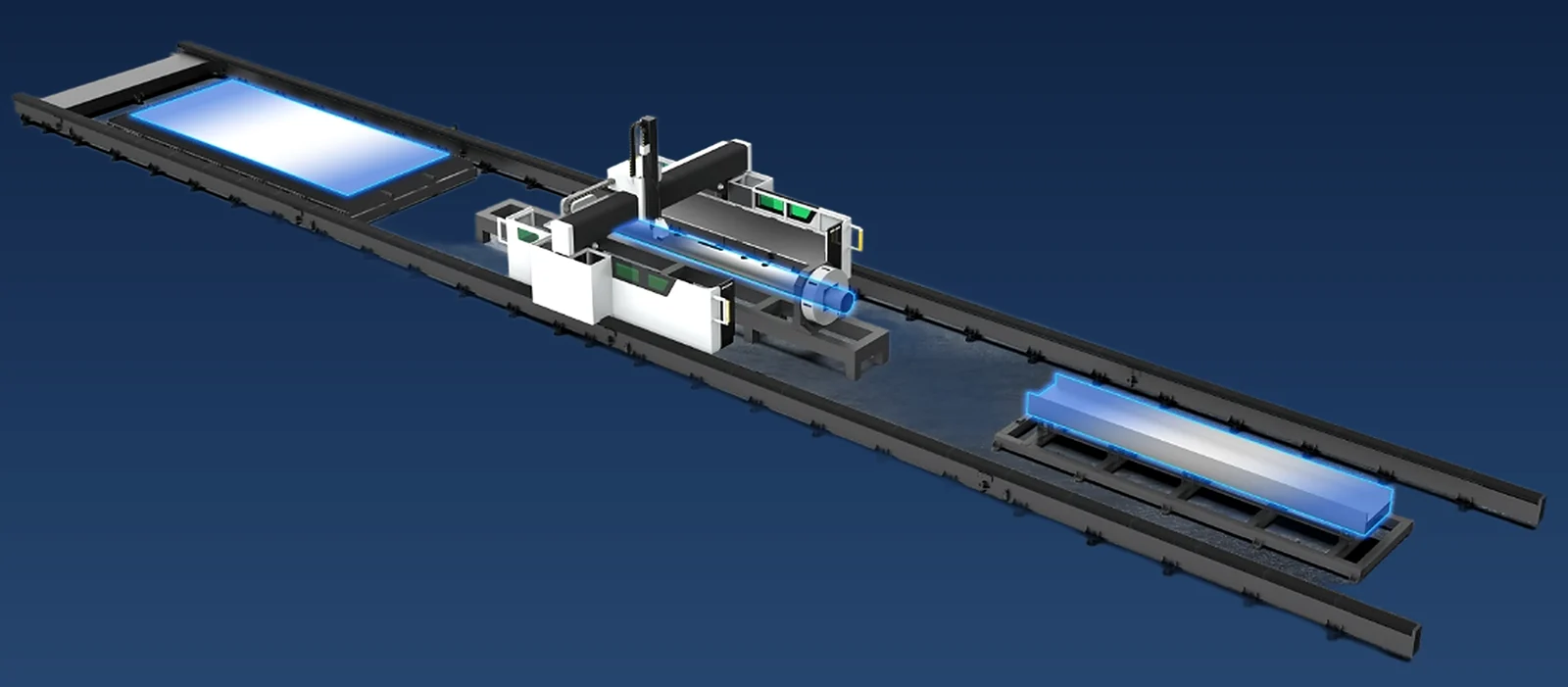
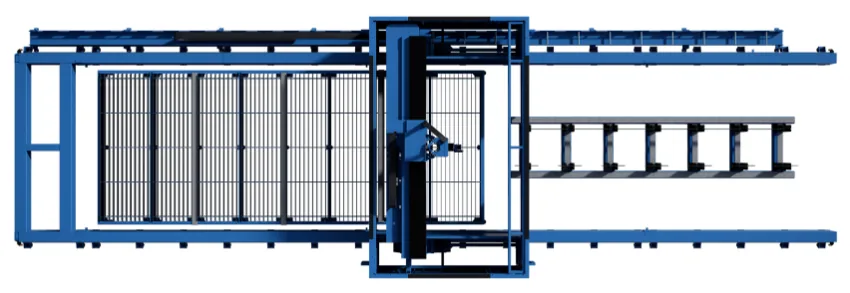
Seen from above, the HFT is one long bed with two zones under a single gantry: a slatted plate table at one end and roller supports for H-beams and tube at the other. While one zone is cutting, the other can be loaded.
In production
| What it means on the shop floor | |
|---|---|
| All section operations in one setup | Bevels, copes, cut-to-length, bolt holes, weld access holes and marking lines, with no transfer between stations |
| Output | Typically 80–100 t of sections in an 8-hour shift, about 4–5 times a saw, drill and manual coping route (depends on the parts) |
| Staffing | One or two people load, unload and run the machine |
| Accuracy | Cutting accuracy within 0.1 mm; laser line scanning measures each beam and corrects the program, holding hole positions within 1–2 mm on real rolled sections |
| True 5-axis head | The beam always points into the material, keeping stray laser light away from the operator area |
| Production management | Work orders, production and job reports, and connection to MES |
| Reliability | Simple to operate, with a low failure rate once in routine use |
Bevels and joints
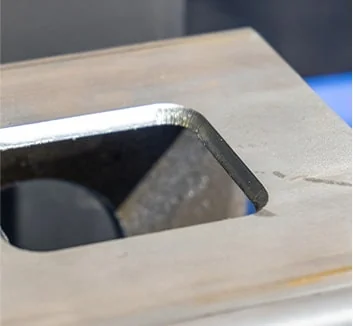
Weld preparation is cut by the laser: bevelled pipe ends, bevels on beam flanges and plate edges, and the saddle shape where one pipe meets another. Joints for truss and frame work, such as notched tube ends that slot over a chord, come off the machine ready to weld. See bevel types and angles.
From drawing to parts
Sections and tubes are imported from the detailing model as DSTV files from Tekla Structures or Advance Steel; plate parts come in as DXF. Parts are nested on bars and sheets, and part numbers can be marked by the laser. See cutting from Tekla DSTV files.
Where it is used
Steel structures and prefabricated buildings, trusses and space frames, pipe racks and petrochemical steelwork, construction machinery, agricultural and mining equipment, and marine work: anywhere plate, tube and sections end up in the same welded assembly.
HFT or a dedicated machine?
| Your work | Better fit |
|---|---|
| Plate, tube and sections in similar amounts | HFT |
| Mostly heavy H-beams up to 1,000 mm high | H-beam laser |
| Mostly thin-wall tube in high volume | Tube laser |
| Mostly large plates up to 12 m | Gantry laser |
FAQ
What sizes does the HFT cut?
H-beams from 200 x 200 to 1,000 x 400 mm and plate up to 3,000 x 27,000 mm, with bevel cutting over 2,500 x 26,000 mm. Tube capacity is configured to order.
Can one laser machine cut plate, pipe and H-beams?
Yes. The HFT cuts flat plate, round, square and rectangular tube, and H-beams, channels and angles on one machine, including holes, copes and weld bevels.
Is an all-in-one machine slower than dedicated machines?
For a shop that cuts mainly one product, a dedicated machine is faster. For mixed work, one machine avoids moving jobs between three machines and keeps all parts of an assembly together.
Can the HFT read Tekla files?
Yes. Tubes and sections are imported as DSTV files from Tekla Structures or Advance Steel, and plate parts as DXF.