AGV Mobile Welding Robot
Tracked, lifting wheeled and cable-powered chassis
A 6-axis welding robot, a 500 A power source and seam-finding sensors on a self-propelled chassis. The operator drives it to the part and it welds in place: ship blocks, box girders, wind towers, excavator booms and pressure vessels that are too big or too heavy for a fixed welding cell.
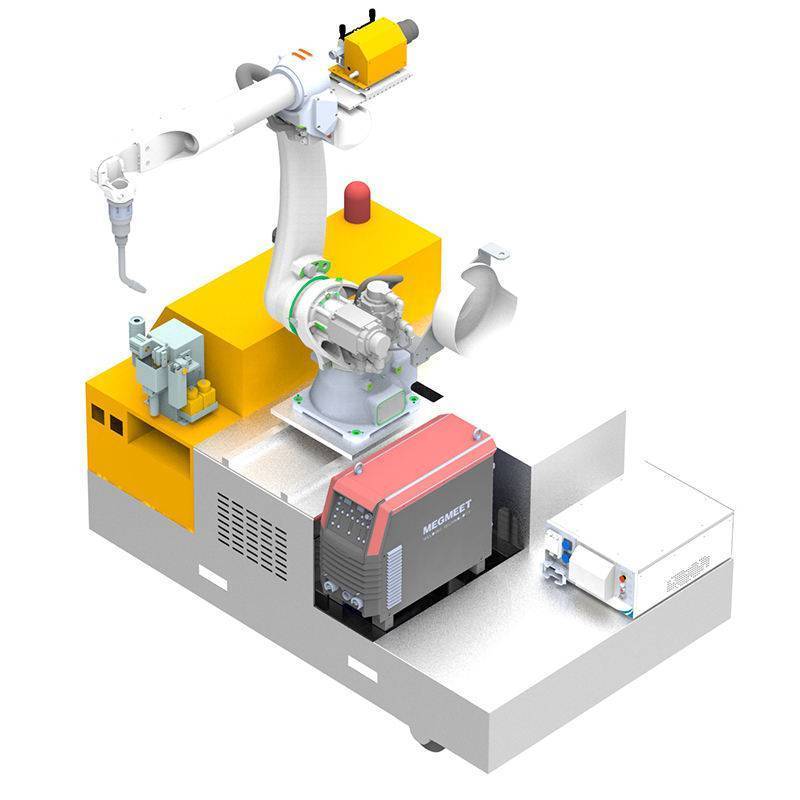
- Reach
- 4 m H / up to 4 m V
- Robot repeatability
- ±0.03 mm
- Welding
- 500 A MIG/MAG
- Battery range
- 20-50 km
- Delivery
- 20-45 days
What is a mobile welding robot?
A mobile welding robot, also called an AGV welding robot, crawler welding robot or on-site welding robot, reverses the usual set-up. In a fixed cell the crane brings every part to the robot, and the cell size limits the part size. Here the robot comes to the part. Large structures are tacked where they stand and the robot drives from seam to seam, so there is no crane time, no large positioner and no limit on part length.
One robot, many parts: it drives to each structure and welds it where it stands.
Is a mobile welding robot right for your parts?
Good fit
- Parts longer than about 3 m or heavier than about 1 t
- More than about 15 minutes of welding per part
- Parts that are slow or costly to crane and turn
- High-mix, low-volume work with changing seams
- Level floor and aisles wider than 1.5-2 m
Better in a fixed cell
- Short-cycle, high-volume small parts (for example automotive pressings)
- Thin sheet, where laser welding is usually better
- Uneven or cluttered floors
- Work that needs continuous travel longer than the battery range (use the cable version)
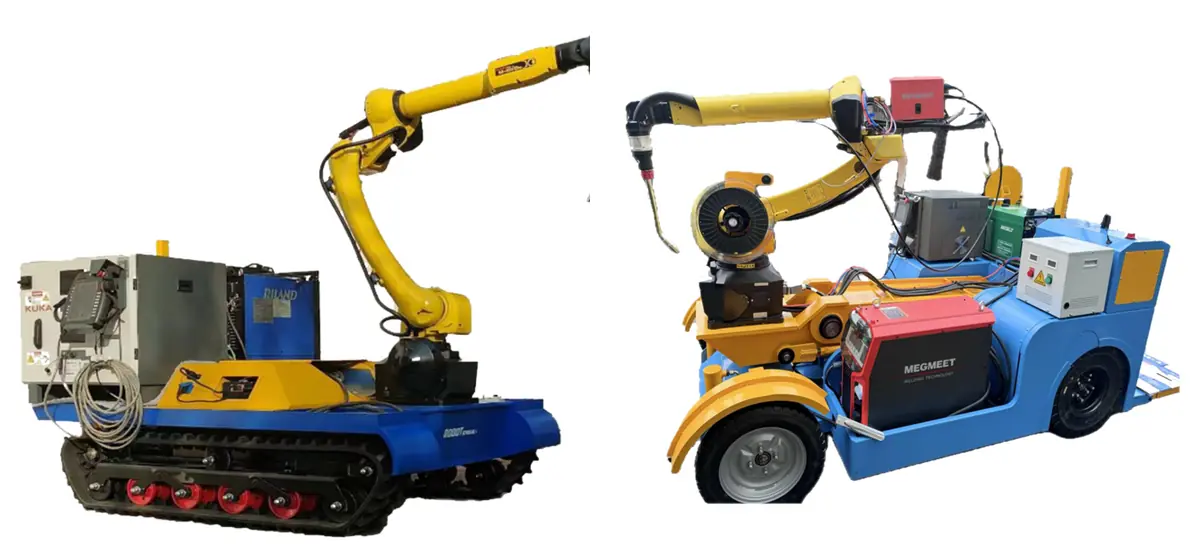
Three chassis: tracked, lifting wheeled and cable-powered
Tracked
1,940 x 1,460 mm footprint, 1,100 kg, 1,200 mm turning radius. Battery powered, 4 m horizontal and 2.7 m vertical reach. For crowded shops and work between parts.
Lifting wheeled
A lifting mast raises the robot so it reaches seams up to 4 m high. Battery powered, 4 m horizontal reach. For wind towers, ship blocks and tall frames.
Steering-wheel, cable-powered
Runs on a 3 x 380 V cable, so welding time is never limited by a battery. 3D point-cloud seam finding (0.1 mm). For long shifts in one bay.
AGV welding robot specifications
| Item | Tracked | Lifting wheeled | Steering-wheel (cable) |
|---|---|---|---|
| Robot arm | FANUC M-10iD/8L | FANUC M-10iD/8L | CRP2010A |
| Welding power source | Megmeet EHAVE2 CM500R | Megmeet EHAVE2 CM500R | Aotai NBC500RP Plus |
| Welding current | 500 A, 12-45 V | 500 A, 12-45 V | 500 A class |
| Reach, horizontal / vertical | 4 m / 2.7 m | 4 m / 4 m | set by the part layout |
| Power supply | Battery 72 V 180 Ah x 6, 30 kW | Battery 48 V 120 Ah x 6, 26.8 kW | Cable 3 x 380 V 50 Hz, 50 kVA |
| Range | 20-50 km per charge | 20-50 km per charge | unlimited on cable |
| Dimensions (L x W x H) | 1,940 x 1,460 x 1,300 mm | 2,600 x 1,400 x 2,100 mm | 3,000 x 1,500 x 2,400 mm |
| Weight | 1,100 kg | 1,700 kg | 2,500 kg |
| Running gear | Tracks 1,750 x 1,390 x 400 mm, 230 mm wide | Tyres Ø530 mm, 130 mm wide, 1,600 mm wheelbase | Steering-wheel drive |
| Min. turning radius | 1,200 mm | 3,000 mm | – |
| Travel speed | 15 km/h rated | 15 km/h rated | 2.2 km/h |
| Control | Remote control | Remote control | Remote control |
| Welding torch | TRM-602W water-cooled | TRM-602W water-cooled | to suit the process |
| Seam finding | Arc tracking or laser tracking | Arc tracking or laser tracking | 3D point cloud, 0.1 mm |
Common to all: carbon steel and stainless steel; flat, horizontal fillet, vertical and low-current overhead welding; shielding gas 80% Ar / 20% CO2, 100% CO2 or 100% Ar; CE and ISO 9001. The FANUC M-10iD/8L arm has 6 axes, 8 kg payload, 2,032 mm reach and ±0.03 mm repeatability, with the welding cable routed through the arm so it does not catch on the part.
How the mobile welding robot works
- Drive: the operator drives the robot beside the tacked part by remote control.
- Program: a new seam is taught on site; similar seams reuse a stored program with a few points adjusted. Offline programming with FANUC ROBOGUIDE is optional.
- Find the seam: touch sensing, laser positioning or 3D vision measures the real seam and corrects for where the robot is parked.
- Weld: arc tracking follows the joint; thick plate is filled with multi-pass welding. The robot then drives to the next seam or the next part.
What it welds
- Ship blocks, hull sections and double-bottom panels
- Bridge box girders, building beams and columns
- Wind towers and pressure vessels
- Excavator booms and construction machinery frames
- Rail car bodies, shipping and energy-storage containers
- Oil and gas manifolds and skids
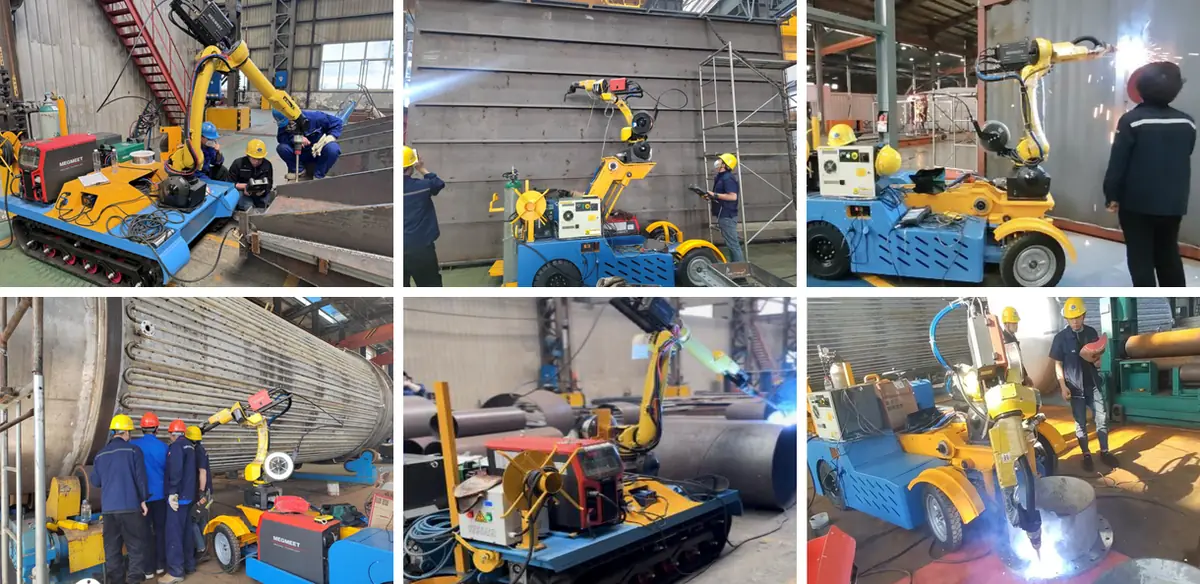
Several robots can work on one large structure at the same time, and one robot can serve several stations while the next parts are being fitted. The same chassis can also carry a cutting or grinding tool.
Welding process and weld quality
On long structural seams, weld quality depends on holding torch angle, stick-out and travel speed constant from the first metre to the last. In automated welding these stay fixed along a 12 m seam, so penetration, bead shape and heat input stay even.
Seam finding and seam tracking
A mobile robot is never parked in exactly the same place twice, so every seam is measured before welding. Touch sensing (the wire touches the plate), laser positioning or 3D vision finds the real start, end and direction of the seam and shifts the program to it. During welding, arc tracking (through-the-arc seam tracking) follows the joint as the plate heats and moves. The cable-powered version can also scan the part as a 3D point cloud and plan paths from it.
Penetration and fusion
Penetration depends on current, voltage, travel speed, torch angle and stick-out. The robot holds all five constant and the seam camera keeps the torch on the root, so lack of fusion at the root or toe is far less likely than with manual welding on long seams. Pulse MAG with mixed gas gives good side-wall fusion with little spatter; DC spray transfer gives the deepest penetration on thick fillet and groove welds.
Multi-layer, multi-pass welding
For large fillet welds and groove (bevel) welds, the software lays out the passes from the joint size: root pass, fill passes and cap pass, each with its own offset, weave and parameters. Arc tracking shifts each pass to the real joint. Complete joint penetration (CJP) and partial joint penetration (PJP) groove welds follow the groove preparation and backing in your procedure.
Wire and shielding gas
- Solid wire 1.0-1.6 mm, 1.2 mm most common (ER70S-6 / G3Si1 for carbon steel)
- Flux-cored wire 1.2-1.4 mm for higher deposition and positional welds
- Mixed gas 80% Ar / 20% CO2 (M21) for pulse and spray transfer with low spatter
- 100% CO2 for lower gas cost where spatter is acceptable
- Stainless steel with matching wire and Ar-rich gas
Heat input and distortion
Heat input (kJ/mm) = voltage x current x 60 / (travel speed in mm/min x 1000). Because the robot never changes speed or pauses mid-seam, heat input stays inside the procedure limits, and a fixed welding sequence repeats the same shrinkage on every beam. Preheat and interpass temperature still follow your WPS.
Standards and procedures
The robot welds to your welding procedure specification (WPS). Procedures can be qualified (PQR) to AWS D1.1, ISO 15614-1 and ship classification rules, and the station fits shops working under EN 1090 and ISO 3834. Every parameter set is stored in the database, so a qualified procedure is repeated exactly.
Typical MAG fillet weld parameters
Starting values for horizontal fillet welds, 1.2 mm solid wire, 80% Ar / 20% CO2. Final values come from your procedure qualification.
| Leg size | Passes | Current | Voltage | Travel speed |
|---|---|---|---|---|
| 6 mm | 1 | 260-300 A | 28-31 V | 40-55 cm/min |
| 8 mm | 1 with weave, or 2 | 280-320 A | 29-32 V | 30-45 cm/min |
| 10 mm | 3 | 280-320 A | 29-32 V | 35-50 cm/min per pass |
| 12 mm | 4-6 | 280-320 A | 29-32 V | 35-50 cm/min per pass |
Mobile welding robot, welding carriage or fixed cell?
| Option | Best for | Limits |
|---|---|---|
| AGV mobile welding robot (this page) | Large, heavy, high-mix structures welded in place | Needs a level floor and aisles; battery range on battery versions |
| Magnetic welding carriage | Long straight fillet welds at low cost | One straight seam at a time; no corners, no seam finding |
| Cantilever welding robot workstation | Long parts up to 3.5 m wide brought to the station by crane; teaching-free | Fixed track length |
| Gantry welding robot | Wide parts such as box girders and panels, one or two robots | Fixed area, foundation needed |
| Robotic welding station with positioner | Repeat batches of medium parts that need turning | Part size and weight set by the positioner |
| Cobot welding machine | Small parts, short runs, hand-guided teaching | Small parts only |
Send a STEP model: what our engineering evaluation covers
For a new product, the assembly sequence decides how much of the welding a robot can do. Send the STEP model and your planned assembly and welding sequence. We run a robotic welding simulation of reachability and collisions, and where a different sequence raises the automation level, we propose it.
What the evaluation reports
- Robot accessibility and reachability for every seam
- Number and percentage of welds the robot can make, and the welds left for manual welding
- Welds made while the structure is still open, separated from the closing welds made after the deck or cover plate is fitted
- Dual-robot allocation, where two robots pay off
- Collision avoidance along every path
- Welding positions and workpiece handling, turning or repositioning
- Heat input, welding sequence and distortion control
- Fixtures and workpiece positioning needed
- Estimated cycle time and overall production efficiency
How we raise the robotic share
- Keep the structure open longer: weld bottom plates, internal frames, bulkheads and walls before the deck goes on, so most internal seams are reachable from above.
- Prefabricate separately: weld the deck or cover plate as its own sub-assembly on the same station.
- Leave only closing welds: the welds that can only be made after closing are listed separately, for robot or manual welding.
- Split long tracks: for very long parts, two units of about 13 m each keep travel accuracy and speed better than one 26 m track, and they can weld at the same time.
- Balance the heat: symmetric sequences and two robots welding opposite sides reduce distortion.
Typical products: pontoons and floating docks, ship blocks and double-bottom panels, bridge deck panels, box girders, columns and crane beams for serial production.
What sets the price
- Chassis: lifting mast and battery capacity add cost; the cable version has no battery.
- Robot arm: imported arms such as FANUC cost more than domestic arms.
- Seam finding: 3D vision costs more than touch sensing but saves time on mixed parts.
- Power source: Megmeet and Aotai standard; Panasonic, Lincoln Electric or Miller on request.
- Number of robots: each extra robot is a complete unit.
- Service: on-site installation and training (about one week) are quoted separately.
Mobile welding robot ROI: estimate your payback
Enter the system price to see the payback period.
A simple estimate from labour savings only. Saved crane time and less rework are not included.
AGV welding robot video

Delivery, site and support
What your shop provides
- Level floor and aisles at least 1.5-2 m wide
- A charging point (battery versions) or a 3 x 380 V, 50 Hz supply (cable version)
- Shielding gas, wire and fume extraction near the welding area
- A welding engineer to set up and qualify procedures
What we provide
- Delivery in 20-45 days depending on configuration
- Export packing and shipping from Qingdao or another Chinese port
- On-site installation and operator training, about one week (quoted separately)
- Remote support by video and phone
Frequently asked questions
What is an AGV mobile welding robot?
A 6-axis welding robot, its welding power source and its seam-finding sensors mounted on a self-propelled chassis. Instead of craning a large part into a fixed welding cell, the operator drives the robot to the part and it welds in place. It is also called a mobile welding robot, crawler welding robot or on-site welding robot.
Tracked, lifting wheeled or cable-powered: which chassis do I need?
The tracked chassis is the most compact (1,940 x 1,460 mm) and turns in a 1,200 mm radius, for crowded shops. The lifting wheeled chassis raises the robot so it reaches seams up to 4 m high, for tall parts such as wind towers and ship blocks. The steering-wheel chassis runs on a 3 x 380 V cable, so it never needs charging, for long shifts in one bay.
How far can it reach?
The tracked and lifting versions reach 4 m horizontally from the chassis. Vertical reach is 2.7 m on the tracked version and up to 4 m on the lifting version. The robot arm itself has a 2,032 mm reach; the chassis moves it along the part between welds.
How accurate is it if the robot is parked by hand?
Parking position does not need to be exact. Before welding, touch sensing, laser positioning or 3D vision measures where the seam really is and shifts the program to it. During welding, arc tracking follows the joint. The FANUC M-10iD/8L arm repeats to ±0.03 mm.
How is it programmed?
A new seam is taught on site with the pendant; similar seams reuse a stored program with a few points adjusted after seam finding. Offline programming with FANUC ROBOGUIDE is available as an option, and the cable-powered version can scan the part as a point cloud (0.1 mm) and generate paths in its vision software.
Which welding positions can it weld?
Flat, horizontal fillet and vertical welds, and overhead welds at low current, on carbon steel and stainless steel. Fillet welds up to 8 mm leg can be made in one pass, and thick joints are filled with multi-pass welding.
How long does the battery last?
The battery versions travel 20-50 km per charge (tracked: 72 V 180 Ah x 6; lifting wheeled: 48 V 120 Ah x 6). Charging is planned into the shift, for example during breaks. The steering-wheel version runs on cable and has no battery limit.
Does the operator need to be a certified welder?
No. A welding engineer sets up and qualifies the procedures once. The operator drives the robot to the part, starts seam finding and the program, and checks the weld.
Can several robots weld one structure?
Yes. Each robot is a complete unit, so two or three can work on a ship block or box girder at the same time, and one robot can move between several stations while parts are fitted at the others.
What floor and space does it need?
A level floor and aisles at least 1.5-2 m wide. The battery versions need a charging point; the cable version needs a 3 x 380 V, 50 Hz supply. Fume extraction near the welding area is recommended.
When is a fixed welding cell better?
For short-cycle, high-volume small parts such as automotive pressings, a fixed cell with a positioner is faster and cheaper. Thin sheet is often better done with laser welding. The mobile robot pays off on parts over about 3 m long or 1 t, with more than about 15 minutes of welding per part.
How long is delivery?
20-45 days depending on the chassis, robot, power source and sensing options. On-site installation and training take about one week and are quoted separately.
How does the robot control weld penetration?
Penetration is set by current, voltage, travel speed, torch angle and stick-out. The robot keeps all five constant along the seam, and the 3D seam camera and arc tracking keep the torch on the joint root, so penetration stays even from one end of the beam to the other. For deeper penetration on thick joints, DC spray transfer and multi-pass welding are used.
Which wire and shielding gas should I use?
For carbon steel, 1.2 mm solid wire (ER70S-6 / G3Si1) with 80% Ar / 20% CO2 mixed gas is the usual choice: stable pulse and spray transfer with little spatter. 100% CO2 lowers gas cost but adds spatter. Flux-cored wire gives higher deposition. Stainless steel uses matching wire and Ar-rich gas.
Can it weld groove welds and full penetration joints?
Yes. Groove (bevel) welds are filled with multi-layer, multi-pass welding: root, fill and cap passes laid out from the joint size, with arc tracking correcting each pass. Complete and partial joint penetration welds follow the groove preparation and backing given in your welding procedure.
Can welds be qualified to AWS D1.1 or EN 1090?
The robot welds to your WPS. Procedures can be qualified to AWS D1.1, ISO 15614-1 or class society rules, and the station suits shops certified to EN 1090 and ISO 3834. Stored parameter sets mean a qualified procedure is repeated exactly.
Can you evaluate my part from a STEP model?
Yes. Send the STEP model and, if you have one, your planned assembly and welding sequence. We simulate reachability and collisions, report how many welds the robot can make and which stay manual, separate open-structure welds from closing welds, and estimate cycle time. Where a different assembly sequence gives a higher robotic share or less distortion, we propose it.
Get a configuration and quotation
Tell us about your parts and we recommend the chassis, robot and seam-finding package, with a price.
- Largest part: length, width, height, weight
- Plate thickness, weld types and positions
- Floor and aisle width, power available
- Drawings or STEP models, if available