Field Technical Report: Integration of 6000W 3D Structural Steel Processing Center in Offshore Fabrication
1. Project Scope and Regional Context
This report examines the operational deployment of a 6000W 3D Structural Steel Processing Center within the heavy engineering corridor of Pune, Maharashtra. While Pune serves as an inland industrial hub, its manufacturing ecosystem is a primary supplier for offshore platform components destined for the Mumbai High and international maritime sectors. The transition from traditional mechanical sawing and plasma cutting to high-wattage fiber laser processing represents a paradigm shift in how structural members—such as H-beams, I-beams, and hollow structural sections (HSS)—are fabricated to meet stringent offshore specifications (API and AWS standards).
2. Technical Specifications of the 6000W Fiber Laser Source
The 6000W fiber laser source provides a specific power density that is critical for the thick-walled sections characteristic of offshore platforms. Unlike lower-wattage systems, the 6000W threshold allows for high-speed sublimation and fusion cutting of carbon steel up to 25mm with minimal Heat Affected Zones (HAZ).
In the context of structural steel, the M2 factor (beam quality) of the fiber source ensures that even at the extremities of a 12-meter beam, the kerf remains narrow and consistent. This power level is optimal for maintaining a stable plasma cloud during oxygen-assisted cutting, which is essential for the verticality of the cut face on heavy flanges. The synergy between the 6000W source and the 3D cutting head allows for complex beveling (up to 45 degrees), which is a prerequisite for weld preparation in offshore jacket structures and deck framing.
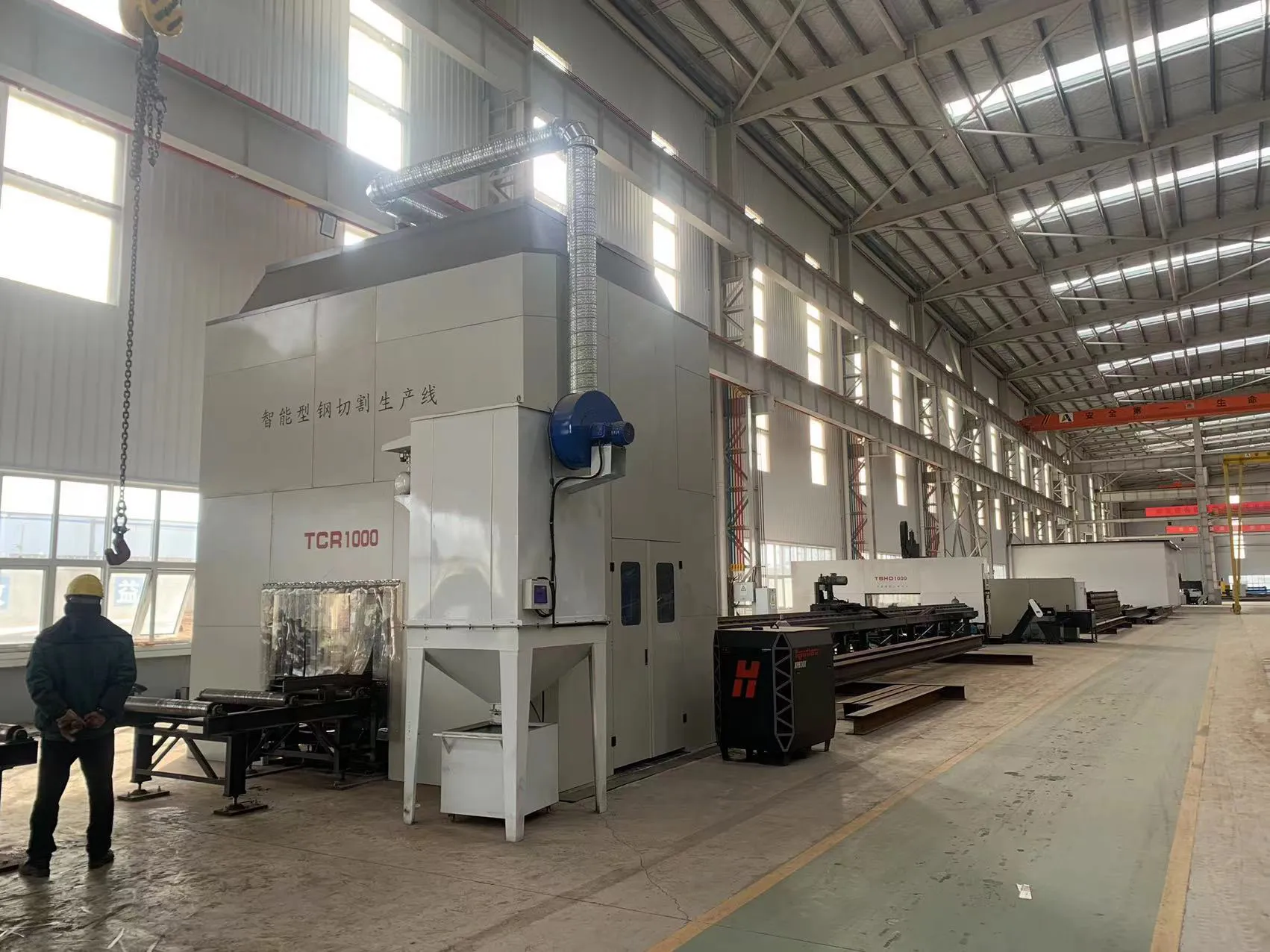
3. 3D Kinematics and Structural Geometry Processing
Traditional 2D laser systems are limited to flat plate processing. The 3D processing center utilizes a multi-axis chuck system combined with a 5-axis laser head. This allows the beam to remain perpendicular to the surface of the material, regardless of whether it is cutting the web of a channel or the radius of a cold-formed rectangular section.
For offshore applications, the precision of bolt holes and “rat-hole” cutouts for weld clearance is non-negotiable. The 3D head compensates for material deviations—such as “camber” or “sweep” in long structural members—using real-time capacitive sensing. In the Pune facility, we observed that the system’s ability to perform 3D intersections (tube-to-tube or tube-to-beam) reduces the need for manual grinding and fitting by approximately 75%, as the laser-cut fit-up tolerances are held within +/- 0.2mm.
4. Automatic Unloading: Solving the Precision-Efficiency Bottleneck
One of the most significant challenges in heavy structural processing is the logistics of the material after the cut is completed. Heavy steel sections (often exceeding 100kg per meter) pose a risk to the machine bed and the accuracy of the final cut if not supported correctly during the unloading phase.
4.1. Mechanical Synchronization
The Automatic Unloading technology integrated into this 6000W center utilizes a series of servo-controlled hydraulic lift supports. These supports are synchronized with the movement of the X-axis and the rotation of the chuck. As the laser completes a cut, the unloading system rises to meet the workpiece, preventing the “drop-off” effect where the weight of the finished part causes a cantilevered snap, often damaging the final few millimeters of the cut or the laser nozzle itself.
4.2. Precision Maintenance
In offshore structures, the integrity of the beam end is critical for load distribution. The automatic unloading system ensures that the workpiece remains on a level plane throughout the entire duration of the cutting cycle. This eliminates secondary stresses on the material and ensures that the dimensional accuracy of long-form members (up to 12,000mm) is maintained from the first cut to the final discharge. In the Pune field test, this automation allowed for continuous “lights-out” operation during the night shift, effectively doubling the throughput of the fabrication yard.
5. Application in Offshore Platform Fabrication
Offshore platforms require a high strength-to-weight ratio and extreme resistance to fatigue. The components manufactured in the Pune hub—ranging from secondary steelwork like stairways and gratings to primary structural members like deck beams—must withstand corrosive maritime environments and cyclic loading.
5.1. Weld Prep and Beveling
The 6000W 3D center facilitates “K,” “V,” and “Y” bevel cuts in a single pass. Previously, these bevels were achieved via manual oxy-fuel torches or mechanical milling, both of which introduce significant thermal stress or require excessive setup time. By integrating the beveling into the laser cutting cycle, the Pune facility has achieved a “Ready-to-Weld” state immediately upon unloading. This is particularly vital for the thick-walled tubulars used in offshore tripod structures.
5.2. Material Utilization and Nesting
Using advanced 3D nesting software, the processing center optimizes the layout of parts on a single beam or pipe. This reduces scrap rates—a critical factor given the high cost of offshore-grade S355 or S420 structural steel. The automatic unloading system further supports this by allowing for the processing of very short remnants that would typically be difficult to handle manually, ensuring that almost 98% of the raw material is utilized.
6. Synergy Between Power and Automation
The 6000W power rating is the “engine,” but the automatic structural processing is the “transmission.” Without the automated loading and unloading systems, the 6000W fiber laser would spend 60% of its operational life idle, waiting for overhead cranes or manual intervention.
In the observed Pune installation, the integration of a chain-type automatic loading magazine and a conveyor-based unloading system has reduced the “idle-to-cut” ratio to less than 15%. This synergy allows the high-density energy of the fiber laser to be applied continuously. Furthermore, the 6000W source permits faster feed rates on thinner secondary structures (6mm-12mm), while the automated handling prevents these smaller parts from becoming lost or jammed in the machine’s internal structure.
7. Technical Challenges and Mitigation in the Pune Environment
Operating high-precision laser equipment in the Pune industrial climate requires specific considerations. The power stability of the 6000W source is sensitive to voltage fluctuations; therefore, a dedicated industrial voltage stabilizer and a dual-circuit chilling system are mandatory to maintain the resonance of the fiber source and the optics of the 3D head.
Dust and particulate matter from the heavy industrial surroundings in Pune can also affect the linear guides and the automatic unloading sensors. The system employs a pressurized bellows system and centralized lubrication to mitigate this, ensuring that the heavy-duty mechanics of the unloading arms do not lose positional accuracy over time.
8. Conclusion: Operational ROI and Structural Integrity
The deployment of the 6000W 3D Structural Steel Processing Center with Automatic Unloading has demonstrated a clear technical advantage for offshore fabrication. By combining high-wattage cutting capabilities with 3D kinematic flexibility and automated material handling, the facility has addressed the two primary bottlenecks in heavy steel processing: cut precision and logistical downtime.
For the offshore sector, where a single failed weld can lead to catastrophic structural failure, the precision offered by this system is an essential risk-mitigation tool. The Pune manufacturing hub is now equipped to deliver structural components that meet global maritime standards with a level of efficiency that was previously unattainable through traditional fabrication methods. The ROI is realized not just in speed, but in the elimination of downstream correction costs and the significant reduction in labor-intensive material handling.













