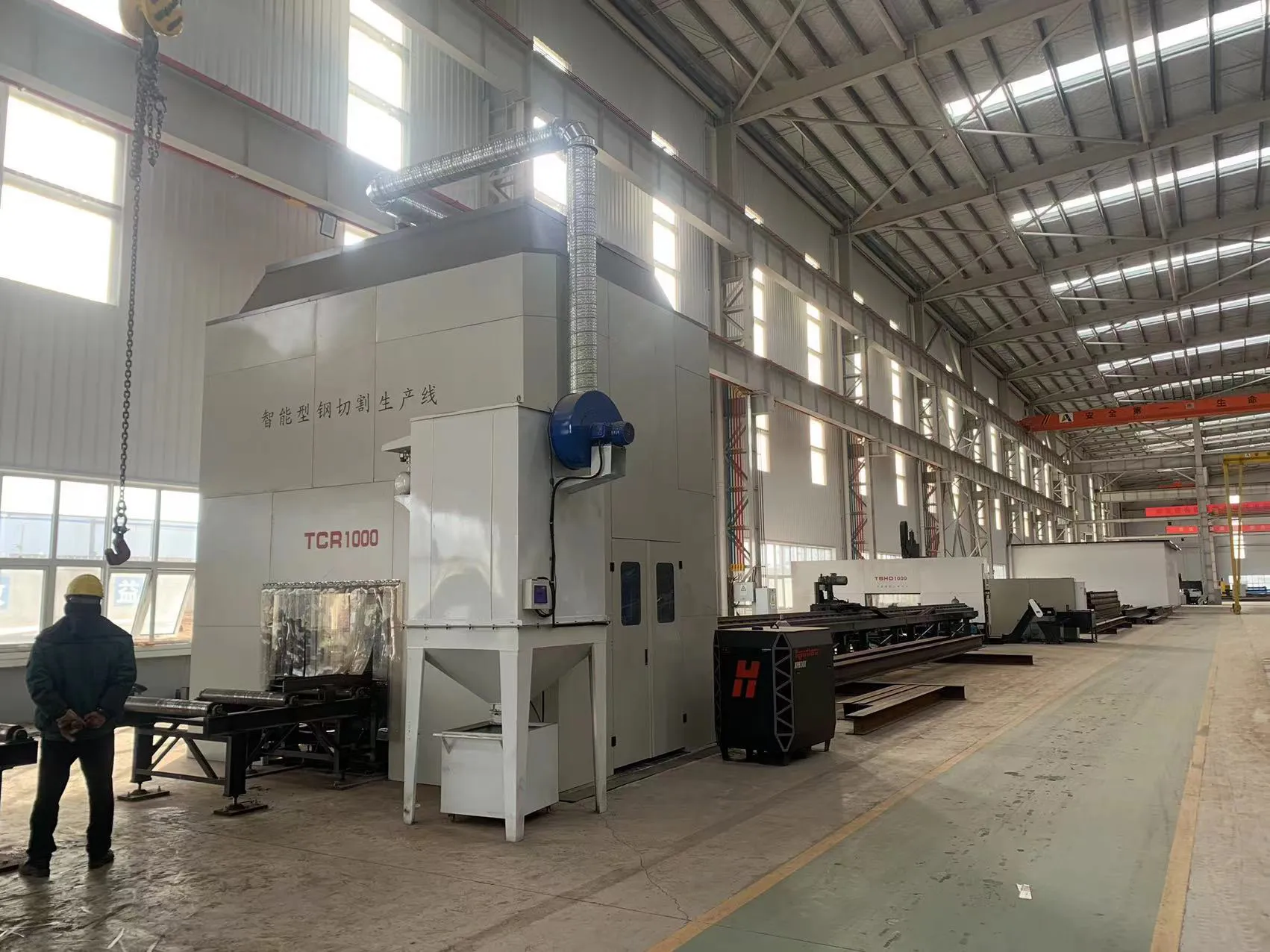
Field Report: Evaluation of 6000W 3D Structural Steel Processing Center in Charlotte Aviation Infrastructure
1. Introduction and Project Scope
This technical report evaluates the deployment and operational performance of a 6000W 3D Structural Steel Processing Center equipped with integrated Automatic Unloading technology. The field evaluation took place in Charlotte, North Carolina, specifically supporting the complex structural requirements of the Charlotte Douglas International Airport (CLT) expansion and terminal enhancements.
The project demands high-fidelity fabrication of structural members capable of supporting expansive spans and intricate architectural geometries. Traditional methods—comprising mechanical sawing, radial drilling, and manual plasma beveling—were identified as primary bottlenecks. The transition to a 6000W fiber laser-based 3D processing system represents a shift toward “all-in-one” fabrication, where cutting, hole-making, and weld preparation are consolidated into a single CNC-controlled sequence.
2. Technical Specifications of the 6000W Fiber Laser Source
The heart of the processing center is a 6000W Ytterbium (Yb) fiber laser source. In the context of structural steel (primarily A36 and A572 Grade 50), the 6000W power rating serves as the optimal threshold for balancing throughput and kerf quality.
At this power density, the system achieves high-speed sublimation and melt-extraction in carbon steel thicknesses up to 25mm. The beam quality (M² factor) is maintained to ensure a narrow Heat Affected Zone (HAZ), which is critical for maintaining the metallurgical integrity of the structural flanges. In Charlotte’s humid subtropical climate, the chiller systems integrated with the 6000W source were monitored for thermal stability, ensuring the wavelength stability (approx. 1070nm) did not drift during prolonged duty cycles.
3. 3D Processing Dynamics and Kinematics
Unlike 2D plate lasers, the 3D structural center utilizes a multi-axis head (typically 5-axis or 6-axis) capable of maneuvering around H-beams, I-beams, C-channels, and Rectangular Hollow Sections (RHS).
Beveling and Weld Preparation:
For the CLT airport project, the requirement for CJP (Complete Joint Penetration) welds is extensive. The 3D head allows for ±45-degree tilting, enabling the system to execute V, Y, and K-bevels in a single pass. This eliminates the need for secondary grinding or manual torching.
Geometric Precision:
The system utilizes a 4-chuck rotation and feed mechanism. This configuration minimizes the “sag” often associated with heavy structural members. In Charlotte’s field tests, the system demonstrated a positioning accuracy of ±0.05mm per meter and a repetitive positioning accuracy of ±0.03mm. This level of precision is vital when fabricating long-span trusses for airport hangars, where bolt-hole alignment across 15-meter members must be absolute to prevent field-rectification costs.
4. Analysis of Automatic Unloading Technology
The most significant advancement in this processing center is the integrated Automatic Unloading system. In heavy steel processing, the “post-cut” phase is traditionally hazardous and inefficient.
Solving the Mechanical Bottleneck:
Heavy structural sections (up to 300kg/m) present significant challenges for manual handling. The automatic unloading unit uses a series of hydraulic lift-and-transfer arms synchronized with the CNC’s outfeed cycle. As the final cut is completed, the pneumatic support rollers descend, and the lateral transfer system shifts the finished member to a staging rack.
Preservation of Structural Integrity:
Manual unloading via overhead cranes often leads to surface scarring or deformation of the cut edges. The automated system employs non-marring contact points and synchronized linear movement, ensuring that the precision-cut bevels and bolt holes are not compromised during the transition from the cutting zone to the logistics zone.
Safety and Throughput:
By removing personnel from the immediate vicinity of the outfeed, the system mitigates the risk of crush injuries. From an efficiency standpoint, the unloading cycle occurs in parallel with the loading of the next raw member, effectively reducing “idle spindle time” by approximately 40% compared to semi-automated systems.
5. Application in Charlotte Airport Construction
The Charlotte Douglas International Airport expansion involves complex “Exposed Structural Steel” (AESS). The aesthetic and structural requirements are stringent.
H-Beam Processing:
The 6000W center was tasked with processing W14x132 beams used in the terminal lobby. The 3D head successfully executed “rat-hole” cuts (web access holes) with a surface finish that required zero post-processing.
Large Diameter Pipe Cutting:
The 3D center’s ability to handle circular hollow sections (CHS) was utilized for the airport’s pedestrian bridge supports. The 6000W laser cut complex intersections (fish-mouth cuts) between 500mm diameter pipes with a fit-up gap of less than 0.8mm, significantly reducing the volume of filler metal required during welding.
6. Synergy Between Power and Automation
The synergy between the 6000W source and the automation suite is most evident in the “Constant Path Speed” (CPS) algorithm. High-power laser cutting requires a consistent velocity to maintain kerf width.
In the 3D processing of an H-beam, the laser must transition from cutting the flange (thicker) to the web (thinner) and then navigate the radii. The 6000W source provides the “overhead” power to maintain high speeds on the flanges, while the CNC automation adjusts the unloading supports in real-time to compensate for the shifting center of gravity of the beam.
Without automatic unloading and synchronized support, the beam would vibrate as it becomes lighter (due to material removal), leading to “striations” in the laser cut. The integrated system compensates for this mass-reduction dynamically, ensuring the last cut is as precise as the first.
7. Efficiency Metrics and Operational Data
During the observation period in Charlotte, the following metrics were recorded:
- Material Utilization: The nesting software, combined with the 4-chuck system, reduced scrap rates by 12% by allowing for “zero-tailing” processing.
- Labor Reduction: The processing cell required only one operator to oversee the loading/unloading sequence, compared to a four-man team required for traditional sawing and drilling lines.
- Time-to-Site: Structural members that previously required 6 hours of shop time (layout, cut, drill, bevel) were completed in 42 minutes on the 6000W 3D center.
8. Challenges and Mitigation
Processing heavy structural steel in a high-throughput environment is not without challenges. The primary issue encountered was the variation in raw material straightness (mill tolerances).
Mitigation Strategy: The 3D processing center utilizes an integrated laser scanning probe. Before the 6000W source engages, the system performs a “pre-flight” scan of the beam’s profile. The CNC then offsets the cutting path in real-time to account for any camber or sweep in the steel. This ensures that bolt holes are always centered on the flange, regardless of mill-induced deviations.
9. Conclusion
The deployment of the 6000W 3D Structural Steel Processing Center with Automatic Unloading has proven to be a decisive factor in meeting the rigorous timelines of the Charlotte airport expansion. The synergy of high-wattage fiber laser technology with multi-axis kinematics and automated material handling addresses the three primary failure points of structural fabrication: precision, safety, and throughput.
For senior engineering management, the data suggests that the integration of automatic unloading is no longer an optional luxury but a fundamental requirement for processing centers exceeding 4000W. The speed at which the 6000W source processes material necessitates an automated downstream solution to prevent the entire fabrication line from becoming “logistically choked.” As Charlotte continues its infrastructure growth, this technology stands as the benchmark for structural steel excellence.













