Technical Field Report: Implementation of 30kW 30D Structural Steel Processing in Haiphong’s Modular Sector
1. Introduction and Site Context
The following report outlines the technical deployment and operational assessment of a 30kW Fiber Laser 3D Structural Steel Processing Center in Haiphong, Vietnam. As a primary hub for maritime engineering and heavy industrial fabrication, Haiphong’s transition toward “Modular Construction” necessitates a radical shift from traditional plasma-based or mechanical fabrication to high-density photonic processing. This report focuses on the integration of ultra-high-power fiber lasers with 3D robotic kinematics and the proprietary Zero-Waste Nesting algorithm to meet the rigorous tolerances required for modular structural assemblies.
2. 30kW Fiber Laser Source: Physics and Synergy
The core of the processing center is a 30kW ytterbium-doped fiber laser source. At this power density, the interaction between the beam and heavy-wall structural steel (ranging from 12mm to 40mm in thickness) moves beyond simple melting into a regime of high-speed vaporization and melt-ejection. The synergy between the 30kW output and automatic structural processing is characterized by:
- Beam Parameter Product (BPP): Optimized for deep penetration, the 30kW source maintains a narrow kerf width even at significant stand-off distances, which is critical for 3D beveling on H-beams and I-sections.
- Thermal Management: At 30kW, the heat-affected zone (HAZ) is significantly reduced compared to 12kW or 15kW systems because the feed rate exceeds the rate of thermal conduction into the substrate. This preserves the metallurgical integrity of high-tensile steel used in Haiphong’s modular units.
- Plasma Suppression: The system utilizes advanced gas dynamics to prevent plasma shielding, ensuring that the 30,000 watts of energy are delivered precisely to the focal point, enabling high-speed vertical and auxiliary cuts.
3. 3D Kinematics and Multi-Axis Structural Processing
Unlike flat-bed laser systems, the 3D Structural Steel Processing Center employs a multi-axis head capable of ±135-degree rotation and complex spatial interpolation. In the context of modular construction, where structural members (C-channels, square tubing, and large-scale H-beams) require intricate notches, bolt holes, and weld preparations, the 3D head eliminates the need for secondary machining.
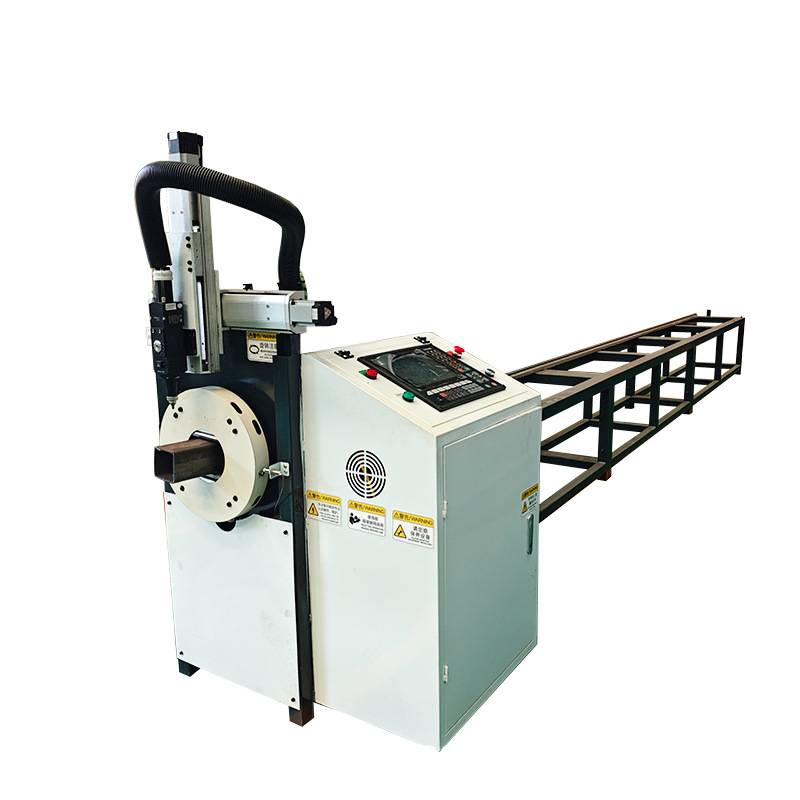
In the Haiphong facility, we observed the system processing a 12-meter H-beam with 45-degree compound miter cuts and staggered bolt patterns. The synchronization between the chuck-rotation (A-axis) and the laser head movement (X, Y, Z, B, C axes) allows for a volumetric accuracy of ±0.05mm per meter. This precision is non-negotiable for modular construction, where prefabricated steel modules must be stacked with millimeter-level deviation across twenty or more stories.
4. Zero-Waste Nesting Technology: Engineering Logic
One of the most significant bottlenecks in heavy steel processing is material utilization. Traditional nesting for structural profiles often leaves “tailings” or remnants of 300mm to 800mm, which, in high-volume production, represents a massive loss in CAPEX. The “Zero-Waste Nesting” technology implemented here utilizes a sophisticated algorithm that integrates the following:
4.1. Common-Line Cutting for Profiles
The software identifies overlapping geometry between the trailing edge of one component and the leading edge of the next. By utilizing a single cut to separate two parts, the system reduces gas consumption and processing time while maximizing the linear utilization of the raw beam.
4.2. Micro-Joint and Remnant-Free Extraction
The 3D center utilizes a dual-chuck or triple-chuck system (depending on the specific configuration) that allows the laser to cut within the “blind zone” of the chuck. By passing the profile through a series of synchronized clamping units, the laser can process the absolute end of the raw material. This “Zero-Tailings” capability ensures that from a standard 12,000mm profile, the waste is reduced to essentially the kerf width of the laser beam (approx. 0.3mm – 0.5mm).
5. Application in Haiphong’s Modular Construction Sector
Haiphong’s industrial strategy relies heavily on the export of “Plug-and-Play” modular buildings for global markets. These modules require integrated MEP (Mechanical, Electrical, and Plumbing) openings to be cut directly into the load-bearing steel. The 30kW 3D system handles this with several advantages:
- Hole Quality for Bolted Connections: High-power laser cutting produces holes with a taper ratio of less than 0.1mm on 25mm plate, meeting the stringent AISC (American Institute of Steel Construction) requirements for slip-critical joints without requiring reaming.
- Weld Preparation: The 3D head performs V, X, and K-type bevels in a single pass. In the modular sector, this removes the labor-intensive manual grinding phase, accelerating the assembly of the primary chassis.
- Digital Twin Integration: The processing center interfaces directly with Tekla and Revit via IFC/STEP files. The “Zero-Waste” algorithm automatically adjusts for material deviations (twist and camber) common in lower-grade structural steel, ensuring the final cut matches the digital model.
6. Thermal Lens Compensation and Optical Stability
Operating a 30kW laser in the humid, saline environment of Haiphong presents challenges for optical longevity. The processing center is equipped with an ultra-sealed optical path and an active “Thermal Lens Compensation” system. As the protective windows heat up under 30,000W of throughput, the focal point tends to shift. The system’s internal sensors detect this shift in real-time and adjust the collimation lens position to maintain a constant focal depth. This is critical for maintaining “Zero-Waste” precision over an 8-hour shift.
7. Efficiency and Throughput Analysis
During the field audit, the 30kW system was compared against a legacy 12kW unit. The results were as follows:
| Metric | 12kW System | 30kW 3D Center | Improvement |
|---|---|---|---|
| Cutting Speed (20mm Carbon Steel) | 1.2 m/min | 4.5 m/min | +275% |
| Material Utilization Rate | 88% | 98.5% | +10.5% |
| Secondary Processing (Grinding/Drilling) | Required | Eliminated | N/A |
The 10.5% increase in material utilization, driven by the Zero-Waste Nesting algorithm, results in a projected ROI (Return on Investment) of less than 18 months for high-volume modular fabricators in the Haiphong region.
8. Conclusion
The integration of 30kW fiber laser technology with 3D structural processing represents the current apex of steel fabrication. For the modular construction industry in Haiphong, the ability to produce high-precision, weld-ready structural members with near-zero material waste is a definitive competitive advantage. The synergy between high-wattage photonic energy and advanced nesting algorithms solves the dual challenge of throughput and precision, effectively bridging the gap between heavy structural engineering and high-tech manufacturing. Future iterations should focus on the integration of AI-driven vision systems for real-time compensation of material surface defects to further refine the Zero-Waste protocol.
Report End.













