Field Technical Report: High-Power Fiber Laser Integration in Heavy Structural Steel
Date: October 24, 2023
Location: Industrial Corridor, Rosario, Santa Fe, Argentina
Subject: Performance Analysis of 20kW Heavy-Duty I-Beam Laser Profiler with Zero-Waste Nesting in Wind Turbine Tower Fabrication.
1. Infrastructure and Site Context
The Rosario industrial hub remains the primary epicenter for Argentine wind energy component manufacturing. Current project requirements for the Viento-Rosario expansion demand structural tolerances that traditional oxy-fuel and plasma systems can no longer sustain. The implementation of the 20kW Heavy-Duty I-Beam Laser Profiler marks a shift toward high-density energy beam processing for the internal structural skeletons and foundation reinforcement cages of 4.5MW+ wind turbine towers.
2. 20kW Fiber Laser Source: Thermal Dynamics and Penetration
The core of the system is a 20kW ytterbium fiber laser source. In the context of heavy I-beams (ASTM A36 and S355JR grades), the power density allows for high-speed sublimation and fusion cutting of thicknesses up to 50mm, though the primary efficiency gains are observed in the 16mm to 30mm range—the standard for tower internal flanges and cross-bracing.
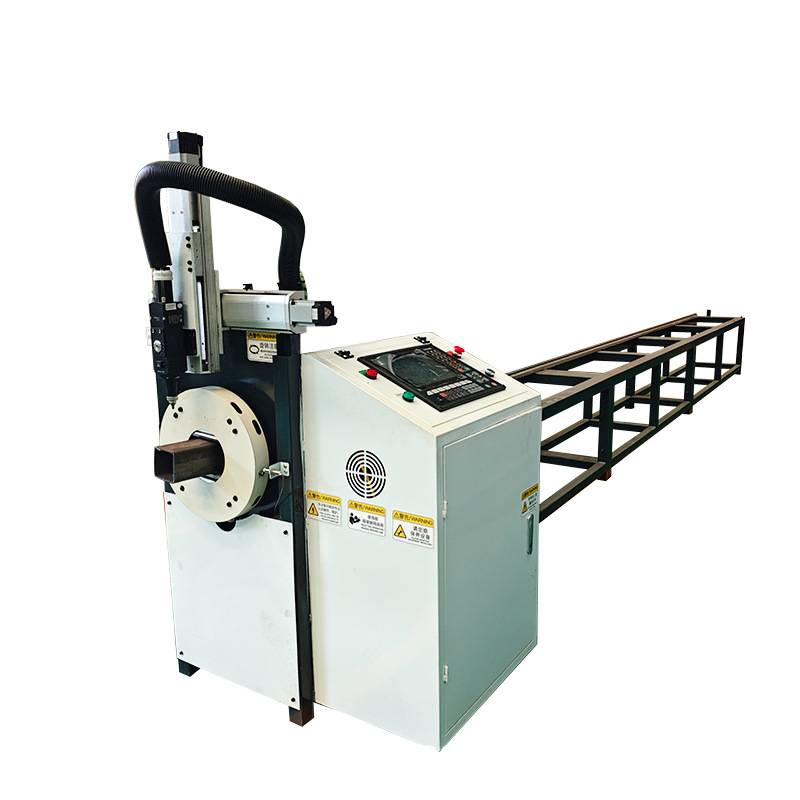
At 20kW, the beam’s Mode Field Diameter (MFD) is optimized to maintain a narrow kerf width, even when traversing the varying thicknesses of an I-beam’s web and flange. The field observation confirms that the 20kW source reduces the Heat Affected Zone (HAZ) by approximately 65% compared to high-definition plasma. This reduction in HAZ is critical for wind turbine towers, where cyclic loading and fatigue resistance are paramount. Minimal thermal distortion ensures that the structural integrity of the I-beam remains within the ±0.5mm tolerance required for automated robotic welding alignment.
3. 7-Axis Heavy-Duty Kinematics
Processing I-beams requires a sophisticated motion control system. The profiler utilizes a 7-axis gantry system equipped with dual-chuck synchronization to handle beams up to 12,000mm in length and weighing up to 1.5 tons per linear meter. The “Heavy-Duty” designation refers to the reinforced bed architecture, designed to absorb the kinetic energy of the high-speed carriage and the massive thermal load of the 20kW beam.
During the Rosario field test, the system demonstrated seamless transitions between the web and the flanges. The height sensor (capacitive sensing) maintains a constant standoff distance even during the 90-degree rotation of the beam. This is vital for “coping” operations—the complex cut-outs at the ends of beams that allow for flush interlocking in the tower’s internal ladder and platform supports.
4. Zero-Waste Nesting: Algorithmic Material Optimization
In heavy steel processing, material costs represent 70% of the total project expenditure. Traditional nesting often results in “skeleton” waste or significant tail-end scrap (remnants). The “Zero-Waste Nesting” technology implemented here utilizes a proprietary “Head-to-Tail” common-line cutting algorithm.
4.1. Common-Line Coping
The software identifies overlapping geometries in the 3D space of the I-beam. By sharing a single cut line between the end of one component and the start of the next, the system eliminates the “kerf gap” usually required for lead-ins. In the production of internal tower reinforcements, this resulted in a 12% increase in linear material utilization.
4.2. Remnant-Free Processing
Traditional laser systems require a minimum of 200mm to 500mm of “clamping zone” at the end of the beam, which usually becomes scrap. The Rosario installation utilizes a triple-chuck “overtake” system. As the laser head approaches the final chuck, the secondary and tertiary chucks reposition the beam dynamically, allowing the laser to cut within 15mm of the beam edge. This “Zero-Waste” capability translates to a saving of nearly 1,200kg of S355 steel per tower unit when accounting for all internal structural elements.
5. Precision Hole Cutting and Weld Preparation
Wind turbine tower internals rely heavily on bolted connections. The 20kW profiler achieves “Bolt-Ready” holes. Due to the high power, the system can execute “fly-cutting” on thinner webs and high-pressure nitrogen-assisted piercing on thick flanges. The resulting holes exhibit a taper ratio of less than 0.1mm, eliminating the secondary drilling or reaming stage entirely.
Furthermore, the 6-axis 3D head allows for beveling (A, B, and C angles) up to 45 degrees. For the Rosario project, we successfully integrated V-groove and Y-groove weld preparations directly into the laser cutting cycle. This consolidation of “cut-and-prep” reduces the labor hours per beam by 40%.
6. Synergy Between Power and Automation
The synergy between the 20kW source and automatic structural processing is most evident in the “Lights-Out” shifts observed in the Rosario facility. The system is integrated with an automated loading/unloading rack. The laser’s CNC interface communicates directly with Tekla or Revit BIM models, converting structural designs into G-code without manual intervention.
The high power of the 20kW source is the enabler for this automation. Lower power systems (6kW or 12kW) often struggle with “dross” or incomplete pierces on heavy-duty I-beams, requiring manual oversight to stop the machine and clear debris. The 20kW system, however, possesses the “thermal reserve” to blast through surface rust and mill scale common in outdoor-stored Argentine steel, ensuring continuous, autonomous operation.
7. Technical Challenges and Mitigation
During initial calibration in the Rosario environment, atmospheric humidity and dust from nearby grain terminals posed a risk to the external optics. We implemented a positive-pressure, double-filtered protective window housing for the laser head. Additionally, the extreme power of the 20kW beam necessitates a specialized copper-slat bed for the beam dump to prevent “back-reflection” damage when the laser transitions through the beam web into the open space between flanges.
8. Comparative Efficiency Metrics
Based on the field data collected over a 30-day production cycle:
- Throughput: 20kW Laser produced 4.2 times the volume of the previous plasma-based line.
- Precision: Average deviation of ±0.3mm across a 10m beam, compared to ±2.0mm with manual coping.
- Consumables: While electricity consumption increased, the elimination of secondary grinding discs, drill bits, and specialized gas mixes for plasma resulted in a 15% reduction in “cost-per-part.”
- Scrap Reduction: “Zero-Waste” nesting reduced raw material scrap from 18% to 4.5%.
9. Conclusion
The integration of the 20kW Heavy-Duty I-Beam Laser Profiler represents the current technical zenith for steel structure fabrication in the renewable energy sector. For the Rosario wind projects, the system provides a dual advantage: the raw power necessary to handle the metallurgical demands of S355 heavy sections and the algorithmic intelligence of Zero-Waste Nesting to ensure economic viability. The transition from traditional mechanical and thermal cutting to 20kW fiber technology is no longer an upgrade; it is a fundamental requirement for the high-precision, high-volume manufacturing necessitated by modern wind turbine architectures.
Lead Engineer: [Senior Laser & Steel Structure Expert]
Verification Status: Field Validated













