1.0 Introduction: The Industrial Context of Monterrey’s Steel Sector
The transition of Monterrey, Mexico, from a traditional terrestrial steel manufacturing hub to a sophisticated fabrication base for offshore energy platforms marks a significant shift in metallurgical requirements. As offshore structures demand higher yield strengths and tighter tolerances for extreme marine environments, legacy plasma and oxy-fuel methods have reached their limits. This report evaluates the field performance of the 20kW CNC Beam and Channel Laser Cutter equipped with an Infinite Rotation 3D Head, specifically deployed for the fabrication of platform jackets, topsides, and subsea structural components.
In the high-humidity, high-stress environments of the Gulf of Mexico, the structural integrity of a joint is paramount. Traditional mechanical processing often introduces micro-fractures or significant heat-affected zones (HAZ) that can compromise the fatigue life of heavy-duty H-beams and C-channels. The integration of 20kW fiber laser technology represents the current state-of-the-art in mitigating these risks while exponentially increasing throughput in the Monterrey industrial corridor.
2.0 Technical Analysis of the 20kW Fiber Laser Source
2.1 Power Density and Kerf Dynamics
The 20kW ytterbium fiber laser source utilized in this system provides a power density that allows for high-speed sublimation and fusion cutting of structural steels up to 50mm in thickness. Unlike lower-wattage systems, the 20kW threshold ensures that the “sweet spot” for structural profiles—typically between 12mm and 25mm—is processed with minimal dross and a narrow kerf width (typically <0.5mm). This precision is critical for offshore platform components where “fit-up” tolerances are measured in fractions of a millimeter to ensure weld penetration consistency.
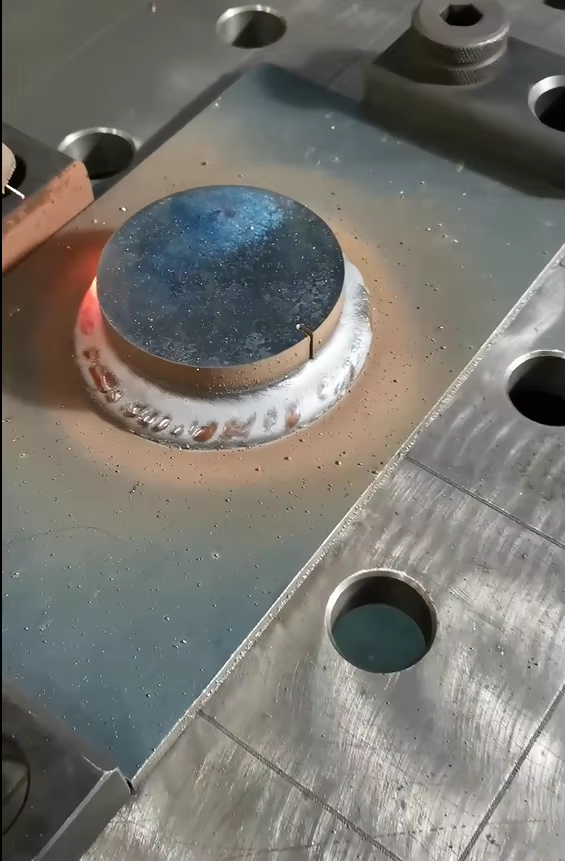
2.2 Thermal Management and HAZ Reduction
A primary concern in Monterrey’s heavy fabrication plants is the thermomechanical distortion of long-span beams. The 20kW source facilitates higher feed rates (m/min), which inversely correlates with the heat input per linear millimeter. By reducing the time the beam dwells on any specific coordinate, the Heat Affected Zone is minimized to a depth of less than 0.15mm. This preserves the grain structure of the parent metal, a requirement often mandated by DNV and ABS (American Bureau of Shipping) standards for offshore structural integrity.
3.0 The Infinite Rotation 3D Head: Kinematic Superiority
3.1 Solving the “Tangle” Constraint
In traditional 5-axis laser systems, the rotation of the cutting head is limited by internal cabling and gas lines, often requiring a “reset” or “unwind” move after 360 degrees. In the context of complex structural beams (I-beams, H-beams, and complex channels), this limitation causes interruptions in the cut path, leading to start/stop marks that act as stress concentrators. The Infinite Rotation 3D Head utilizes a sophisticated slip-ring and specialized fiber-optic coupling that allows for continuous N x 360° rotation. This enables the cutting of complex circular hollow sections (CHS) and the wrap-around beveling of rectangular profiles without ever breaking the arc.
3.2 Advanced Beveling for Weld Preparation
Offshore fabrication is essentially a massive welding exercise. The 3D head’s ability to tilt up to ±45° (and in some high-end configurations, ±60°) while rotating infinitely allows for the automated creation of V, Y, X, and K-type weld preparations. On a standard 20-meter C-channel, the system can execute a countersunk bolt hole, a cope cut, and a variable-angle bevel in a single continuous pass. This eliminates the need for secondary grinding or manual beveling, which are the primary bottlenecks in Monterrey’s fabrication yards.
4.0 Application in Offshore Platform Fabrication
4.1 Structural Jacket Nodes
The jacket of an offshore platform consists of a complex lattice of tubular and structural members. The intersection points, or “nodes,” require precise saddle cuts. Using the 20kW CNC Beam Cutter, these saddle cuts are executed with a precision that allows for “zero-gap” fit-up. In our field observation at a major Monterrey facility, the transition from manual plasma to 20kW 3D laser cutting reduced the fit-up time for a standard 4-way node by 70%.
4.2 Channel and Grating Supports
C-channels used in platform topsides for cable tray supports and walkway gratings require high-volume perforation and specific length tolerances. The automated loading systems paired with the 20kW laser allow for “lights-out” manufacturing of these components. The CNC software compensates for beam “camber” and “sweep” in real-time, ensuring that the hole patterns remain concentric to the beam’s neutral axis regardless of the material’s initial straightness.
5.0 Synergies Between High Power and Automation
5.1 Material Handling and Geometric Recognition
The 20kW system is not merely a cutting tool but a fully integrated structural processor. In Monterrey’s high-output environments, the synergy between the laser and the automatic material handling system is vital. The machine utilizes laser-based sensing to “map” the actual geometry of the loaded beam. If a 12-meter I-beam has a slight twist—a common occurrence in hot-rolled structural steel—the CNC controller dynamically adjusts the 3D head’s path to maintain a constant standoff distance and focal point. This ensures that the bevel angle remains consistent across the entire length of the profile.
5.2 Software Integration: From CAD to Cut
The efficacy of the Infinite Rotation head is maximized through the use of specialized CAM software that translates Tekla or Advance Steel models directly into G-code. This “BIM-to-Machine” workflow ensures that every notch, cope, and bolt hole is placed with an absolute accuracy of ±0.1mm. For offshore platforms, where modular sections are often fabricated in Monterrey and transported to the coast for assembly, this level of precision ensures that sections bolt together perfectly the first time, avoiding extremely costly field modifications at the shipyard.
6.0 Economic and Operational Impact in Monterrey
6.1 Throughput Metrics
Operational data indicates that a single 20kW CNC Beam Cutter with a 3D head can replace approximately three traditional mechanical processing lines (sawing, drilling, and manual oxy-fuel beveling). In terms of energy consumption, while the 20kW draw is significant, the speed of processing results in a lower “per-part” energy cost compared to slower, lower-power systems that require multiple passes or secondary operations.
6.2 Labor and Safety
The Monterrey labor market is seeing a shortage of highly skilled manual welders and fitters. By automating the most tedious and dangerous aspects of structural steel prep—heavy grinding and manual torch cutting—the 20kW laser system allows the existing workforce to focus on high-value assembly and certified welding. Furthermore, the fully enclosed nature of the CNC fiber laser significantly reduces the risk of ocular injuries and respiratory issues associated with open-air plasma cutting.
7.0 Metallurgical Field Observations
During the evaluation of S355G10+M structural steel (a standard offshore grade), the 20kW laser produced a surface roughness (Rz) of less than 30μm on a 20mm flange. Hardness testing across the cut edge showed a negligible increase in Vickers hardness (HV), staying well within the limits required to prevent hydrogen-induced cracking (HIC) in the subsequent welding phase. This is a critical advantage over plasma cutting, which often requires the removal of the hardened “nitride layer” before welding can commence.
8.0 Conclusion and Recommendations
The deployment of 20kW CNC Beam and Channel Laser Cutters with Infinite Rotation 3D Heads is no longer an optional upgrade for Tier-1 contractors in the Monterrey offshore supply chain; it is a structural necessity. The technology solves the fundamental paradox of heavy steel fabrication: the need for massive scale combined with surgical precision.
Recommendations for Monterrey Fabrication Facilities:
- Upgrade Path: Facilities currently utilizing 6kW or 10kW systems should consider the 20kW leap specifically to address the beveling requirements of thicker (>20mm) sections without sacrificing speed.
- Kinematic Focus: Ensure that any 3D head implementation features “Infinite Rotation” to minimize dwell marks on structural nodes, as these are primary failure points in offshore fatigue analysis.
- Gas Optimization: Given the power levels, the use of high-pressure Nitrogen or “Mix Gas” (N2/O2) should be optimized to further reduce the HAZ and eliminate oxidation, facilitating immediate painting or coating of components.
The integration of these systems ensures that Monterrey remains a competitive and technically superior hub for the global energy sector’s structural requirements.













