Field Technical Report: Deployment of 6000W Universal Profile Steel Laser System in Queretaro Airport Infrastructure
1. Project Scope and Environmental Context
The expansion of aviation infrastructure in Queretaro, Mexico, necessitates the implementation of advanced structural steel fabrication techniques. As the region evolves into a primary aerospace and logistics hub, the demand for long-span structures and high-load-bearing terminal frames has surged. This report details the field deployment and performance analysis of the 6000W Universal Profile Steel Laser System, specifically focusing on its integration into the fabrication of complex structural nodes and heavy-gauge profiles (H-beams, I-beams, and hollow structural sections).
Traditional methods involving plasma cutting or mechanical sawing followed by manual grinding are no longer viable under the current project timelines and tolerance requirements. The 6000W fiber laser source, coupled with a five-axis kinematic head, represents a shift toward “single-pass” processing, where cutting, hole-making, and beveling occur within a single CNC cycle.
2. 6000W Fiber Laser Source: Photon Density and Material Interaction
The choice of a 6000W (6kW) fiber laser source is strategic for the structural requirements of Queretaro’s airport facilities. In structural steel processing, particularly with ASTM A36 and A572 Grade 50 steel, the 6kW threshold allows for an optimal balance between cutting speed and edge quality on thicknesses ranging from 12mm to 25mm.
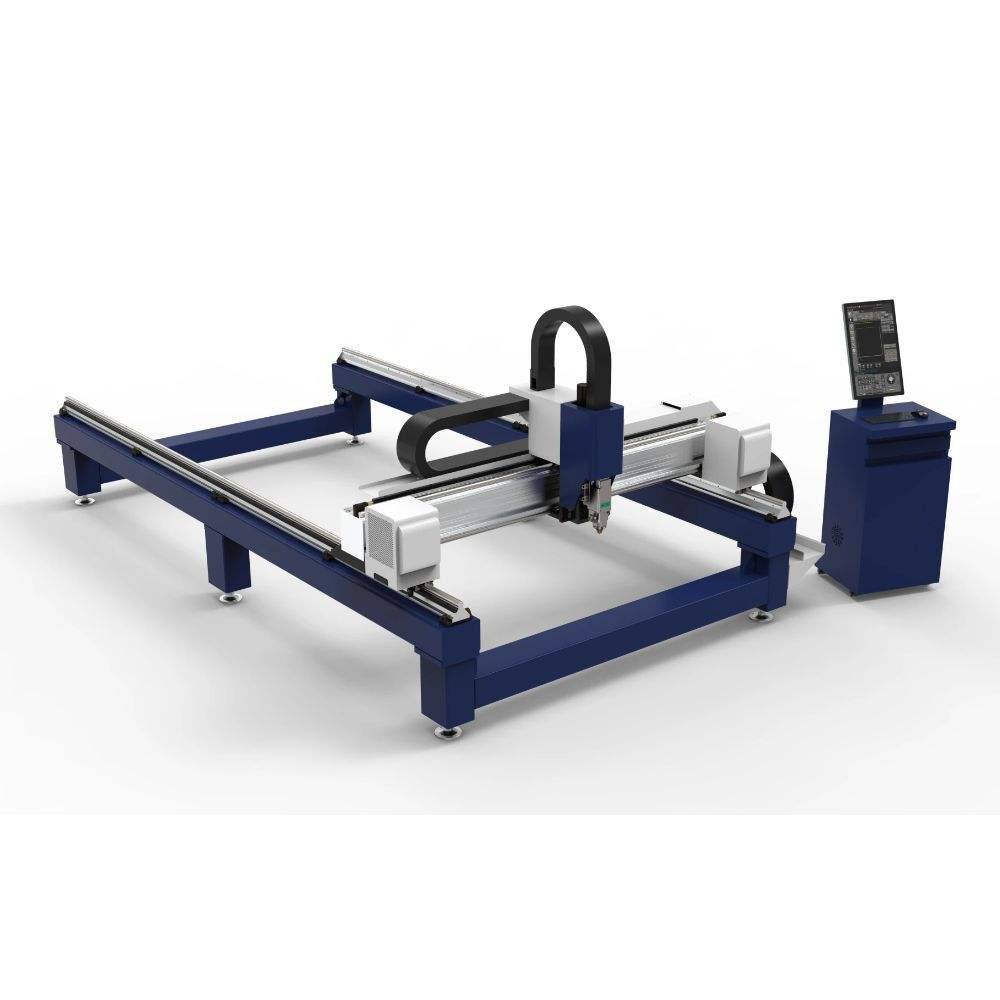
At 6000W, the power density at the focal point is sufficient to maintain a stable melt pool even when the beam is tilted at extreme angles (±45°). In profile cutting, the laser must often penetrate varying thicknesses as it traverses the web and flanges of an H-beam. The 6kW source provides the necessary “power reserve” to ensure consistent penetration without increasing the Heat Affected Zone (HAZ) beyond the permissible limits defined by AWS (American Welding Society) standards. The narrow kerf width associated with this power level minimizes material loss and thermal distortion, which is critical for the geometric stability of 12-meter structural members.
3. ±45° Bevel Cutting Kinematics and Weld Preparation
The core technological advantage of this system is the ±45° bevel cutting capability. In heavy steel construction, beveling is mandatory for CJP (Complete Joint Penetration) welds. Traditionally, this required secondary processing via oxy-fuel torches or portable beveling machines.
3.1. Five-Axis Motion Control
The system utilizes a specialized B/C-axis cutting head. Unlike flat-sheet lasers, the profile laser must compensate for the rotation of the beam (C-axis) and the tilt of the head (B-axis) while simultaneously tracking the surface of the profile using high-frequency capacitive sensing. This is particularly challenging on Queretaro’s industrial site due to the inherent deviations in hot-rolled steel profiles. The system’s ability to map the profile’s surface in real-time allows the ±45° bevel to remain consistent relative to the actual flange geometry, rather than the theoretical CAD model.
3.2. Bevel Types and Geometric Accuracy
The system executes V, Y, X, and K-type bevels with high precision. In the construction of the airport’s main terminal roof, the “fish-mouth” cuts for circular hollow sections (CHS) meeting H-beams at oblique angles require varying bevel angles along a single contour. The 6000W system calculates the instantaneous tilt required to maintain a constant welding land, effectively reducing fit-up time from hours to minutes. This precision ensures that the root gap remains uniform during the assembly of the massive structural trusses.
4. Integration in Airport Structural Nodes
Airport architecture often features complex geometries intended to distribute seismic and wind loads across large spans. In Queretaro, the project utilizes heavy-wall sections that act as primary load-bearing columns. The “Universal” aspect of the laser system allows it to process not just standard tubes, but also asymmetric profiles and heavy-duty channels.
4.1. Bolt Hole Precision
A critical requirement in airport steelwork is the precision of bolt holes for friction-grip joints. Using the 6000W laser, the system achieves a cylindricality and diameter tolerance within ±0.1mm. Unlike plasma cutting, which often results in a slight taper, the laser’s high-pressure nitrogen or oxygen assist gas ensures a clean, perpendicular bore even on the exit side of a 20mm flange. This eliminates the need for reaming on-site, significantly accelerating the erection phase of the project.
4.2. Slotting and Interlocking Joints
For the aesthetic and structural requirements of the terminal’s canopy, the system was programmed to cut interlocking “tab-and-slot” joints into 15mm steel plates. This level of mechanical interlocking, enabled by the laser’s accuracy, provides additional shear resistance and serves as a self-jigging mechanism during the welding process, reducing the reliance on complex external fixtures.
5. Synergy Between Automation and Structural Software
The efficiency of the 6000W system is maximized through its software integration. The workflow in Queretaro utilizes a direct pipeline from Tekla Structures to the laser’s CAM environment. This bypasses manual drafting, moving straight from the structural engineer’s BIM model to the G-code generation.
5.1. Automatic Loading and Profiling
The system is equipped with an automatic loading rack capable of handling 12-meter profiles weighing up to 2 tons. As each beam is fed into the system, a laser scanning sequence identifies the profile’s start point and any longitudinal twist. The motion control software then “warps” the cutting path to match the physical reality of the steel. This is essential in Queretaro, where temperature fluctuations can affect the straightness of stored steel members.
6. Comparative Analysis: Laser vs. Legacy Processing
An analysis conducted on-site compared the 6000W laser system against traditional CNC plasma and mechanical drilling lines for a batch of 50 complex H-beam rafters:
- Processing Time: The laser system completed the rafters in 14 hours. The legacy method (plasma + drilling + manual beveling) required 62 hours.
- Consumable Cost: While the initial investment in fiber laser technology is higher, the cost per meter of cut—accounting for gas consumption and nozzle wear—was 30% lower than plasma, primarily due to the elimination of secondary grinding.
- Quality Compliance: 100% of the laser-cut bolt holes passed the “go/no-go” gauge test, whereas the plasma-cut holes required a 15% rework rate for taper correction.
7. Metallurgical Considerations and Post-Cut Processing
One concern in high-strength steel fabrication is the formation of a hardened layer on the cut edge. With the 6000W fiber laser, the high cutting speed minimizes heat input into the base material. Metallurgical cross-sections of the 45° bevels in A572 steel showed a martensitic transformation layer of less than 0.2mm, which is easily consumed during the welding process. This ensures that the ductility of the welded joint is not compromised, a non-negotiable requirement for seismic-resistant structures in the Queretaro region.
8. Conclusion
The implementation of the 6000W Universal Profile Steel Laser System with ±45° beveling technology has redefined the benchmarks for structural fabrication in the Queretaro airport project. By consolidating cutting, beveling, and hole-making into a single, high-precision operation, the system has effectively mitigated the traditional bottlenecks associated with heavy steel processing. The synergy between high-wattage fiber laser sources and 5-axis motion control provides the geometric versatility required for modern architectural designs while maintaining the rigorous structural integrity standards of the aviation industry.
Future phases of the project will focus on further optimizing nesting algorithms to reduce material waste and exploring the use of high-pressure air cutting for thinner secondary members to further reduce operational costs without sacrificing edge quality.







