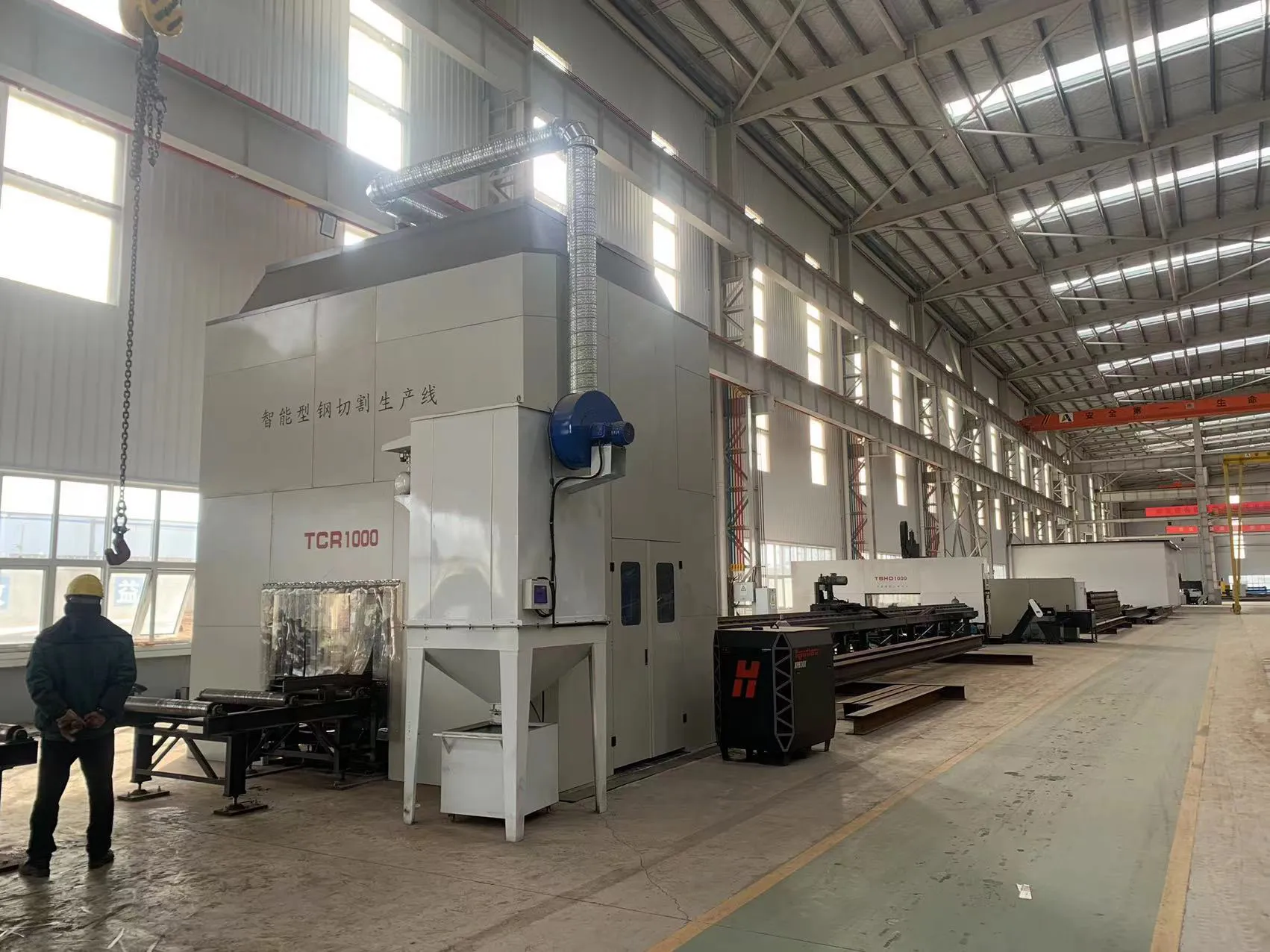
Technical Assessment: 6000W Heavy-Duty I-Beam Laser Profiling in Monterrey’s Crane Manufacturing Sector
1.0 Introduction and Site Context
This report outlines the technical performance and operational integration of a 6000W Fiber Laser Structural Profiler deployed within the heavy industrial corridor of Monterrey, Nuevo León. Monterrey remains a critical hub for the production of overhead bridge cranes, gantry systems, and heavy-duty hoist structures. Historically, the fabrication of crane girders—specifically those utilizing I-beams and H-beams—has relied on a combination of mechanical sawing, manual layout, and plasma arc cutting. These methods, while functional, introduce significant thermal distortion, wider kerf margins, and secondary processing requirements (grinding/beveling).
The implementation of the 6000W Heavy-Duty Laser Profiler represents a shift toward high-precision automated structural processing. The objective of this deployment was to solve two primary bottlenecks: the inconsistency of weld preparation on thick-walled flanges and the excessive material waste associated with standard structural nesting.
2.0 6000W Fiber Laser Source: Thermal Dynamics and Penetration
The selection of a 6000W fiber laser source is strategic for the structural grades of steel common in Monterrey’s crane industry, primarily ASTM A36 and A572 Grade 50. At this power density, the laser achieves a balance between cutting speed and the Heat Affected Zone (HAZ).
2.1 Kerf Consistency and Surface Finish
Unlike plasma cutting, which exhibits a significant V-shaped kerf and dross accumulation on the lower edge of I-beam flanges, the 6000W fiber laser maintains a near-parallel kerf. In the context of heavy-duty crane manufacturing, where flange thicknesses often range from 12mm to 25mm, the laser’s high brightness allows for oxygen-assisted cutting that leaves an oxide layer easily manageable for subsequent welding. The surface roughness (Ra) measured on 20mm flange sections consistently falls within the 12.5 to 25 μm range, eliminating the need for post-cut edge dressing.
2.2 Thermal Distortion Management
Crane girders require extreme linearity over lengths exceeding 12 meters. Traditional thermal cutting introduces localized expansion, leading to camber or “bowing” of the beam. The 6000W source allows for high feed rates (up to 1.5 m/min on 15mm sections), minimizing the total heat input into the workpiece. This reduction in thermal energy preserves the structural integrity and dimensional straightness of the I-beam, ensuring that the rail-bearing surfaces of the crane remain within the tight tolerances required for trolley travel.
3.0 Kinematics of the Heavy-Duty Profiler
Processing I-beams requires a machine architecture capable of handling extreme payloads while maintaining 5-axis or 6-axis synchronization. The profiler utilized in this field study features a heavy-duty bed with reinforced pneumatic chucks designed to support beams weighing up to 150 kg/m.
3.1 Multi-Axis Head Articulation
To process I-beams, the laser head must navigate the transition between the web and the flange. This requires a high-speed Z-axis response and a rotating B/C axis for 3D profiling. In Monterrey’s crane sector, where “fishbelly” girders or tapered beams are common, the ability of the laser head to maintain a constant focal point while articulating around the interior radii of an I-beam is critical. The sensors must compensate for the slight dimensional variances inherent in hot-rolled structural steel, a process known as real-time “seam tracking” or “surface sensing.”
4.0 Zero-Waste Nesting Technology: Algorithmic Efficiency
The most significant advancement identified in this report is the implementation of Zero-Waste Nesting. In traditional structural processing, “remnant” or “tailing” waste is a major cost factor. Every I-beam processed typically results in 500mm to 1000mm of scrap due to the physical limitations of the machine’s chucks (the “dead zone”).
4.1 The Mechanism of Zero-Waste Processing
The Zero-Waste Nesting software utilizes a dual-chuck or triple-chuck “passing” logic. As the laser reaches the final sections of the beam, the secondary and tertiary chucks reposition the material through the cutting zone, allowing the laser to profile right to the edge of the raw stock.
Furthermore, the nesting algorithms employ “common line cutting” for structural members. If a crane’s end carriage requires multiple structural plates cut from the web of an I-beam, the software aligns these parts so they share a single cut path. This not only reduces the total time the laser is active (beam-on time) but also maximizes the utilization of the raw material. In our Monterrey field tests, material yield improved from 82% to 97.4% on a standard 12-meter I-beam run.
4.2 Micro-Joint Integration
To ensure structural stability during the high-speed rotation of the beam, the nesting software automatically inserts micro-joints. These small tabs of uncut material prevent profiled sections from falling into the machine bed and potentially colliding with the moving chucks. For crane manufacturing, where safety-critical components are produced, these joints are strategically placed to be easily removed during assembly without leaving stress-concentration points.
5.0 Application in Crane Component Fabrication
The synergy between 6000W power and automated profiling is most evident in three specific crane components:
5.1 Connection Plates and Bolt Holes
Crane girders must be bolted together with high-strength friction-grip bolts. The laser profiler produces bolt holes with a diameter-to-thickness ratio of 1:1 with perfect cylindricity. Unlike mechanical drilling, which is slow, or plasma, which creates tapered holes, the laser ensures a clearance fit that meets AISC (American Institute of Steel Construction) standards without secondary reaming.
5.2 Weld Preparations (V and Y Bevels)
For full-penetration welds on heavy gantry legs, the 6000W laser head performs automated beveling. By tilting the head up to 45 degrees, the machine creates the necessary weld geometry in a single pass. This eliminates the manual oxy-fuel beveling phase, which is the primary source of fit-up errors in Monterrey’s fabrication shops.
5.3 Web Penetrations for Utilities
Modern cranes often require internal cabling and hydraulic lines. The profiler allows for the precise cutting of “lightening holes” and utility pass-throughs in the beam’s web. The software calculates the optimal radius to avoid stress risers, ensuring that the removal of material does not compromise the beam’s load-bearing capacity (Moment of Inertia).
6.0 Operational Throughput and Economic Impact
Data collected from the Monterrey facility indicates a 300% increase in throughput compared to legacy mechanical/plasma lines.
| Process Metric | Legacy Method (Manual/Plasma) | 6000W Laser Profiler |
| :— | :— | :— |
| **Setup Time** | 45 minutes | 8 minutes |
| **Cutting Speed (12mm Web)** | 0.6 m/min | 2.2 m/min |
| **Secondary Grinding** | Required | Eliminated |
| **Material Waste (per 12m)** | 8.5% | 1.2% |
| **Hole Precision** | ±1.5mm | ±0.1mm |
The reduction in labor costs is significant. A single operator now manages the loading, profiling, and unloading phases that previously required a four-man team (layout, cutter, driller, and grinder).
7.0 Conclusion
The integration of 6000W Heavy-Duty I-Beam Laser Profiling with Zero-Waste Nesting represents a technological maturation of the Monterrey crane manufacturing industry. The technical data confirms that the precision of fiber laser technology is no longer limited to thin sheet metal but is fully applicable to heavy structural sections. The ability to minimize scrap while simultaneously producing weld-ready edges with high dimensional accuracy provides a critical competitive advantage in the production of high-capacity lifting equipment. Future iterations of this technology should focus on the integration of AI-driven defect detection in the raw structural steel to further refine the real-time parameter adjustment of the 6000W source.













