Technical Field Report: 6000W Fiber Laser Integration in Structural H-Beam Fabrication
1. Project Overview and Environmental Parameters
This report details the technical deployment and operational assessment of a 6000W H-Beam laser cutting Machine equipped with an integrated Automatic Unloading System. The deployment site is located in the Dubai industrial zone, specifically targeting the fabrication of structural components for regional railway infrastructure expansions.
In the context of Dubai’s climate, the machinery operates under significant thermal stress and particulate challenges. The project necessitates the processing of heavy-duty H-beams (S355JR and S355J2 grades) with web heights ranging from 100mm to 500mm. The primary objective of the 6000W laser integration is to replace traditional mechanical drilling and plasma cutting methods, which have historically failed to meet the stringent tolerance requirements of modern high-speed rail support structures.
2. 6000W Fiber Laser Source Analysis
The selection of a 6000W fiber laser source is strategic for railway infrastructure. While 10kW+ sources exist, the 6kW threshold provides the optimal balance between beam quality (M² factor) and power density for the specific thickness of H-beam flanges commonly used in track-side electrification masts and station frameworks.
The 6000W source ensures a stable keyhole effect during the cutting process. In H-beam processing, the flange thickness often exceeds the web thickness. The 6kW density allows for high-speed dross-free cutting of 12mm to 20mm sections, maintaining a Heat Affected Zone (HAZ) of less than 0.2mm. This minimal HAZ is critical for railway applications where structural fatigue and metallurgical integrity are non-negotiable. Traditional plasma cutting often creates a wider HAZ, leading to potential micro-cracking under the cyclic loading conditions inherent in rail environments.
3. Kinematic Architecture and 3D Cutting Precision
Processing H-beams requires a sophisticated multi-axis approach that differs significantly from flat-sheet laser cutting. The machine utilizes a five-axis or six-axis 3D cutting head capable of ±45-degree beveling. This is essential for creating “bird-mouth” joints and complex weld preparations required for the intersecting girders of Dubai’s railway stations.
The technical challenge in H-beam processing is the compensation for “rolling tolerances.” Structural steel beams are rarely perfectly straight. The integrated system utilizes high-precision laser sensors to perform a real-time scan of the beam’s profile before the cutting sequence begins. The CNC controller (typically running on a specialized bus-based system like EtherCAT) adjusts the Z-axis height and the rotational angle of the cutting head in micro-seconds to compensate for any deviation in the beam’s geometry. This ensures that bolt holes for rail fasteners are positioned with an absolute accuracy of ±0.1mm over a 12-meter span.
4. Automatic Unloading Technology: Solving the Throughput Bottleneck
In heavy steel processing, the “cutting time” is often overshadowed by “handling time.” An H-beam can weigh upwards of 150kg per meter. Manual unloading using overhead cranes is not only hazardous but introduces significant downtime, often exceeding 20 minutes per workpiece.
The Automatic Unloading System integrated into this 6000W unit utilizes a heavy-duty synchronized conveyor and hydraulic lifting mechanism. The system logic is as follows:
- Synchronized Support: As the laser finishes the final cut, a series of pneumatic or hydraulic support rollers rise to maintain the structural equilibrium of the beam, preventing the “snapping” of the final bridge of metal, which can damage the cutting head.
- Transverse Displacement: Once the cut is complete and the chuck releases, the unloading module moves the finished beam transversely to a storage rack. This allows the loading sequence for the next beam to begin simultaneously on the input side.
- Scrap Management: The system automatically segregates small cut-outs and slag from the primary workpiece, preventing mechanical interference during the unloading phase.
By automating this phase, the duty cycle of the machine is increased from approximately 40% (manual) to over 85%. In the Dubai rail project, this throughput increase is vital for meeting the aggressive construction timelines of the Etihad Rail expansion.
5. Application in Dubai Railway Infrastructure
The railway sector in Dubai demands materials that can withstand extreme thermal expansion cycles. The components cut by this machine—specifically cross-girders, catenary poles, and platform support beams—must facilitate a “perfect fit” to ensure that thermal expansion does not lead to structural buckling.
Catenary System Fabrication: The 6000W laser is used to cut intricate mounting holes and cable management slots in H-beams used for overhead line equipment. The precision of the laser ensures that galvanization coatings apply uniformly to the cut edges, preventing the rapid corrosion often seen in salt-heavy desert air when edges are rough or burred.
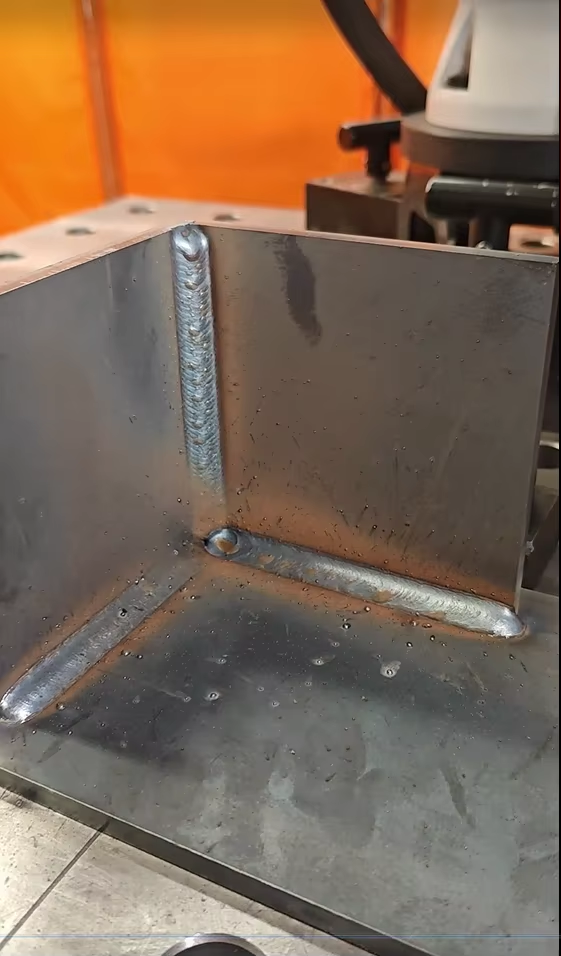
Bridge and Gantry Components: For railway gantries, the machine performs complex miter cuts and weld preparations. Because the 6000W laser provides a cleaner edge than oxy-fuel, the subsequent robotic welding cells can operate with higher consistency, as the fit-up gap is minimized to near-zero tolerances.
6. Thermal Compensation and Environmental Protection
A specific technical concern in the Dubai region is the ambient temperature, which can reach 50°C. The 6000W laser requires a high-capacity dual-circuit water chiller to maintain the temperature of both the laser source and the cutting head.
Furthermore, the machine’s bed and the automatic unloading rails are subject to thermal expansion. The system employs a “floating” rail design and a centralized lubrication system that prevents the fine desert sand from acting as an abrasive in the linear guides. The optical path is kept under positive pressure with filtered nitrogen to prevent dust ingress, which is the leading cause of lens failure in desert environments.
7. Efficiency Metrics and Operational ROI
From an engineering perspective, the transition to an automated H-beam laser system yields the following measurable improvements:
- Labor Reduction: The automatic unloading system reduces the required floor crew from four technicians to one operator.
- Consumable Optimization: High-pressure nitrogen cutting at 6000W eliminates the need for secondary grinding or cleaning of the workpiece, reducing the cost-per-part by an estimated 22%.
- Material Yield: The nesting software specifically designed for 3D profiles optimizes the “tails” of the H-beams, reducing scrap rates in high-cost S355J2 steel by 15%.
8. Conclusion
The integration of 6000W fiber laser technology with automatic unloading systems represents a paradigm shift for structural steel processing in the Middle Eastern railway sector. The ability to maintain high precision under extreme environmental conditions, coupled with the elimination of the unloading bottleneck, allows for a level of production scalability previously unattainable with mechanical or plasma-based methods.
For the Dubai railway infrastructure projects, this machine does not merely offer a faster cut; it provides the structural reliability and geometric precision required for high-speed rail safety. The synergy between the 6000W source’s power density and the mechanical efficiency of the unloading system ensures that the facility can meet both the quality standards of international rail authorities and the commercial demands of the regional market.













