The Industrial Evolution: Why Ho Chi Minh City is Adopting 6000W Beam Lasers
Ho Chi Minh City (HCMC) has long been the heartbeat of Vietnam’s industrial growth. As the city expands its logistics infrastructure, from the modernization of the Cat Lai Port to the construction of massive industrial parks in Long An and Dong Nai, the demand for heavy-duty lifting equipment has skyrocketed. Crane manufacturing—encompassing overhead traveling cranes, gantry systems, and jib cranes—requires structural components that can withstand immense stress and fatigue.
Traditionally, the fabrication of crane girders and support channels relied on oxygen-fuel cutting or plasma systems. While effective, these methods often left wide kerfs, significant heat-affected zones (HAZ), and dross that required hours of manual labor to clean. The introduction of the 6000W CNC Fiber Laser Cutter designed specifically for profiles (beams and channels) has revolutionized this workflow. At 6kW, the laser possesses the power density to pierce through thick-walled structural steel in seconds, offering a level of edge quality that plasma simply cannot match. For HCMC-based manufacturers, this means faster turnaround times and the ability to meet the stringent ISO and AWS (American Welding Society) standards required for international projects.
Technical Mastery: The Power of 6000W and Structural Profiles
A 6000W fiber laser source is considered the “sweet spot” for structural steel fabrication. It provides enough power to handle the heavy webs of H-beams and the thick flanges of U-channels, which are the skeletal components of any crane. Unlike flatbed lasers, a beam laser cutter utilizes a specialized chuck system and a multi-axis head to rotate and move the profile, allowing for 360-degree processing.
The 6kW fiber engine excels in cutting carbon steel, which is the primary material in crane manufacturing. It produces a stable, concentrated beam that minimizes the heat-affected zone. This is critical in crane production because excessive heat can alter the metallurgical properties of the steel, potentially leading to structural vulnerabilities. By maintaining a narrow kerf and minimal thermal distortion, the 6000W laser ensures that the structural integrity of the beam remains intact, ensuring the safety of the final lifting equipment.
±45° Bevel Cutting: Redefining Weld Preparation
The most significant technological leap in these machines is the ±45° bevel cutting head. In the world of crane manufacturing, “fit-up” is everything. Crane girders are subject to dynamic loads; therefore, the welds connecting the various structural members must be deep-penetration welds.
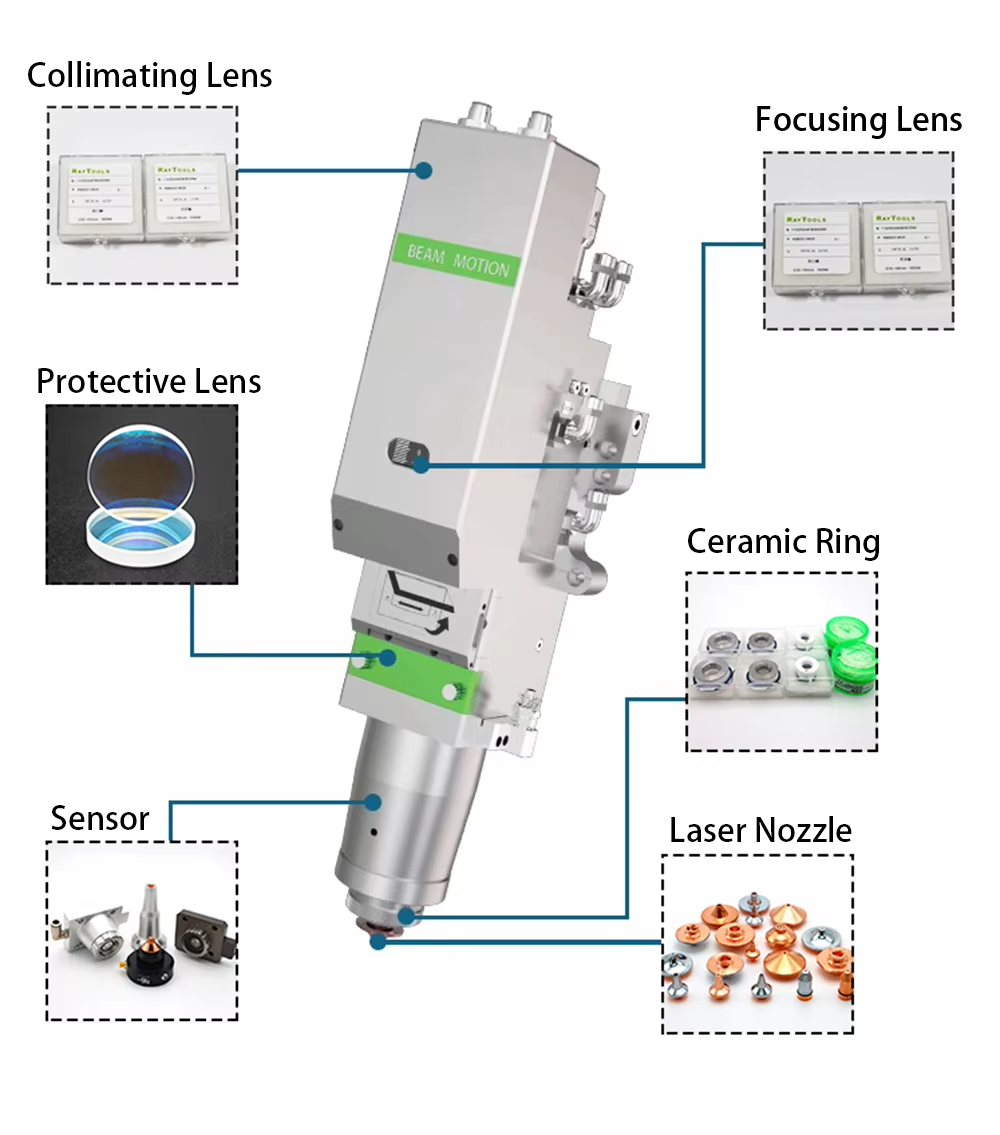
Historically, preparing a “V” or “K” groove on the edge of a thick channel required a secondary process—usually manual grinding or the use of a specialized milling machine. This was time-consuming and prone to human error. The 5-axis CNC laser head changes this by tilting the laser beam up to 45 degrees in either direction during the cutting process.
1. **V-Grooves and Y-Grooves:** The laser can cut the profile and the bevel simultaneously. When two beams are brought together, the pre-cut bevels form a perfect groove for the welding wire to fill, ensuring a high-strength bond.
2. **Precision Countersinking:** The ±45° capability allows for the creation of countersunk holes for bolted connections, which are common in modular crane designs.
3. **Complex Intersections:** When a cross-beam meets a main girder at an angle, the laser can cut complex “saddle” or “fish-mouth” joints with the necessary bevels, allowing for a seamless fit that requires zero gap-filling during welding.
Impact on Crane Structural Integrity and Safety
In Ho Chi Minh City’s competitive construction market, safety is non-negotiable. A crane failure can be catastrophic. The precision of a 6000W CNC laser directly contributes to the safety of the finished product. Because the laser is controlled by sophisticated CAD/CAM software, every bolt hole, slot, and notch is placed with a tolerance of ±0.05mm.
This precision ensures that the load distribution across the crane’s chassis is exactly as the engineers intended. In manual fabrication, a hole that is slightly out of alignment can create a “stress riser,” a point where cracks are likely to form over years of operation. By using a CNC laser, HCMC manufacturers eliminate these irregularities. Furthermore, the clean, dross-free edges produced by the laser ensure that there are no microscopic inclusions or defects trapped in the weld pool, leading to X-ray quality welds every time.
Operational Efficiency in the HCMC Industrial Context
Operating a 6000W laser in the humid, tropical climate of Ho Chi Minh City requires specific engineering considerations. Modern beam cutters destined for this region are equipped with advanced chilling systems and dust extraction units to handle the environmental conditions.
From an efficiency standpoint, the 6000W CNC cutter replaces multiple machines. A single laser can perform:
* **The Saw:** Cutting the beam to length.
* **The Drill Press:** Creating bolt and wiring holes.
* **The Milling Machine:** Creating weld bevels.
* **The Marking Tool:** Etching part numbers and assembly lines directly onto the steel.
By consolidating these processes into a single workstation, manufacturers in HCMC can reduce their floor space requirements and drastically cut down on material handling. In a city where industrial land prices are rising, maximizing the output per square meter is a vital economic strategy.
Software Integration: From CAD to Finished Beam
The “CNC” aspect of these machines is powered by sophisticated nesting software specifically designed for 3D profiles. For a crane manufacturer, this means they can import a 3D model of an entire gantry system into the software. The program then “unwraps” the beams, optimizes the cutting path to minimize material waste (nesting), and generates the G-code for the ±45° bevels.
This digital workflow allows HCMC engineers to prototype new crane designs rapidly. If a client requires a custom span or a specific lift capacity, the modifications can be made in the software and sent directly to the laser. This agility is a significant competitive advantage when bidding for bespoke infrastructure projects across Vietnam and Southeast Asia.
Sustainability and Economic ROI
The transition to 6000W fiber laser technology is also a move toward “Green Manufacturing.” Fiber lasers are significantly more energy-efficient than older CO2 lasers or plasma systems. They convert a higher percentage of electrical energy into light, reducing the carbon footprint of the fabrication shop.
Furthermore, the precision of the laser reduces material waste. In crane manufacturing, where high-grade structural steel is expensive, saving even 3-5% of material through optimized nesting can result in tens of thousands of dollars in annual savings. For a factory in Ho Chi Minh City, the Return on Investment (ROI) for a 6000W beam laser is typically realized within 18 to 24 months, driven by labor savings, reduced secondary processing, and the ability to take on higher-value, more complex projects.
Conclusion: The Future of Heavy Fabrication in Vietnam
As Ho Chi Minh City continues to evolve into a high-tech manufacturing hub, the adoption of 6000W CNC Beam and Channel Laser Cutters is no longer an option—it is a necessity for those who wish to lead the market. The ability to process heavy structural sections with ±45° beveling allows crane manufacturers to produce equipment that is lighter, stronger, and safer than ever before.
This technology is not just about cutting steel; it is about elevating the entire standard of Vietnamese engineering. By embracing the precision of fiber lasers, HCMC’s crane industry is positioning itself at the forefront of the global supply chain, ready to build the infrastructure of tomorrow with the surgical accuracy of light.