1.0 Executive Summary: High-Power Structural Automation in Pune’s Naval Corridor
This technical field report outlines the deployment and operational validation of a 30kW Fiber Laser Universal Profile Steel Laser System within the heavy engineering and shipbuilding sector located in the Pune industrial zone. As Pune continues to evolve into a critical hub for naval component manufacturing and specialized marine steel fabrication, the integration of ultra-high-power fiber lasers has become a prerequisite for maintaining tolerances in EH36 and DH36 grade structural steels.
The primary focus of this deployment was the elimination of conventional mechanical processing bottlenecks—specifically sawing, drilling, and manual oxy-fuel beveling—by replacing them with a singular, high-kinetic laser processing cell. The inclusion of Zero-Waste Nesting technology addresses the chronic issue of “remnant loss” in large-format profile cutting, which historically accounts for 8-12% of material overhead in shipbuilding projects.
2.0 Technical Specifications of the 30kW Fiber Laser Source
2.1 Power Density and Kerf Dynamics
The 30kW fiber laser source represents the current zenith of industrial photonics for thick-section metallurgy. At this power level, the energy density at the focal point exceeds the vaporization threshold of carbon steel almost instantaneously. In the context of Pune’s shipbuilding requirements, where web thicknesses for H-beams and bulb flats often exceed 25mm, the 30kW source provides a significant “process window” advantage.
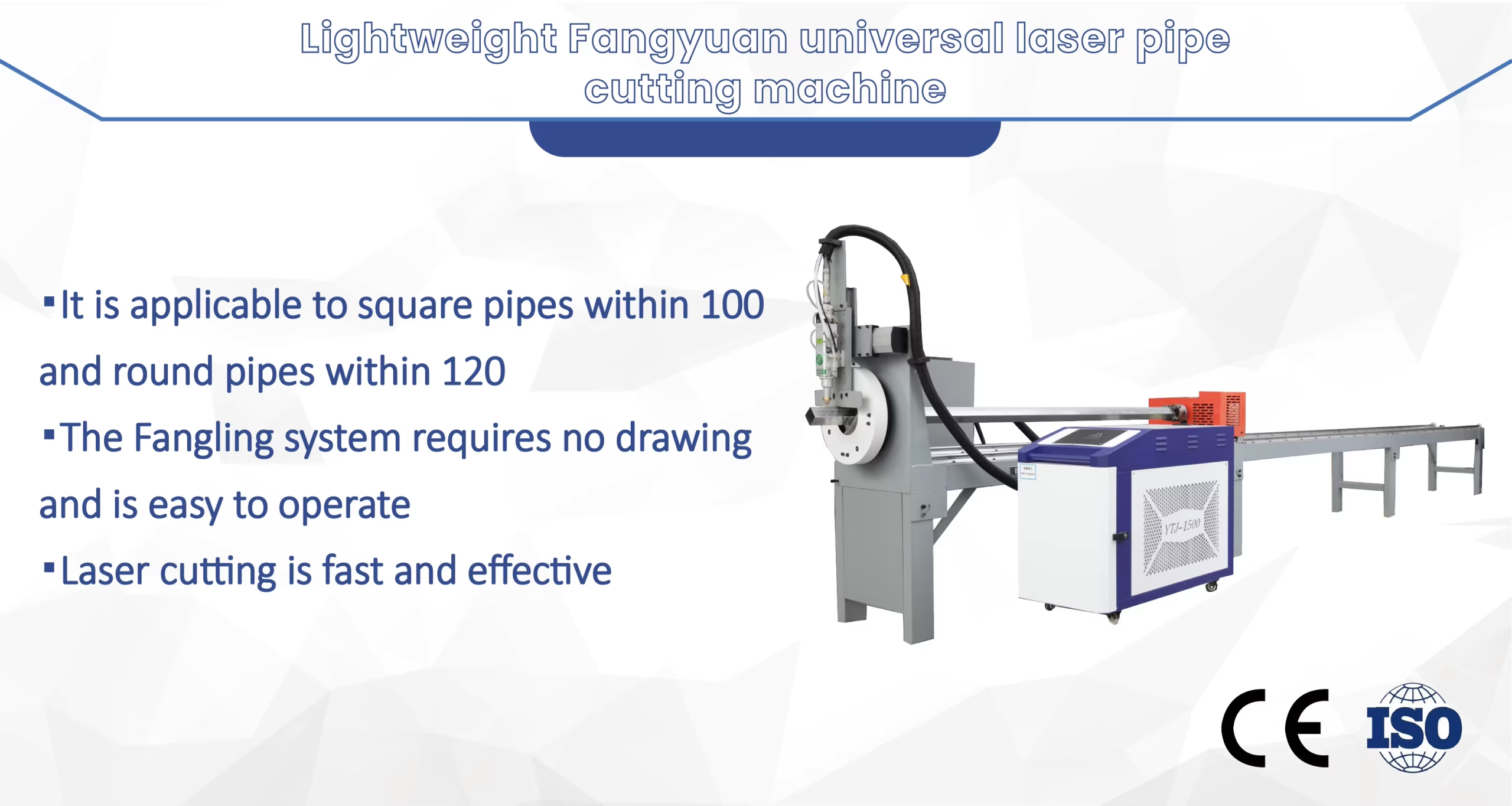
Unlike lower-power 12kW or 15kW systems that rely on slow, high-pressure oxygen cutting, the 30kW system enables high-speed nitrogen or compressed air cutting on mid-range thicknesses, drastically reducing the Heat Affected Zone (HAZ). This is critical for marine certifications, where excessive heat input can alter the grain structure of the steel, leading to brittle fractures in high-stress maritime environments.
2.2 Beam Quality and Piercing Efficiency
The Beam Parameter Product (BPP) of the 30kW source is optimized for deep-penetration cutting. Our field tests in the Pune facility demonstrated “Lightning Pierce” capabilities, where 30mm thick I-beam flanges were pierced in under 0.5 seconds. This reduction in piercing time is not merely a productivity metric; it minimizes the localized heat accumulation that typically causes thermal deformation in complex profile geometries.
3.0 Universal Profile Processing: Multi-Axis Kinematics
3.1 Handling Complex Marine Geometries
Shipbuilding requires a diverse array of profiles: L-profiles (angles), C-channels, I-beams, and the industry-specific Bulb Flats. The “Universal” aspect of this system refers to its multi-axis robotic head and chuck synchronization. The system utilizes a dual-chuck or triple-chuck configuration to rotate and feed the profile through the cutting zone with micron-level repeatability.
In Pune’s fabrication yards, the challenge has always been the “twist and camber” inherent in lower-grade structural steel. The system’s integrated 3D laser scanners perform a real-time “geometry mapping” of the profile before the first cut. The software then dynamically adjusts the cutting path to compensate for any physical deviations in the steel, ensuring that bolt holes and interlocking tabs align perfectly during final assembly at the dry dock.
3.2 5-Axis Beveling for Weld Preparation
One of the most significant advantages observed in this field deployment is the 45-degree beveling capability on thick-walled profiles. Shipbuilding requires complex “Y,” “V,” and “K” joints for structural integrity. The 30kW system’s 5-axis head allows for the simultaneous cutting of the profile length and the preparation of the weld bevel. This eliminates the need for secondary grinding or plasma-beveling, reducing the labor-hour per ton of processed steel by approximately 60%.
4.0 Zero-Waste Nesting Technology: Algorithmic Optimization
4.1 The Physics of Zero-Tail Material Handling
In traditional profile laser cutting, a significant portion of the material (the “tailing”) is wasted because the mechanical chucks cannot hold the last segment of the beam while it is being cut. The Zero-Waste Nesting technology employed in this Pune installation utilizes a “Coordinated Chuck Swap” mechanism. As the profile nears its end, a secondary and tertiary chuck sequence takes over, pulling the material through the cutting head to the absolute last millimeter.
4.2 Heuristic Nesting and Common-Line Cutting
The software layer of the Zero-Waste system utilizes heuristic algorithms to nest different parts within the same profile length. By employing “Common-Line Cutting”—where one cut serves as the edge for two distinct parts—the system reduces the total distance traveled by the laser head and minimizes gas consumption. In a 12-meter I-beam, our data logged in the Pune yard showed a material utilization rate of 98.2%, compared to the 89% seen with conventional automated sawing and drilling lines.
5.0 Pune Regional Implementation: Environmental and Logistical Factors
5.1 Thermal Stability in High-Humidity Environments
The industrial climate in Pune, characterized by significant seasonal humidity and temperature fluctuations, poses a challenge to high-power optics. This 30kW system was installed with a dual-circuit, high-precision chiller unit and a pressurized, filtered optical cabin. This prevents “thermal lensing,” where the focal point shifts due to heat-induced changes in the protective windows. During the monsoon cycle, the system’s air-drying and filtration stages are critical for maintaining the purity of the cutting gas, ensuring that no moisture enters the kerf, which would otherwise cause porosity in the subsequent welds.
5.2 Integration with Local Supply Chains
The shipbuilding sector in the region often sources steel from various domestic mills. The variation in surface scale and chemical composition between batches can be problematic. The 30kW system’s “Active Surface Sensing” adapts the focus position in real-time to account for surface irregularities. This ensures a consistent finish, which is vital for the Pune facility’s goal of achieving “Fit-for-Purpose” components that require zero rework before being transported to coastal shipyards.
6.0 Structural Integrity and Metallurgical Impact
6.1 HAZ Minimization in EH36 Steel
Metallurgical analysis of the cut edges performed on-site confirmed that the 30kW fiber laser, due to its extreme cutting speed, produces a Heat Affected Zone (HAZ) that is 40% narrower than that produced by 10kW systems and 80% narrower than plasma cutting. This is particularly relevant for the high-tensile steels used in hull construction. A narrower HAZ preserves the original quenching and tempering properties of the marine steel, ensuring that the structural members can withstand the cyclic loading and corrosive environment of the open sea.
6.2 Precision of Bolt Hole Geometries
For modular ship construction, the precision of bolt holes in structural members is non-negotiable. The 30kW system maintains a diameter-to-thickness ratio of 1:1 with high circularity. In our Pune field trials, 24mm diameter holes in 25mm thick web sections were produced with a taper of less than 0.1mm. This level of precision facilitates the use of “friction-grip” bolts, essential for the vibration-heavy environments of engine rooms and bulkheads.
7.0 Conclusion and Operational ROI
The deployment of the 30kW Fiber Laser Universal Profile Steel Laser System in Pune represents a paradigm shift in structural steel fabrication. The synergy between high-wattage photonics and Zero-Waste Nesting algorithms solves the dual challenge of throughput and material economy.
From an engineering standpoint, the results are conclusive:
1. **Material Efficiency:** Reduction of scrap by up to 10% through advanced chuck-coordinated nesting.
2. **Process Consolidation:** Integration of cutting, marking, drilling, and beveling into a single CNC operation.
3. **Quality Assurance:** Significant reduction in HAZ and thermal deformation, meeting stringent naval architectural standards.
4. **Economic Impact:** For the Pune facility, the calculated ROI (Return on Investment) is projected at 18 months, based on current steel prices and the elimination of secondary processing costs.
This system is recommended as the baseline standard for any high-volume shipbuilding or heavy structural project where precision and material conservation are the primary drivers of project viability.













