The Dawn of High-Power Laser Processing in Katowice
The global transition toward renewable energy has placed immense pressure on the manufacturing sector to produce wind turbine components faster, cheaper, and with higher precision. In Katowice, a city with a deep-rooted history in heavy metallurgy and engineering, the introduction of a 30kW Fiber Laser Universal Profile Steel Laser System marks the beginning of a new industrial chapter. This is not merely an incremental upgrade; it is a leap into the frontier of “Extreme Power” laser processing.
For wind turbine towers, which are essentially massive tapered steel cylinders, the requirements for material thickness and edge quality are stringent. Traditionally, these components were processed using plasma or oxy-fuel cutting. However, the 30kW fiber laser provides a level of thermal control and speed that was previously unthinkable for plates exceeding 30mm. By situating this technology in Katowice, manufacturers are leveraging the region’s logistical advantages and skilled workforce to create a hub for European wind energy infrastructure.
The Technical Superiority of 30kW Fiber Optics
As an expert in fiber laser technology, I must emphasize that the jump to 30kW changes the physics of the cut. At lower power levels, such as 10kW or 12kW, cutting thick carbon steel requires a delicate balance of gas pressure and slow feed rates to maintain a stable melt pool. At 30kW, the energy density is so high that the laser achieves a “keyhole” effect even in thick-section steel, allowing for lightning-fast vaporization and expulsion of the melt.
In the context of wind turbine towers—where sections are often made of S355 or S420 structural steel—the 30kW source allows for high-speed nitrogen or oxygen cutting of 20mm to 50mm plates. The result is an incredibly narrow kerf and a Heat Affected Zone (HAZ) that is significantly smaller than that produced by plasma cutting. This is critical for wind towers, as a large HAZ can lead to micro-cracking or grain growth, compromising the fatigue life of the tower under the constant oscillation of the turbine blades.
Universal Profile Processing: Beyond Flat Sheets
The “Universal Profile” designation of this system is what truly sets it apart for the wind energy sector. Wind turbine manufacturing is not limited to flat plates that are rolled into cans. It involves complex flanges, internal support structures, ladder brackets, and door frames that require processing of various steel profiles—including L-beams, I-beams, and heavy-walled tubes.
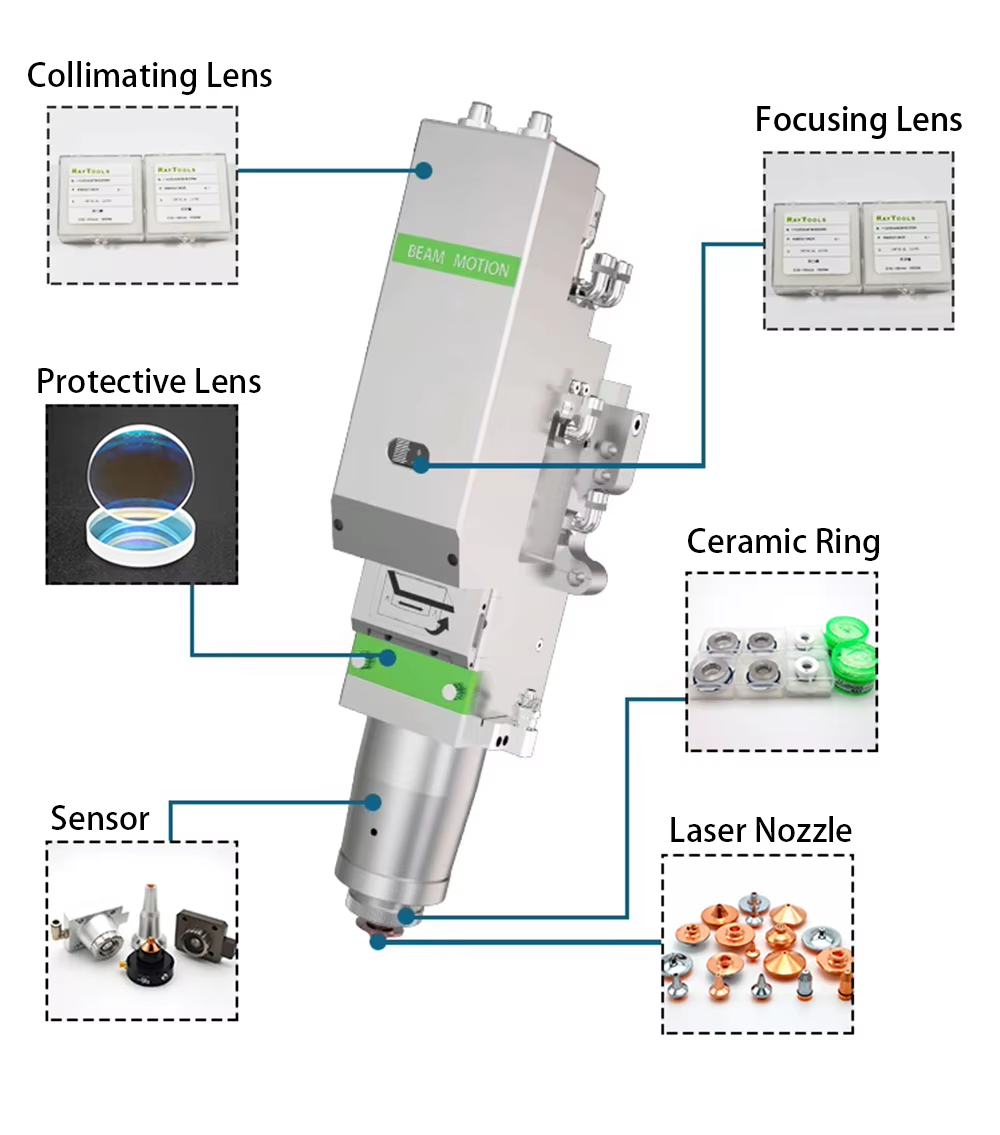
A Universal Profile system equipped with a 3D cutting head allows for 5-axis manipulation. This enables the machine to perform complex bevel cuts (V, X, K, and Y shapes) directly onto the profiles. In the past, these bevels had to be ground manually or processed on a separate secondary machine to prepare them for welding. By integrating beveling and profile cutting into a single 30kW laser cycle, the Katowice facility can reduce the total production time of a tower section by as much as 30%. The precision of the laser ensures that when these massive profiles meet for welding, the fit-up is perfect, reducing the volume of weld filler metal required and ensuring a stronger bond.
Efficiency Through Automatic Unloading Systems
One of the most significant bottlenecks in high-power laser cutting is material handling. A 30kW laser cuts so fast that a manual loading and unloading crew cannot keep up. Without automation, the “beam-on” time—the only time the machine is actually making money—drops significantly.
The system in Katowice features a state-of-the-art automatic unloading system designed specifically for the heavy, oversized segments characteristic of wind towers. Once the 30kW head has finished its path, a series of heavy-duty vacuum lifters or magnetic grippers, coordinated by sophisticated nesting software, identifies each part and moves it to a designated pallet.
This automation serves two purposes. First, it ensures the safety of the operators. Handling 40mm thick steel plates is inherently dangerous; removing the human element from the immediate vicinity of the cutting bed reduces the risk of industrial accidents. Second, it allows for “lights-out” manufacturing. The system can continue to process and unload parts through the night, ensuring that the rolling and welding stations are constantly supplied with fresh components for the next shift.
Strategic Importance of the Katowice Installation
Katowice is strategically positioned as a gateway between Western European design and Eastern European manufacturing capacity. The city’s proximity to major steel mills in Poland and the Czech Republic minimizes the “carbon footprint of the footprint”—the environmental cost of transporting raw steel to the laser system.
For the wind energy sector, which is under scrutiny to ensure its own supply chain is as green as the energy it produces, the efficiency of the 30kW fiber laser is a major selling point. Fiber lasers have a wall-plug efficiency of approximately 40-45%, which is far superior to CO2 lasers or older plasma systems. When you combine this electrical efficiency with the reduced waste from precise nesting and the elimination of secondary grinding processes, the Katowice system becomes a benchmark for sustainable heavy manufacturing.
Overcoming Challenges in Thick Plate Laser Cutting
While 30kW offers immense power, it also introduces challenges that require expert calibration. At these power levels, back-reflection can be a significant issue when cutting highly reflective materials or during the piercing phase. The system in Katowice utilizes advanced optical isolators and real-time sensor feedback to protect the laser source from reflected energy.
Furthermore, the “Smart Piercing” technology integrated into this system is vital for wind tower production. Piercing a 40mm plate can traditionally take several seconds and create a large crater of slag. The 30kW system uses high-frequency pulsing and precise gas pressure modulation to “drill” through the steel in a fraction of a second, leaving a clean hole that allows the cut to begin immediately. This prevents the accumulation of heat in the plate, which is essential for maintaining the dimensional accuracy of large-diameter tower flanges.
The Impact on Weld Preparation and Structural Integrity
In wind turbine tower construction, the weld is the most vulnerable point. The industry is moving toward “friction stir welding” and advanced “submerged arc welding,” both of which require incredibly tight tolerances. A 30kW fiber laser delivers an edge quality that is almost “weld-ready.”
By using the universal profile capabilities to cut precise bevels, the Katowice system eliminates the need for manual edge preparation. This consistency is vital for robotic welding cells. If the bevel angle or the root face varies by even a millimeter, the robotic welder may produce a defect. The laser’s repeatability ensures that every segment of the wind tower is identical, allowing for a seamless transition to automated welding and assembly.
The Future: Scaling for Offshore Wind
The current trend in wind energy is “bigger is better.” Offshore turbines are now reaching capacities of 15MW and beyond, requiring towers that are taller, thicker, and wider than ever before. The 30kW system in Katowice is designed with this future in mind. Its large-format cutting bed and the sheer power of the 30kW source mean it is already capable of handling the next generation of S460 and S690 high-strength steels that will be required for deep-water offshore foundations (monopiles) and towers.
As these towers grow in scale, the “Universal Profile” aspect will become even more important. Secondary structures like internal platforms and complex cable management systems will require intricate cuts in heavy-duty profiles. The 30kW laser’s ability to handle these with speed and precision will be the deciding factor in which manufacturers remain competitive in the surging European offshore market.
Conclusion: A Benchmark for European Industry
The 30kW Fiber Laser Universal Profile Steel Laser System with Automatic Unloading in Katowice is more than a piece of machinery; it is a strategic asset for the European energy transition. It represents the perfect marriage of raw power and intelligent automation. By solving the bottlenecks of thick-material processing and manual handling, it provides a blueprint for how heavy industry can evolve to meet the demands of the 21st century.
For the engineers and stakeholders in Katowice, this system provides the tools to build the backbone of the renewable grid. From the precision of the 30kW beam to the efficiency of the automated unloading, every element of this system is tuned for the high-stakes world of wind turbine manufacturing, ensuring that the towers of tomorrow are stronger, more efficient, and produced with an unprecedented level of technological sophistication.