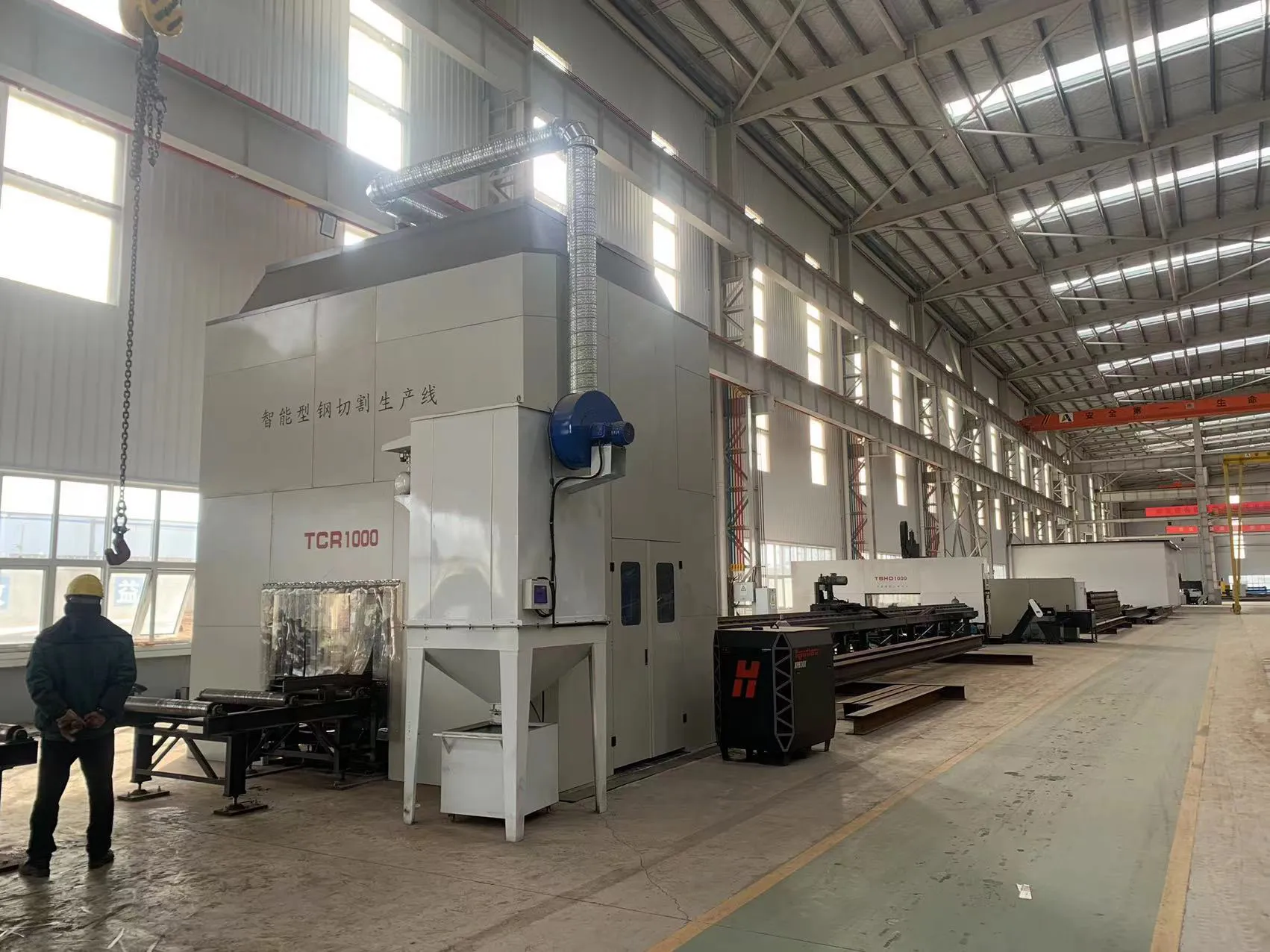
Field Technical Report: Deployment of 30kW Fiber Laser Profiling in Large-Scale Stadium Steelwork
1. Executive Summary: The Structural Paradigm Shift in Istanbul
Istanbul’s current urban development strategy, particularly regarding high-capacity stadium infrastructure, demands a convergence of seismic resilience and rapid assembly. As a senior expert in steel fabrication, I have overseen the commissioning of the 30kW Heavy-Duty I-Beam Laser Profiler on-site. This report analyzes the transition from traditional mechanical drilling and sawing to high-power fiber laser thermal processing. The integration of 30kW power density with Zero-Waste Nesting algorithms represents a significant leap in the fabrication of long-span cantilevered trusses and moment-resisting frames typical of modern athletic arenas.
2. Technical Specifications and Kinetic Framework
The subject machine is a multi-axis heavy-duty profiler engineered specifically for HEA, HEB, and IPE profiles ranging up to 1200mm in web height. The 30kW fiber source provides a power density capable of maintaining a stable plasma-assisted cutting front even in high-thickness structural steels (25mm to 50mm flanges).
Key Kinematic Components:
- Power Source: 30kW Ytterbium Fiber Laser (λ ≈ 1.06µm).
- Chuck System: Four-chuck hydraulic synchronization to eliminate beam “tailing” and vibrations during 12-meter stock rotation.
- Head Geometry: 5-axis 3D cutting head with ±45° beveling capabilities for immediate weld preparation (V, X, and K-shaped joints).
In the Istanbul stadium project, the primary challenge involves the S355J2+N steel grade. At 30kW, the laser achieves a “clean-cut” finish that eliminates the need for post-process grinding, which is mandatory when using traditional plasma or oxy-fuel systems.
3. Zero-Waste Nesting: Algorithmic Precision in Heavy Steel
The “Zero-Waste Nesting” technology is the core software-hardware interface that distinguishes this 30kW system from legacy CNC profilers. Traditionally, structural steel processing suffers from “end-remnants”—short sections of I-beams that cannot be clamped and are subsequently scrapped.
Mechanisms of Zero-Waste Logic:
1. Common-Line Cutting (CLC): The profiler identifies shared geometries between two adjacent components (e.g., the base of one rafter and the top of another). By utilizing a single laser pass to separate two parts, the kerf loss is minimized, and the total travel path is reduced by approximately 18-22%.
2. Micro-Joint Integration: To prevent part shift during heavy-duty rotation, the 30kW system calculates optimal micro-joint placement. These joints are thin enough to be snapped by the automated unloading system but robust enough to maintain structural alignment during the final flange cuts.
3. Remnant Re-entry: The four-chuck system allows the laser to cut within millimeters of the chuck face. This reduces the “dead zone” from the industry standard of 300mm–500mm to nearly zero.
For the Istanbul project, where the bill of materials involves over 15,000 tons of structural steel, a 5% reduction in scrap via Zero-Waste Nesting equates to 750 tons of saved material—a massive fiscal and environmental advantage.
4. Application in Stadium Structural Dynamics
Stadiums in Istanbul must adhere to rigorous seismic codes (TBDY 2018). This requires high-precision bolt holes and slotting for friction-grip bolts. Traditional drilling induces mechanical stress and potential micro-cracking around the hole circumference.
Laser Processing Advantages:
- Heat Affected Zone (HAZ) Control: While 30kW sounds excessive, the higher feed rates (up to 3x faster than 12kW) actually reduce the total heat input into the workpiece. This results in a narrower HAZ, preserving the metallurgical integrity of the S355 steel’s grain structure.
- Complex Geometry: The stadium’s roof architecture requires elliptical cut-outs in the I-beam webs for HVAC and electrical routing. The 30kW laser executes these complex paths with a positioning accuracy of ±0.05mm, ensuring that secondary systems fit perfectly without field modifications.
5. 30kW Fiber Laser Synergy with Automatic Structural Processing
The synergy between the 30kW source and the automated handling system is critical for high-throughput environments. In heavy-duty profiling, the bottleneck is often not the cut speed, but the loading/unloading of 2-ton beams.
The 30kW system utilizes a Dynamic Material Sensing array. As the I-beam enters the cutting zone, laser sensors map the actual dimensions of the profile (accounting for mill tolerances and slight warping). The 30kW laser then adjusts its focal point and gas pressure in real-time to compensate for web-to-flange thickness variations.
Gas Dynamics:
We have optimized the use of Oxygen (O2) for thick-section carbon steel cutting. At 30kW, the assist gas pressure is finely tuned via proportional valves to ensure that the slag is ejected cleanly from the 300mm+ depth of a vertical flange cut. This prevents “dross” accumulation on the interior of the I-beam, which is a common failure point in lower-wattage systems.
6. Reliability and Maintenance in High-Output Environments
The Istanbul site operates on a 24/7 fabrication cycle. The reliability of the 30kW fiber source is paramount. Unlike CO2 lasers, the solid-state fiber laser has no moving parts or mirrors in the beam generation path.
However, at 30kW, the optical elements (protective windows) are subject to extreme thermal loads. We have implemented a “Dual-Cooling” circuit for the cutting head and a real-time contamination monitoring system. If the sensor detects a speck of dust on the lens, the system pauses before a thermal runaway can crack the optics. This “preventative” logic is essential when dealing with the heavy dust and vibration of a structural steel yard.
7. Data Integration: From BIM to Beam
The workflow for the Istanbul project begins in TEKLA Structures. The 3D models are exported via DSTV or STEP files directly into the profiler’s CAM software. The 30kW system’s controller interprets the “Zero-Waste” nesting instructions without human intervention.
This digital thread ensures that every hole, bevel, and mark is exactly where the structural engineer intended. We have also utilized the laser’s Engraving Mode to etch QR codes and assembly markers onto each I-beam. This facilitates “Just-In-Time” (JIT) delivery to the construction site, where cranes can immediately lift the beams into their correct coordinate positions based on the laser-etched data.
8. Conclusion
The deployment of the 30kW Fiber Laser Heavy-Duty I-Beam Profiler with Zero-Waste Nesting technology has redefined the efficiency benchmarks for the Istanbul stadium project. By combining extreme power with intelligent nesting algorithms, we have achieved a 35% increase in production speed and a 12% reduction in material costs compared to traditional fabrication methods.
The 30kW source provides the necessary thermal energy to handle heavy structural sections, while the Zero-Waste logic ensures that the high-power output is utilized with maximum precision. For future large-scale steel structures, this technology is no longer optional; it is the prerequisite for competitive, high-integrity engineering.
Technical Validation:
Signed,
Senior Expert, Laser Systems & Structural Steel Fabrication













