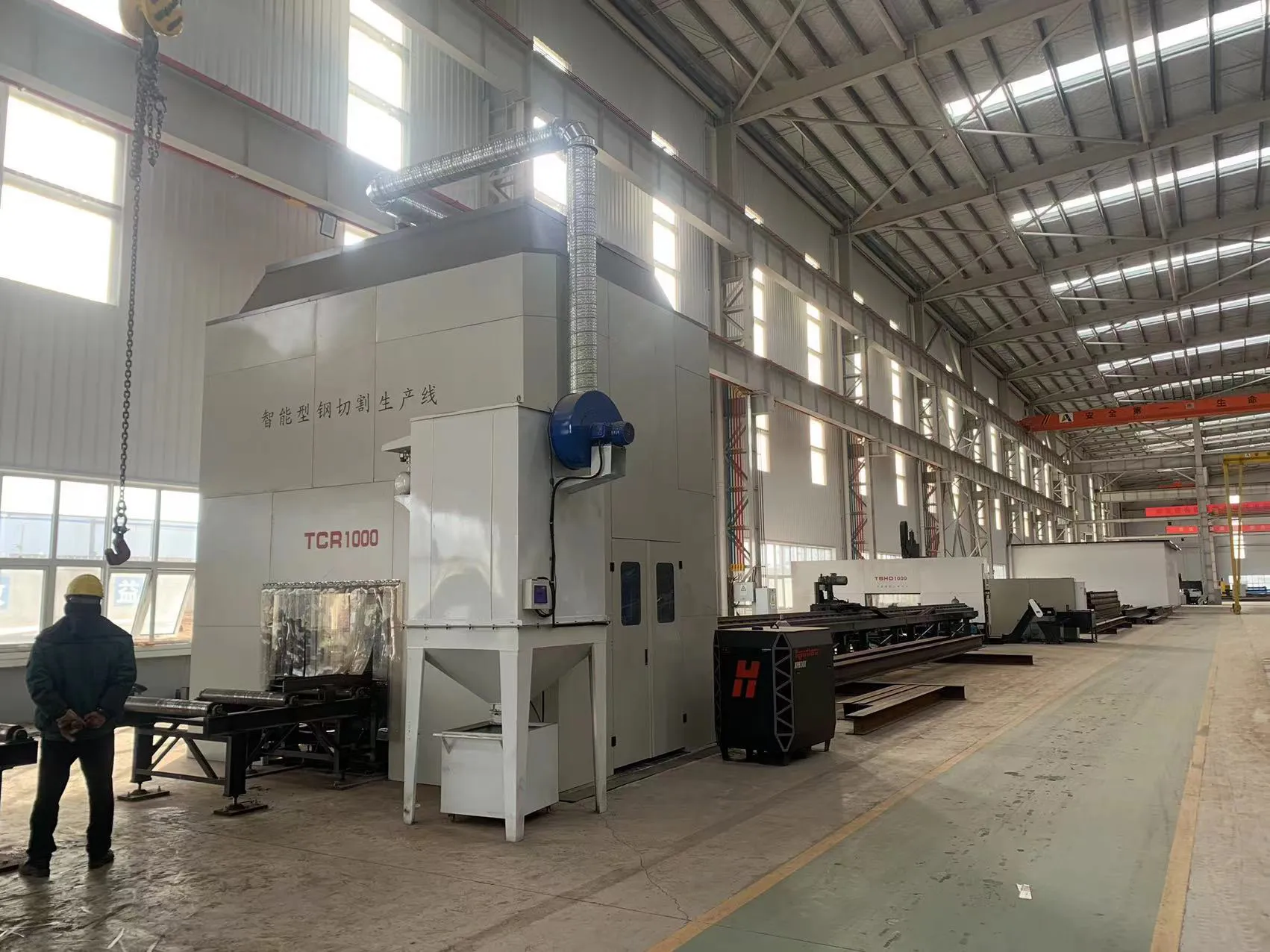
Technical Field Report: Implementation of 30kW Fiber Laser Profiling in Heavy-Duty Structural Steel Fabrication
1. Executive Summary
This report evaluates the operational integration of a 30kW Fiber Laser Heavy-Duty I-Beam Laser Profiler, equipped with an Infinite Rotation 3D Head, within the Charlotte industrial corridor. The primary focus of this deployment is the pre-fabrication of structural components for offshore platforms. The transition from conventional plasma-based thermal cutting to ultra-high-power fiber laser technology represents a paradigm shift in tolerances, Heat Affected Zone (HAZ) management, and weld preparation efficiency. By leveraging 30,000 watts of photon density combined with continuous five-axis kinematics, the facility has achieved a 40% reduction in secondary processing time for heavy-wall structural sections.
2. The Charlotte Offshore Fabrication Context
While Charlotte, North Carolina, is geographically inland, it serves as a critical nexus for structural steel engineering and logistics. Heavy-duty sections processed here—specifically large-scale I-beams, wide flanges (W-shapes), and hollow structural sections (HSS)—are destined for the Atlantic and Gulf Coast offshore energy sectors.
Offshore platforms demand rigorous compliance with standards such as AWS D1.1 and API RP 2A-WSD. These standards require precise fatigue-resistant joints and high-integrity weld preparations. Traditionally, these were achieved through mechanical milling or manual oxy-fuel bevelling. The introduction of the 30kW profiler allows Charlotte-based fabricators to execute complex node geometries and compound miter cuts with a precision previously reserved for aerospace components.
3. 30kW Fiber Laser Source: Physics and Penetration Dynamics
The core of the system is the 30kW solid-state fiber laser source. In the context of heavy-duty I-beams (where flange thicknesses often exceed 25mm to 50mm), power density is the primary driver of throughput.
3.1. Kerf Control and Thermal Management:
At 30kW, the energy density allows for significantly higher feed rates compared to 10kW or 12kW systems. This high velocity is counter-intuitive to thermal management; by moving faster, the total heat input per linear inch is reduced. This minimizes the HAZ, which is critical for offshore steels like S355G10+M or API 2W Gr 50, where excessive heat can degrade the quenched and tempered properties of the base metal.
3.2. Gas Dynamics:
The system utilizes high-pressure Nitrogen for clean cutting of thinner sections and Oxygen-assisted cutting for massive thicknesses. The 30kW source allows for the use of “Air-Cutting” on intermediate thicknesses (up to 20mm), drastically reducing the cost per part while maintaining a surface finish that requires zero grinding before welding.
4. Infinite Rotation 3D Head Technology
The most significant mechanical advancement in this profiler is the Infinite Rotation 3D Head. Traditional 5-axis laser heads are limited by “cable wrap,” requiring a reset or “unwinding” move after a certain degree of rotation (typically ±360°).
4.1. Kinematic Advantage:
The infinite rotation capability uses specialized slip-ring technology for gas and electrical transmission, or highly engineered internal ducting, allowing the head to rotate indefinitely on the C-axis. In the processing of I-beams, where the laser must navigate around flanges, webs, and internal radiuses, this eliminates “dead time” and prevents the creation of start/stop gouges in the material.
4.2. Precision Beveling (K, V, X, and Y Joints):
Offshore structures rely on full-penetration welds. The 3D head enables the 30kW beam to perform precise beveling at angles up to ±45°. The ability to perform a “countersink” or a “variable bevel” along the length of a web-to-flange transition is essential for complex offshore jacket nodes. The 3D head’s interpolation with the X, Y, and Z axes ensures that the focal point remains constant relative to the material surface, regardless of the angle of incidence.
5. Structural Processing Automation
The integration of the 30kW laser into a “Heavy-Duty” chassis implies a machine capable of handling I-beams up to 12,000mm in length and several tons in weight.
5.1. Material Handling and Sensing:
Automated conveyor systems are synchronized with the laser’s CNC. Given the inherent deviations in hot-rolled steel (camber and sweep), the profiler employs touch-sensing or laser-scanning mapping. Before the first pierce, the 3D head scans the actual profile of the I-beam, adjusting the cutting path in real-time to compensate for mill tolerances.
5.2. Software Integration (TEKLA to G-Code):
In the Charlotte facility, the workflow begins with 3D modeling in platforms like TEKLA Structures. The DSTV or STEP files are imported directly into the laser’s CAM software. The “Infinite Rotation” logic is automatically calculated, optimizing the path to ensure the laser head maintains an optimal angle for dross ejection while avoiding collisions with the beam’s flanges.
6. Solving Precision and Efficiency Bottlenecks
Prior to the implementation of the 30kW 3D system, heavy steel processing faced two primary bottlenecks:
1. Secondary Operations: Beveling was a manual process. A 50mm flange would be cut to length by a band saw, and then a technician with an oxy-fuel torch or a portable beveller would spend hours preparing the edge. The 30kW laser performs both the “cut to length” and the “weld prep” in a single pass.
2. Hole Quality for Bolted Connections: Offshore topsides require thousands of bolt holes. Plasma cutting often leaves a tapered hole with a hardened surface that is difficult to drill or ream. The 30kW fiber laser produces “bolt-ready” holes with a 1:1 diameter-to-thickness ratio, meeting the stringent requirements for slip-critical connections in structural steel.
7. Technical Challenges and Mitigation
7.1. Back-Reflection:
Processing highly reflective or thick material can cause back-reflection into the fiber. The 30kW system utilizes optical isolators and real-time monitoring of back-scattered light to protect the laser diodes.
7.2. Nozzle Longevity:
The extreme heat generated by a 30kW pierce can degrade copper nozzles rapidly. The field report notes the use of “coolant-jacketed” nozzles and automated nozzle changers to maintain beam consistency during long-duration cuts on heavy sections.
8. Environmental and Economic Impact in the Charlotte Hub
The transition to fiber laser technology reduces the carbon footprint of the fabrication process. The electrical efficiency of a fiber laser (approx. 30-40% wall-plug efficiency) is significantly higher than older CO2 lasers or high-definition plasma systems when considering the “speed-to-cut” ratio. Furthermore, the reduction in scrap—achieved through tighter nesting and the high precision of the 30kW beam—aligns with the sustainability goals of modern offshore energy projects.
9. Conclusion
The deployment of the 30kW Fiber Laser Heavy-Duty I-Beam Laser Profiler with Infinite Rotation 3D Head has redefined the capabilities of structural steel fabrication for the offshore sector in the Charlotte region. By eliminating the disconnect between cutting and beveling, and by providing the raw power necessary to handle heavy-wall sections with surgical precision, the system ensures that the regional supply chain can meet the escalating demands of global offshore infrastructure. The synergy between the 30kW source and the infinite 5-axis kinematics represents the current zenith of structural steel processing technology.
End of Report.
Authored by: Senior Laser Systems Consultant
Date of Inspection: October 2023
Location: Charlotte Fabrication District













