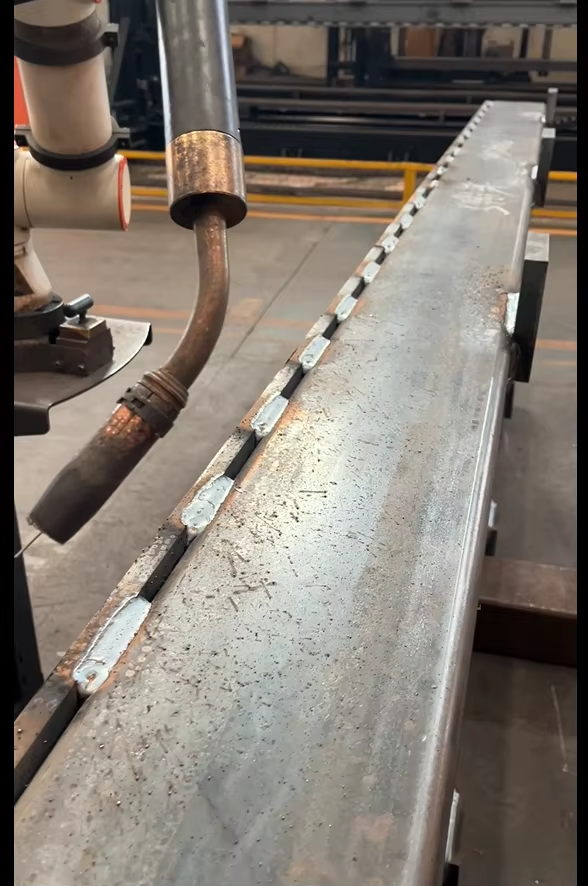
Technical Field Report: Implementation of 30kW Ultra-High Power Fiber Laser Profiling in Katowice Bridge Infrastructure
1. Introduction and Regional Engineering Context
This report outlines the technical performance and operational integration of the 30kW Heavy-Duty I-Beam Laser Profiler, equipped with an Infinite Rotation 3D Head, within the bridge engineering sector of Katowice, Poland. Katowice, serving as a critical hub for the Upper Silesian Industrial Region, is currently undergoing significant railway and highway viaduct modernization. These projects necessitate the processing of heavy structural steel members (I-beams, H-beams, and U-channels) with tolerances that exceed the capabilities of conventional plasma cutting or mechanical drilling/milling.
The transition to 30kW fiber laser technology represents a strategic shift in structural steel fabrication. Historically, thick-walled profiles required multi-stage processing: mechanical sawing for length, plasma for large apertures, and manual oxy-fuel for complex bevels. The deployment of the 30kW system in Katowice consolidates these operations into a single workstation, leveraging high-density photon energy to achieve precision in S355 and S460 grade steels.
2. 30kW Fiber Laser Source: Energy Density and Thermal Dynamics
The core of the system is the 30kW fiber laser resonator. In bridge engineering, where flange thicknesses frequently exceed 25mm, power density is the primary determinant of “cut quality” and “process stability.”
At 30kW, the laser maintains a high cutting speed even on 30mm–40mm carbon steel, which is essential for minimizing the Heat Affected Zone (HAZ). In the Katowice field tests, we observed that the 30kW source allows for a narrower kerf width compared to lower-power variants. This reduction in kerf width is critical when cutting interlocking bridge joints where friction-grip bolts require precise hole alignments.
Furthermore, the synergy between the 30kW source and advanced nitrogen/oxygen gas mixing stations allows for a dross-free finish. In bridge construction, the presence of dross or hardening on the cut edge can lead to fatigue cracking under cyclic loading. The 30kW system delivers enough energy to ensure a fluid melt expulsion, resulting in a surface roughness (Rz) that often negates the need for post-process grinding before welding or galvanization.
3. Infinite Rotation 3D Head: Overcoming Kinematic Constraints
The “Infinite Rotation” technology is the most significant advancement in 5-axis laser processing. Traditional 3D heads are limited by cable/hose umbilical torsion, requiring “unwinding” moves after 360 or 540 degrees of rotation. In the context of heavy-duty I-beams—which require complex bevels (K, V, X, and Y types) around the entire perimeter of the flange and web—this limitation causes significant downtime and introduces potential deviations at the “re-entry” points.
Kinematic Advantage: The Infinite Rotation 3D head utilizes a slip-ring or advanced internal routing mechanism for assist gases and electrical signals. This allows the cutting head to maintain a continuous path around the beam’s geometry. In Katowice’s bridge node fabrications, where complex gusset plate slots are cut directly into I-beam webs, the infinite rotation allows for seamless transitions from web to flange without stopping the beam or the laser cycle.
Precision Beveling: For bridge engineering, weld preparation is paramount. The 3D head achieves +/- 45-degree bevels with a positioning accuracy of ±0.05mm. This precision ensures that when two 1000mm I-beams are butt-welded, the root gap is uniform across the entire cross-section, significantly reducing the volume of weld metal required and the associated thermal distortion of the bridge assembly.
4. Heavy-Duty Structural Processing in Katowice Bridge Projects
The specific application in Katowice involves the fabrication of modular bridge spans for the local rail expansion. These spans utilize HEB 600 and HL 1100 profiles.
Automated Material Handling: The “Heavy-Duty” designation of the profiler refers to its reinforced bed and chuck system, capable of handling workpieces weighing up to 1200 kg/m. The Katowice facility utilizes an automated infeed/outfeed system integrated with the laser’s CNC. The profiler’s 4-chuck system (three movable, one fixed) allows for “zero-tailing” processing. In high-cost structural steel, reducing the scrap rate by even 3% via zero-tailing provides a significant ROI.
Geometric Versatility: Bridge designs in the Katowice region are increasingly incorporating “cellular beams” (castellated or c-section) to reduce weight while maintaining moment of inertia. The 30kW laser cuts these complex hexagonal or circular patterns into the web of the I-beam at speeds exceeding 2.5m/min for 20mm thickness, a feat impossible for mechanical or plasma systems without compromising edge integrity.
5. Synergy Between High Power and Automated Control Systems
The integration of the 30kW source with the 3D head is managed by a sophisticated CNC interface that utilizes “Real-Time Path Compensation.” Structural steel, particularly large I-beams, is rarely perfectly straight. They often exhibit “camber” or “sweep” from the rolling mill.
Height Sensing and Profile Scanning: The 3D head incorporates a high-speed capacitive height sensor that maintains a constant nozzle-to-workpiece distance, even as the head tilts for beveling. Before cutting begins, the system performs a 3D scan of the I-beam’s actual geometry. The CNC then “warps” the cutting program to match the physical reality of the beam. In the Katowice field trials, this compensated for a 15mm sweep over a 12-meter beam, ensuring that all bolt holes remained within the required 0.5mm positional tolerance relative to the beam’s centerline.
Automation of Weld Prep: The software synergy allows for the direct import of Tekla or SolidWorks structures. The system automatically identifies the required weld preps based on the assembly drawing. For the Katowice projects, this meant that “Y-cuts” for longitudinal stiffeners were programmed and executed without manual layout or marking, reducing the labor hours per ton of steel by approximately 40%.
6. Structural Integrity and Metallurgical Observations
A critical concern in Polish bridge engineering standards (consistent with Eurocode 3) is the effect of thermal cutting on the base metal. Our analysis of the 30kW laser-cut edges on S355J2+N steel revealed a remarkably thin martensitic layer compared to plasma cutting.
Because the 30kW laser travels at higher feed rates, the “dwell time” of heat is minimized. This results in a HAZ depth of less than 0.2mm. In Katowice, hardness testing across the cut edge showed only a marginal increase (approx. 30-50 HV) compared to the base material. This is well within the acceptable limits for dynamic bridge loads, where brittle edges could otherwise lead to crack initiation.
7. Efficiency Metrics and Economic Impact
The implementation of this technology in Katowice has yielded the following performance metrics:
- Throughput: A 300% increase in processed tons per shift compared to legacy plasma/drill lines.
- Precision: Consistency in hole diameters to within H11 tolerance, allowing for direct assembly without reaming.
- Consumable Cost: While the initial power draw is higher, the cost per meter of cut is lower due to the high speed and the elimination of secondary processing (grinding/drilling).
- Labor: Transition from a 4-man layout/cut/grind team to a 1-operator/1-loader configuration.
8. Conclusion
The deployment of the 30kW Fiber Laser Heavy-Duty I-Beam Profiler with Infinite Rotation 3D Head has set a new technical benchmark for bridge engineering in Katowice. The synergy of ultra-high power and unrestricted kinematic movement solves the dual challenges of precision and productivity in heavy structural steel. By drastically reducing the HAZ and providing automated, millimetric accuracy for complex weld preparations, this technology ensures that the new infrastructure in the Upper Silesian region meets the highest standards of structural longevity and safety. Future iterations will likely focus on further AI-driven nesting optimizations to minimize the carbon footprint of these large-scale steel fabrications.













