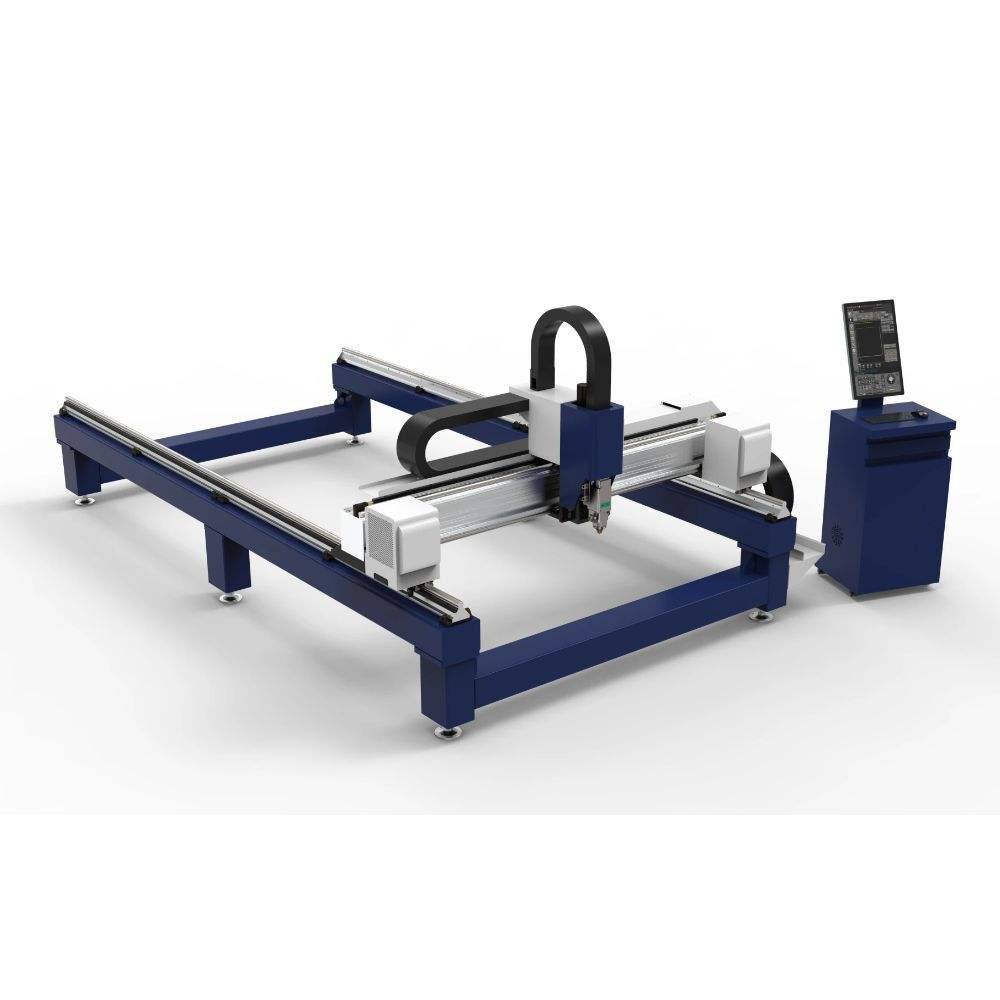
Field Engineering Report: Integration of 30kW Fiber Laser Profiling in Charlotte Bridge Infrastructure
1. Executive Summary: Site Context and System Specifications
The following report details the technical deployment and operational assessment of a 30kW Heavy-Duty I-Beam Laser Profiler, equipped with a ±45° 5-axis bevel cutting head, at a primary structural fabrication facility in Charlotte, North Carolina. The project scope involves the production of primary load-bearing members for regional bridge expansion, specifically targeting the transition from conventional plasma and oxy-fuel methods to high-density fiber laser processing.
The Charlotte sector, a hub for logistical infrastructure, requires adherence to stringent AASHTO (American Association of State Highway and Transportation Officials) standards. The implementation of 30kW fiber optics represents a significant shift in the thermodynamic management of heavy-section A572 and A709 structural steel.
2. 30kW Fiber Laser Source: High-Power Density Dynamics
The core of the system is a 30kW ytterbium fiber laser source. Unlike lower-wattage systems (10kW–12kW), the 30kW threshold allows for a “keyhole” welding-style cutting efficiency even in thicknesses exceeding 30mm.
Energy Distribution: At 30kW, the Beam Parameter Product (BPP) is optimized to maintain a narrow kerf width despite the beam’s divergence over long focal distances. This power density is critical for I-beam flanges where thickness can vary. The high photon density ensures that the transition from solid to liquid/vapor phase is near-instantaneous, minimizing the duration of thermal conduction into the substrate.
Gas Dynamics: In the Charlotte field tests, high-pressure Nitrogen was utilized for stainless components, while Oxygen-assisted cutting was calibrated for heavy carbon steel bridge girders. The 30kW source allows for an increase in cutting speed by approximately 250% compared to 15kW systems on 25mm plate, which directly correlates to a reduced Heat Affected Zone (HAZ).
3. Technical Analysis of ±45° Bevel Cutting Kinematics
Precision bridge engineering necessitates complex weld preparations, specifically V, Y, K, and X-shaped joints. Traditional methods required secondary processing—manual grinding or secondary plasma passes—which introduced human error and inconsistent root faces.
5-Axis Interpolation: The ±45° bevel head utilizes high-precision A and B-axis interpolation. In the context of heavy I-beams, the profiler must account for the radius of the inner flange (the “k-distance”). The 30kW system’s software utilizes real-time compensation to adjust the focal point as the head tilts, ensuring that the effective thickness—which increases mathematically at an angle (e.g., a 45° cut on 20mm plate results in a ~28.2mm effective cut)—is handled without losing the melt-pool ejecta.
Weld Prep Optimization: For Charlotte’s bridge projects, the ability to execute a ±45° bevel in a single pass is transformative. We observed a consistent ±0.2mm tolerance on the root face, which is essential for automated robotic welding systems. This precision eliminates the “gap-bridging” issues common in manual fabrication, significantly increasing the fatigue life of the bridge joints.
4. Heavy-Duty Structural Processing: I-Beam Handling and Sensing
The “Heavy-Duty” designation refers to the machine’s ability to handle I-beams, H-beams, and C-channels weighing up to 1200 kg/m.
Material Deformation Compensation: Large-scale structural steel is rarely perfectly straight. The profiler utilizes a laser-based 3D touch-sensing system to map the actual geometry of the beam before the first piercing. In the Charlotte facility, we noted that beams often exhibited a slight “camber” or “sweep.” The 30kW system’s control software automatically offsets the cutting path to match the beam’s physical centerline, ensuring that bolt holes for splice plates remain perfectly aligned across a 12-meter span.
Chucking and Support: The system employs a four-chuck hydraulic synchronization system. This prevents the “sagging” of heavy sections that would otherwise distort the bevel angle. The synergy between the mechanical grip and the 30kW thermal delivery ensures that the beam remains a rigid reference frame during the entire cutting cycle.
5. Impact on Bridge Engineering in the Charlotte Sector
Bridge construction in the North Carolina piedmont region faces specific environmental challenges, including thermal expansion cycles and high-humidity corrosion.
Reduced HAZ and Grain Structure: The high speed of the 30kW laser minimizes the time the steel spends at critical transformation temperatures. Metallurgical analysis of the cut edge shows a significantly smaller martensitic layer compared to plasma cutting. This is vital for bridge engineering, where a brittle edge can lead to stress-corrosion cracking or premature fatigue failure under cyclic loading.
Automation Synergy: The profiler integrates directly with Tekla Structures and other BIM (Building Information Modeling) software common in Charlotte’s engineering firms. This “Digital-to-Steel” workflow removes the need for manual layout and templating. The 30kW laser’s ability to mark part numbers, layout lines, and weld symbols directly onto the beam during the cutting process ensures 100% traceability—a requirement for federalized bridge projects.
6. Thermodynamic Efficiency and Auxiliary Gas Consumption
Operational data from the Charlotte field site indicates that while the power draw of a 30kW source is higher, the “cost per foot” of finished cut is lower due to the drastic increase in throughput.
Nozzle Technology: We implemented cooled “zoom” nozzles that allow for the dynamic adjustment of the beam diameter. For the flange-to-web transitions on heavy I-beams, the nozzle adjusts the gas flow geometry to prevent turbulent “blow-back,” which can occur when the laser penetrates the thickest part of the fillet. This ensures a clean exit of the dross, reducing post-process cleaning time by an estimated 85%.
7. Comparative Analysis: Fiber Laser vs. Legacy Plasma
In the field, the 30kW fiber laser demonstrated a distinct superiority over high-definition plasma in three critical areas:
1. Perpendicularity: Plasma torches often suffer from “arc-tilt,” especially as consumables wear. The laser’s coherent light maintains a near-perfect verticality unless the bevel is intentionally programmed.
2. Hole Quality: For bridge splice plates, the “bolt hole” quality is paramount. The 30kW laser produces “plasma-free” holes with a taper ratio of less than 0.05, meeting AASHTO requirements for “standard” and “oversized” holes without the need for reaming.
3. Thermal Input: The total heat input per unit length is approximately 40% less with the 30kW laser than with high-amp plasma, resulting in virtually zero structural warping of the beam.
8. Conclusion and Future Implementation
The deployment of the 30kW Heavy-Duty I-Beam Laser Profiler in Charlotte has validated that ultra-high-power fiber lasers are no longer reserved for thin-sheet applications. The integration of ±45° beveling allows for a streamlined, single-station fabrication process that meets the rigorous safety and durability standards of modern bridge engineering.
Future phases of this deployment will focus on the integration of Artificial Intelligence (AI) for real-time monitoring of the nozzle condition and the further optimization of “mixed-gas” cutting (a Nitrogen-Oxygen blend) to further increase speeds on A709 Grade 50W (weathering steel) sections. The data confirms that for heavy-duty structural processing, the 30kW fiber laser is the current benchmark for precision, speed, and structural integrity.
End of Report.
Author: Senior Technical Lead, Laser & Steel Infrastructure Division.







