Field Report: Deployment of 30kW High-Power 3D Fiber Laser Systems in Jakarta’s Power Infrastructure Sector
1. Executive Summary and Site Context
This report details the technical deployment and operational performance of a 30kW Fiber Laser H-Beam Cutting Machine, equipped with an Infinite Rotation 3D Head, at a primary steel fabrication facility in the Greater Jakarta region. The site is currently tasked with the production of high-voltage transmission tower components for the Indonesian national grid expansion. Historically, Jakarta’s structural steel sector has relied on plasma cutting, mechanical drilling, and manual oxy-fuel beveling. The introduction of 30kW fiber laser technology represents a paradigm shift in processing speed, geometric accuracy, and metallurgical integrity for heavy-duty H-beam and I-beam profiles.
2. The Catalyst: 30kW Fiber Laser Source Integration
The core of the system is a 30kW ultra-high-power fiber laser source. In the context of H-beam fabrication, the energy density provided by 30kW allows for the processing of carbon steel flanges up to 25mm–40mm with high-pressure nitrogen or oxygen-assisted cutting.
From a technical standpoint, the 30kW source solves the “thermal lag” experienced by lower-wattage systems. When cutting thick-walled H-beams (typically S355 or ASTM A572 grades), the high photon density ensures that the melt pool is expelled instantaneously. This minimizes the Heat Affected Zone (HAZ), which is critical for power towers subjected to high cyclic wind loads and seismic stresses common in the Indonesian archipelago. By maintaining a narrow kerf width, the system ensures that the structural integrity of the H-beam is not compromised by excessive heat input, a common failure point in traditional plasma processing.
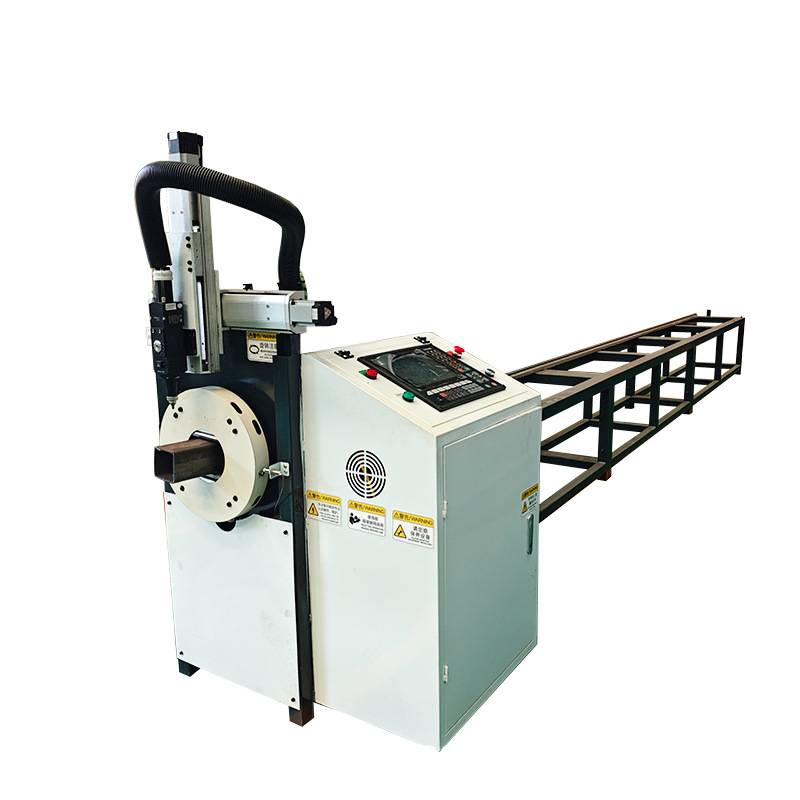
3. Kinematics of the Infinite Rotation 3D Head
The most significant technological advancement discussed in this report is the Infinite Rotation 3D Head. Traditional 5-axis laser heads are often limited by cable-wrap constraints, requiring a “rewind” cycle after 360 or 540 degrees of rotation. In H-beam processing—where the head must navigate the flange-to-web transition and perform complex bevels across the entire profile—these resets lead to significant air-cut time and potential path deviations.
The Infinite Rotation technology utilizes a slip-ring or advanced fiber-coupling mechanism that allows for continuous N×360° rotation. This facilitates:
- Continuous Beveling: The ability to cut V, X, Y, and K-shaped weld preparations along the entire length of the H-beam without stopping.
- Radius Transitioning: Power tower designs often require precise cuts at the junction of the web and the flange. The 3D head maintains a constant standoff distance and perpendicularity (or a specific bevel angle) even as it rounds the internal radii of the beam.
- Geometric Versatility: The head compensates for “beam twist” and “camber” in real-time. Using integrated laser sensors, the 3D head maps the actual profile of the H-beam and adjusts the cutting path dynamically to ensure that bolt holes are perfectly aligned across the 3D space.
4. Application in Power Tower Fabrication
Transmission towers in the Jakarta-Bandung corridor require extreme precision for modular assembly. These structures consist of thousands of lattice members that must be bolted together on-site. Any deviation in hole positioning leads to “drifting” during assembly, necessitating costly field corrections.
4.1 Bolt Hole Precision and Galvanization Preparation
In power tower fabrication, the laser is used to cut hundreds of bolt holes in H-beam sections. The 30kW source produces holes with a taper of less than 0.1mm on 20mm thick steel. Furthermore, the laser-cut edge is “clean,” meaning it does not require secondary grinding before hot-dip galvanization. The consistency of the laser cut ensures that the zinc coating adheres uniformly, preventing the premature corrosion that often plagues infrastructure in Jakarta’s humid, tropical environment.
4.2 Complex Web-to-Flange Notching
Power towers often require complex “bird-mouth” cuts or notches where secondary bracing meets the main H-beam leg. The Infinite Rotation 3D head allows the laser to perform these multi-planar cuts in a single pass. This replaces a three-step process: mechanical sawing, followed by magnetic drilling, followed by manual grinding for the weld prep.
5. Efficiency Metrics: Manual vs. Automated 30kW Laser
Observation of the Jakarta facility revealed the following performance deltas when transitioning to the 30kW 3D system:
- Throughput: A standard 12-meter H-beam with 15 holes and 4 bevelled ends was processed in 4.5 minutes. The previous manual/plasma workflow required 35 minutes per unit.
- Consumables: While the initial investment in a 30kW source is higher, the cost per meter of cut is reduced by 40% due to the elimination of secondary finishing and the high speed of nitrogen-assisted cutting.
- Labor Allocation: The system requires one operator and one loader, replacing a team of six involved in layout, drilling, and oxy-fuel cutting.
6. Technical Challenges and Solutions in the Jakarta Environment
Deploying high-power fiber lasers in Southeast Asia presents specific environmental challenges that were addressed during this commissioning:
6.1 Power Stability
Jakarta’s industrial power grid can experience voltage fluctuations. The 30kW system was integrated with a high-capacity industrial voltage stabilizer and a dedicated transformer to ensure the laser source maintains a stable power density. Any dip in power would result in “dross” or incomplete cuts in thick H-beams, which is unacceptable for structural steel.
6.2 Humidity and Optics Management
The high humidity in Jakarta poses a risk of condensation on the laser optics. The 3D head is equipped with a positive-pressure, dry-air filtration system. This ensures that the internal optical cavity remains at a constant dew point, preventing “lens burn” which is common in high-wattage applications if the environment is not controlled.
7. Metallurgical Integrity and Compliance
For structural steel fabrication under Indonesian National Standard (SNI) and Eurocode 3, the quality of the cut surface is paramount. The 30kW laser-cut edges demonstrate a surface roughness (Ra) significantly lower than plasma cutting. Hardness testing of the cut edge shows a minimal increase in Vickers hardness, ensuring that the material remains ductile enough to withstand the dynamic loads of high-tension power lines. The “Infinite Rotation” head specifically contributes here by maintaining a consistent feed rate; by avoiding the “stop-start” motion of limited-rotation heads, it eliminates the thermal accumulation points that cause localized hardening.
8. Conclusion
The integration of a 30kW Fiber Laser H-Beam Cutting Machine with Infinite Rotation 3D technology represents the current apex of structural steel processing. For Jakarta’s power tower fabrication sector, the technology solves the dual problems of production bottlenecking and geometric inaccuracy. The ability to perform complex, 360-degree beveling on heavy H-sections with the speed of a 30kW source allows for a “Ready-to-Assemble” output that significantly reduces the total cost of infrastructure projects. Future deployments should focus on the integration of automated loading/unloading buffers to further capitalize on the 30kW source’s high duty cycle.
Field Engineer: Senior Technical Consultant
Sector: Structural Steel & Laser Kinematics
Location: Jakarta, Indonesia













