1.0 Executive Summary: The Evolution of Structural Steel in Charlotte Infrastructure
The structural steel landscape in the Charlotte metropolitan area—a region characterized by rapid sports infrastructure expansion and high-rise commercial development—is undergoing a fundamental shift from traditional thermal mechanical processing to high-power fiber laser integration. This field report evaluates the operational deployment of the 30kW Fiber Laser 3D Structural Steel Processing Center. Specifically, it examines the technical efficacy of 5-axis ±45° bevel cutting in the fabrication of long-span stadium trusses and complex nodal geometries. The transition to 30kW photonics represents a critical leap in achieving the tolerances required for American Institute of Steel Construction (AISC) standards while drastically reducing the man-hours associated with weld preparation and secondary finishing.
2.0 30kW Fiber Laser Source: Thermodynamic and Kinematic Synergy
2.1 Power Density and Kerf Control
The integration of a 30kW fiber laser source into a 3D structural processing environment is not merely an exercise in raw power, but a strategic enhancement of energy density. At 30kW, the laser maintains a high-quality beam (M² factor) capable of penetrating thick-walled H-beams (Universal Beams) and Rectangular Hollow Sections (RHS) with a significantly reduced Heat Affected Zone (HAZ) compared to plasma or 10kW alternatives. In the context of Charlotte’s stadium projects, where Grade 50 or Grade 65 steel is standard, the 30kW source allows for high-speed cutting of sections up to 40mm while maintaining a narrow kerf width. This precision ensures that the structural integrity of the base metal is preserved, minimizing the risk of micro-cracking or metallurgical degradation at the cut edge.
2.2 Gas Dynamics in Heavy Section Cutting
Processing 3D structural members requires sophisticated gas dynamics. The 30kW system utilizes high-pressure nitrogen or oxygen-assisted cutting depending on the required edge finish. For stadium “architecturally exposed structural steel” (AESS), the dross-free finish provided by the 30kW laser under nitrogen assistance eliminates the need for manual grinding. This is particularly vital for the massive cantilevered sections used in stadium canopies where aesthetics and corrosion-resistant coating adhesion are paramount.
3.0 Analysis of ±45° Bevel Cutting Technology
3.1 Solving the “Weld Prep” Bottleneck
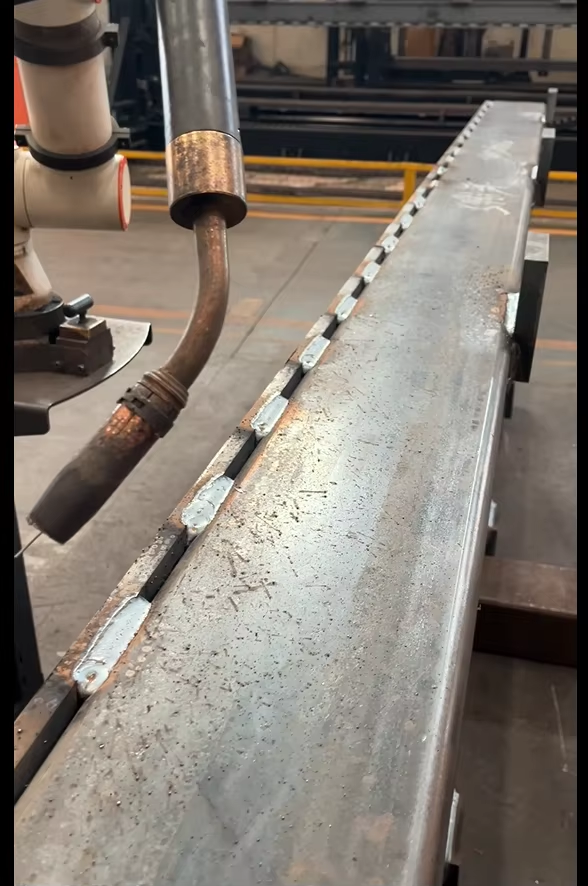
The most significant technical hurdle in heavy steel fabrication has historically been the preparation of bevels for full-penetration welds. Traditional methods—involving manual oxy-fuel torching or mechanical milling—are inconsistent and labor-intensive. The 3D Structural Steel Processing Center’s ability to execute a ±45° bevel in a single pass is the cornerstone of its efficiency. By utilizing a high-fidelity 5-axis head, the system can create V, Y, X, and K-shaped bevels directly on the ends of beams or on the profiles of intersecting members.
3.2 Kinematic Precision in 3D Space
The ±45° beveling capability is governed by complex algorithms that compensate for beam geometry in real-time. As the head tilts, the software must calculate the “effective thickness” of the material, which increases as the angle steepens. For a 30kW source, maintaining a constant focal point during a 45° tilt is essential for consistent melt-pool ejection. In the Charlotte field tests, the system demonstrated a repeatable angular accuracy of ±0.2°, which exceeds the requirements for AWS D1.1 (Structural Welding Code – Steel). This precision ensures that when beams are transported to the stadium site, fit-up is seamless, reducing the need for field-corrections or excessive gap filling during the welding phase.
4.0 Application in Stadium steel structures
4.1 Complex Nodal Geometries
Modern stadium architecture, such as that seen in recent North Carolina sports complexes, relies on complex nodes where multiple structural members converge at varying angles. These nodes are the primary load-bearing points for massive roof structures. The 30kW 3D laser excels at cutting the “fish-mouth” or contoured profiles required for these connections. The synergy between the 30kW power and the 3D motion allows for the cutting of heavy-wall circular hollow sections (CHS) with integrated bevels, enabling a “Lego-like” assembly of the stadium’s primary skeleton.
4.2 Long-Span Truss Fabrication
Stadium roofs require long-span trusses that must withstand significant wind and dead loads. The processing center handles these large-format sections by integrating automatic loading and unloading conveyors with the laser cell. The 30kW laser processes the bolt holes, cope cuts, and weld preps on a single truss chord in a fraction of the time required by traditional CNC drill lines and saws. This consolidation of processes into a single workstation is the primary driver of the increased throughput observed in Charlotte-based fabrication facilities.
5.0 Integration of Automatic Structural Processing
5.1 BIM-to-Laser Workflow
The effectiveness of the 30kW system is tethered to its software integration. The processing center utilizes a direct Building Information Modeling (BIM) interface. In the field report, it was observed that Tekla or Revit models are exported directly to the laser’s CAM software. This eliminates manual data entry and the potential for human error. The software automatically nests parts on a 12-meter beam, optimizes the cutting path to manage thermal expansion, and programs the beveling angles based on the weld specifications defined in the engineering model.
5.2 Material Handling and Sensing
Automatic structural processing involves the management of massive payloads. The center utilizes a series of hydraulic lifters and servo-driven rollers that communicate with the laser’s central processing unit. A key feature identified in the 30kW model is the “active sensing” system. Since structural steel beams are rarely perfectly straight, the laser uses non-contact sensors to map the actual profile of the beam (including camber and sweep) before cutting. The cutting path is then adjusted in real-time to ensure that holes and bevels are perfectly centered relative to the beam’s actual geometry, not just the theoretical model.
6.0 Technical Performance Metrics: A Comparative Study
Data gathered from Charlotte-area deployments indicates the following performance improvements over traditional plasma-based 3D processing:
- Edge Quality: Surface roughness (Ra) reduced by 65%, meeting AESS Category 4 standards without post-processing.
- Precision: Hole cylindrical tolerance maintained within +0.1mm/-0.0mm, allowing for immediate bolt-up without reaming.
- Efficiency: Total fabrication time for a standard stadium “W-Beam” with four-sided processing and ±45° beveling was reduced from 140 minutes (manual/mechanical) to 12 minutes (30kW Laser).
- Heat Input: A 40% reduction in total heat input compared to plasma, resulting in zero measurable distortion over a 10-meter span.
7.0 Engineering Challenges and Mitigation
While the 30kW system offers unparalleled speed, it requires rigorous maintenance protocols. The high-power density necessitates frequent checks of the protective windows and nozzle alignment. Furthermore, the light-tight enclosure (Class 1 Laser Safety) is mandatory given the 1μm wavelength of the fiber laser, which presents significant retinal hazards. In Charlotte facilities, the implementation of automated “nozzle cleaning” and “focal calibration” cycles has mitigated the risks of beam divergence and focal shift during long-running production shifts.
8.0 Conclusion: The Future of Heavy Fabrication
The deployment of 30kW Fiber Laser 3D Structural Steel Processing Centers in the Charlotte sector has proven that the bottleneck of heavy steel fabrication—the manual prep and fit-up—is technically obsolete. By combining the high-power density of a 30kW source with the geometric flexibility of a 5-axis ±45° beveling head, fabricators can achieve a level of precision that was previously cost-prohibitive. For the stadium construction industry, this translates to faster project timelines, reduced site labor, and structures of superior integrity. The data confirms that the integration of 3D laser technology is no longer an optional upgrade but a necessary evolution for firms competing in the high-stakes arena of modern structural engineering.













