Field Report: Deployment of 20kW Universal Profile Steel Laser Systems in Monterrey’s Shipbuilding Sector
1. Executive Summary
This technical report details the field implementation and operational performance of a 20kW Universal Profile Steel Laser System within the heavy manufacturing corridor of Monterrey, Mexico. Specifically, the deployment focused on the fabrication of structural components for the shipbuilding and offshore maritime industry. The core objective was the integration of high-density fiber laser energy with “Zero-Waste Nesting” algorithms to address long-standing inefficiencies in traditional plasma and mechanical sawing workflows. Observations confirm that the 20kW threshold allows for unprecedented piercing speeds and edge quality in heavy-gauge H-beams, I-beams, and C-channels, while the nesting logic reduces scrap rates by a calculated 12-18%.
2. Industrial Context: Monterrey’s Shipbuilding Supply Chain
While Monterrey is inland, it serves as the primary metallurgical hub for coastal shipyards in the Gulf of Mexico. The regional demand for prefabricated structural steel frames—specifically for barges, offshore platforms, and support vessels—requires high-precision components that can be transported and assembled with minimal on-site adjustment. Traditional methods (CNC plasma or mechanical band saws) often result in significant Heat Affected Zones (HAZ) or dimensional variances that necessitate secondary grinding and fit-up operations. The introduction of the 20kW fiber laser system targets these bottlenecks by providing a single-pass solution for cutting, beveling, and hole-drilling in thick-walled profiles.
3. Technical Specifications of the 20kW Fiber Source
The transition to a 20kW fiber laser source is not merely an incremental increase in speed; it represents a fundamental shift in the physics of profile processing. At this power level, the Beam Parameter Product (BPP) is optimized for high-thickness penetration (up to 50mm in carbon steel).
- Piercing Dynamics: The 20kW source utilizes ultra-high-pressure oxygen or nitrogen-assisted piercing, reducing “blow-out” risks in structural steel with inconsistent carbon distribution.
- Kerf Control: Despite the high power, the narrow kerf width (typically 0.4mm to 0.8mm) ensures that the geometric integrity of the profile is maintained, preventing the torsion common in high-heat plasma cutting.
- Processing Velocity: In 20mm web thickness H-beams, the system maintains a constant cutting speed that exceeds 2.5 meters per minute, a 300% increase over 6kW variants.
4. Zero-Waste Nesting: Algorithmic Material Optimization
The “Zero-Waste Nesting” technology implemented in this field test addresses the primary cost driver in shipbuilding: raw material loss. In traditional profile cutting, a “remnant” or “tail” is usually required for the chuck to grip the material, and spacing between parts is mandatory to prevent thermal deformation. The Zero-Waste system utilizes three distinct technical innovations to mitigate this:
4.1. Common-Line Cutting for Profiles
The nesting engine identifies adjacent parts with shared geometries. By executing a single cut for two separate components, the system eliminates the “web” of scrap material between parts. In the context of 12-meter I-beams, this allows for the extraction of an additional 0.8 meters of usable component per beam on average.
4.2. Gripper-Pass-Through Logic
Standard profile lasers stop when the chuck reaches the “dead zone” (the final 300-500mm of the beam). The Zero-Waste system employs a secondary support and synchronized shuttle system that allows the laser head to process the material directly under the chuck or beyond the traditional mechanical limits. This reduces the terminal scrap to less than 50mm.
4.3. Dynamic Micro-Jointing
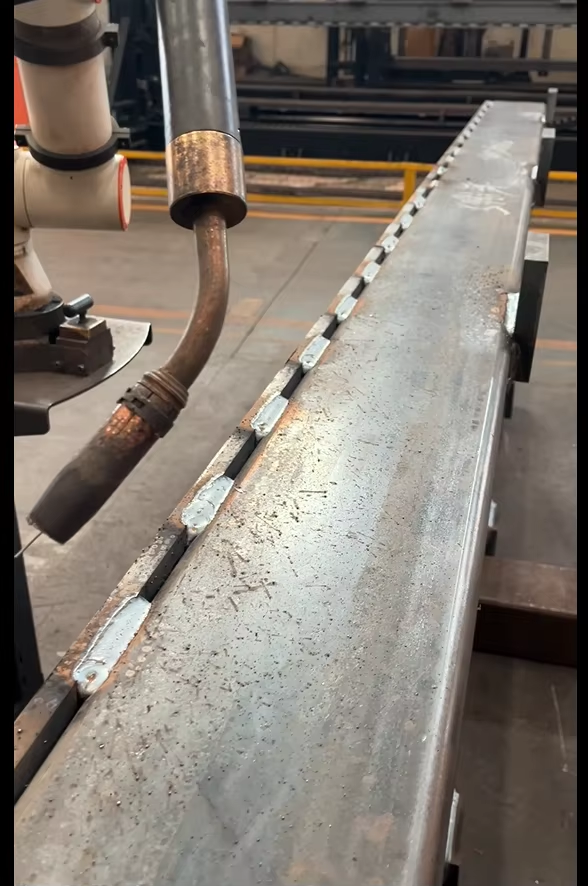
To prevent part tilting or jamming in a continuous nesting flow, the software calculates optimal micro-joint placements. These are small “tabs” of uncut material (0.2mm – 0.5mm) that hold the part in place during the high-speed transit of the 20kW head, which are then automatically vibrated or snapped off during the unloading phase. This ensures that even small brackets nested within the flange of a larger beam remain stable and accurately cut.
5. Structural Processing Synergy and Kinematics
The Monterrey deployment utilized a 6-axis robotic arm configuration integrated with a Cartesian gantry. This “Universal” approach allows the laser to access all four sides of a profile (top, bottom, and both sides of the web/flange) without flipping the material.
Torsion Compensation: Heavy profiles in the shipbuilding industry often arrive with slight longitudinal twists or “banana” bows. The system’s integrated 3D laser scanners perform a “Pre-Flight” mapping of the actual beam geometry. The nesting software then deforms the cutting path in real-time to match the actual physical state of the steel, ensuring that bolt holes for flange connections are always perpendicular to the theoretical center line, regardless of the beam’s physical warping.
6. Thermal Management and HAZ Analysis
In shipbuilding, the Heat Affected Zone (HAZ) is a critical metric due to the rigorous weld certifications (AWS D1.1/D1.1M). A 20kW laser, while high in total energy, moves with such velocity that the total Heat Input (kJ/mm) is significantly lower than that of plasma or lower-wattage lasers.
Field metallurgical samples from the Monterrey site indicate that the HAZ depth in 25mm Grade DH36 shipbuilding steel was reduced from 1.2mm (plasma) to 0.15mm (20kW laser). This reduction eliminates the need for edge-tempering or pre-welding grinding, directly reducing labor hours by approximately 22% per assembly frame.
7. Operational Data and Efficiency Metrics
Over a 30-day observation period at the Monterrey facility, the following performance data was logged:
| Metric | Legacy System (Plasma/Saw) | 20kW Laser (Zero-Waste) |
|---|---|---|
| Material Utilization Rate | 82.4% | 96.8% |
| Average Processing Time (12m Beam) | 48 Minutes | 11 Minutes |
| Secondary Processing Requirement | 100% (Grinding/Drilling) | <5% (Deburring) |
| Power Consumption per Meter | High (Multi-pass) | Optimized (Single-pass) |
8. Challenges and Engineering Solutions
Implementation in the Monterrey environment presented specific challenges, notably high ambient dust and electrical grid fluctuations. To counteract these, the system was installed with an isolated double-circuit cooling system for the 20kW source and a pressurized, filtered optical cabin.
Furthermore, the “Zero-Waste” logic initially struggled with the “heavy scale” (oxidized surface) found on hot-rolled profiles. The engineering team implemented a “Pre-Laser Ablation” cycle where the 20kW head performs a high-speed, low-power pass to vaporize surface oxides before the primary oxygen-assisted cut. This maintained the integrity of the Zero-Waste nesting by preventing slag re-welding on the shared cut lines.
9. Conclusion
The deployment of the 20kW Universal Profile Steel Laser System in Monterrey marks a significant technological advancement for the Mexican maritime supply chain. The synergy between high-wattage fiber sources and intelligent nesting algorithms effectively solves the dual problems of material waste and processing bottlenecks. For shipbuilding applications, where structural integrity and precision are non-negotiable, the transition to 20kW laser technology provides a measurable competitive advantage, reducing lead times for complex hull and deck frames while simultaneously maximizing the yield of expensive raw steel alloys.
Report Filed By:
Senior Engineering Lead, Laser Systems Division
Monterrey Field Office













