1.0 Executive Summary: Structural Laser Integration in the Riyadh Renewable Corridor
This technical field report evaluates the deployment and operational performance of a 20kW ultra-high-power fiber laser cutting system specifically configured for H-beam structural profiles. The installation, located in an industrial facility outside Riyadh, Saudi Arabia, serves the burgeoning wind energy sector, focusing on the fabrication of internal structural components for wind turbine towers. The primary objective of this integration was to replace conventional plasma cutting and mechanical drilling with a singular, high-autonomy laser solution featuring an advanced automatic unloading subsystem.
The transition to 20kW power density allows for the processing of heavy-gauge H-beams (up to HEB 600 series) with a focus on weld-ready edge quality and hole precision required for high-fatigue wind environments. The report details the synergy between high-wattage photonics and robotic material handling, addressing the specific challenges of thermal management and mechanical throughput in a high-ambient-temperature environment.
2.0 Technical Specifications of the 20kW Fiber Source
2.1 Power Density and Kerf Dynamics
The 20kW fiber laser source utilized in this configuration provides a Beam Parameter Product (BPP) optimized for thick-section structural steel. In the context of H-beam processing, where flange thicknesses frequently exceed 25mm, the 20kW output allows for a significant reduction in the Heat Affected Zone (HAZ) compared to 10kW or 12kW alternatives. By maintaining a high power-to-feed-rate ratio, the system achieves a “melt-and-blow” dynamic that minimizes dross adhesion on the lower flange surfaces.
2.2 Multi-Axis Head Kinematics
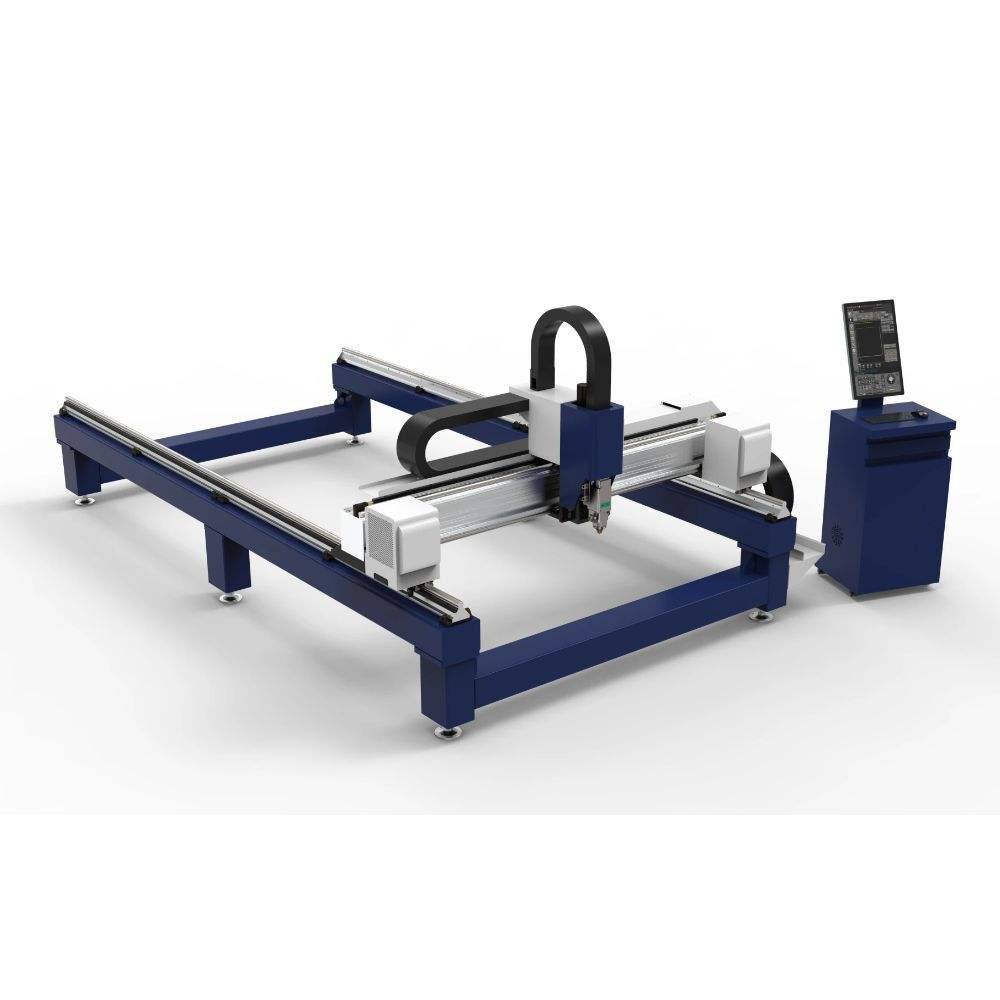
To process H-beams effectively, the machine utilizes a specialized 3D 5-axis cutting head. This allows for +/- 45-degree beveling, essential for preparing V-type and Y-type weld preparations on the web and flanges of the H-beam. In Riyadh’s wind tower projects, these beams are often used for internal platforms and stiffening rings, where precision fit-up is non-negotiable for structural certification.
3.0 Application in Wind Turbine Tower Fabrication
3.1 Internal Structural Components
Wind turbine towers are not merely hollow tubes; they require complex internal architectures. This includes ladder supports, cable tray mounts, and heavy-duty service platforms. The 20kW H-beam laser cuts these profiles to length while simultaneously executing complex copes, bolt holes, and service pass-throughs. The precision of the laser ensures that secondary grinding or reaming of bolt holes—common in plasma-based workflows—is eliminated, ensuring the structural integrity of the high-tensile bolts used in tower assemblies.
3.2 Material Challenges: Riyadh Site Conditions
Operating a 20kW system in Riyadh presents unique environmental challenges, primarily regarding ambient temperature and airborne particulates. The system’s chiller unit was uprated to handle 50°C+ peaks, ensuring the laser medium and the cutting head optics remain within a strict 2°C operating window. Furthermore, the H-beam profiles, often stored in outdoor yards, require the machine’s sensing system to compensate for surface oxidation and slight thermal expansion variances during the cutting cycle.
4.0 The Mechanics of Automatic Unloading Technology
4.1 Solving the Throughput Bottleneck
In traditional heavy steel processing, the cutting cycle is frequently interrupted by the need for overhead cranes or forklifts to clear the work zone. The automatic unloading system integrated into this 20kW unit utilizes a heavy-duty chain-driven conveyor and hydraulic lift-and-sort arms. As the 20kW laser completes a cut, the material is advanced to an unloading zone where sensors detect the beam’s center of gravity. The system then executes a lateral transfer to a designated sorting rack.
4.2 Precision and Safety in Heavy Handling
Automatic unloading is not merely a convenience; it is a precision requirement. For H-beams exceeding 12 meters in length, manual handling often results in minor structural deformation or surface scratching that can compromise protective coatings. The automated system uses non-marring contact points and synchronized servo-motors to ensure the beam remains perfectly linear during the transition from the cutting bed. This prevents the “whiplash” effect common in crane unloading, which can knock the machine out of alignment over time.
5.0 Comparative Efficiency Analysis: Laser vs. Conventional Methods
5.1 Speed and Feed Optimization
Data collected during the commissioning phase in Riyadh indicates a 400% increase in throughput compared to traditional mechanical fabrication. A standard HEB 400 beam requiring six bolt holes and two beveled ends previously required 45 minutes across three different workstations (sawing, drilling, and manual oxy-fuel beveling). The 20kW laser completes the entire sequence in 7.5 minutes, inclusive of the automatic unloading cycle.
5.2 Gas Consumption and Kerf Quality
By utilizing 20kW of power, the system can utilize high-pressure air or nitrogen for thinner sections and optimized oxygen-assist for the thickest flanges. The high power allows for faster travel speeds in oxygen-assisted cutting, which paradoxically reduces the total volume of gas consumed per meter of cut. The resulting kerf is narrow (0.5mm – 0.8mm), which is critical for the tight tolerances required in wind tower internal fit-outs.
6.0 Metallurgical Considerations and Heat Affected Zone (HAZ)
One of the critical engineering concerns in Riyadh’s wind energy sector is the fatigue life of structural steel. Excessive heat input during cutting can alter the martensitic structure of the steel edge, leading to micro-cracking. The 20kW fiber laser, through its high-speed processing, limits the duration of thermal exposure. Microscopic analysis of the cut edges on S355JR grade steel (common in wind towers) showed a HAZ depth of less than 0.15mm, significantly lower than the 0.5mm+ depth found in high-definition plasma cutting. This ensures that the structural properties of the H-beam remain within the original mill specification.
7.0 Integration of Smart Software and Nesting
The system utilizes specialized 3D nesting software that accounts for the unique geometry of H-beams. Unlike flat-sheet nesting, H-beam nesting must manage the web and both flanges simultaneously. The software integrates with the automatic unloading logic to ensure that parts are sorted by “sub-assembly” rather than just by size. In the Riyadh facility, this allowed the subsequent welding teams to receive “kits” of beams directly from the laser’s unloading racks, further reducing logistical overhead.
8.0 Maintenance and Operational Longevity in Desert Climates
8.1 Filtration and Positive Pressure
The 20kW H-beam laser is equipped with a dual-stage dust extraction system and a positive-pressure optical cabin. In Riyadh, the presence of fine silica dust is a constant threat to 20kW optics, where even a single micron-sized particle can cause catastrophic thermal runaway. The maintenance protocol established in this field report mandates a weekly inspection of the unloading system’s hydraulic seals and a daily purge of the optical nitrogen curtain.
8.2 Redundancy in Unloading
The automatic unloading system includes redundant sensors to detect “jam” conditions, which can occur if an H-beam has significant camber or sweep from the mill. The system’s ability to self-correct and adjust the lifting pressure ensures that the 20kW laser source maintains a high Duty Cycle without being sidelined by mechanical handling errors.
9.0 Conclusion
The deployment of the 20kW H-Beam Laser Cutting Machine with automatic unloading in Riyadh represents a significant leap in structural steel fabrication for the wind energy sector. By consolidating multiple fabrication steps into a single automated process, the system addresses the critical needs of precision, speed, and metallurgical integrity. The automatic unloading technology, in particular, serves as the linchpin for high-volume production, eliminating the logistical bottlenecks inherent in heavy steel handling. As Saudi Arabia continues its expansion into renewable energy, this specific configuration of high-power photonics and automated kinematics will serve as the benchmark for industrial structural processing.













