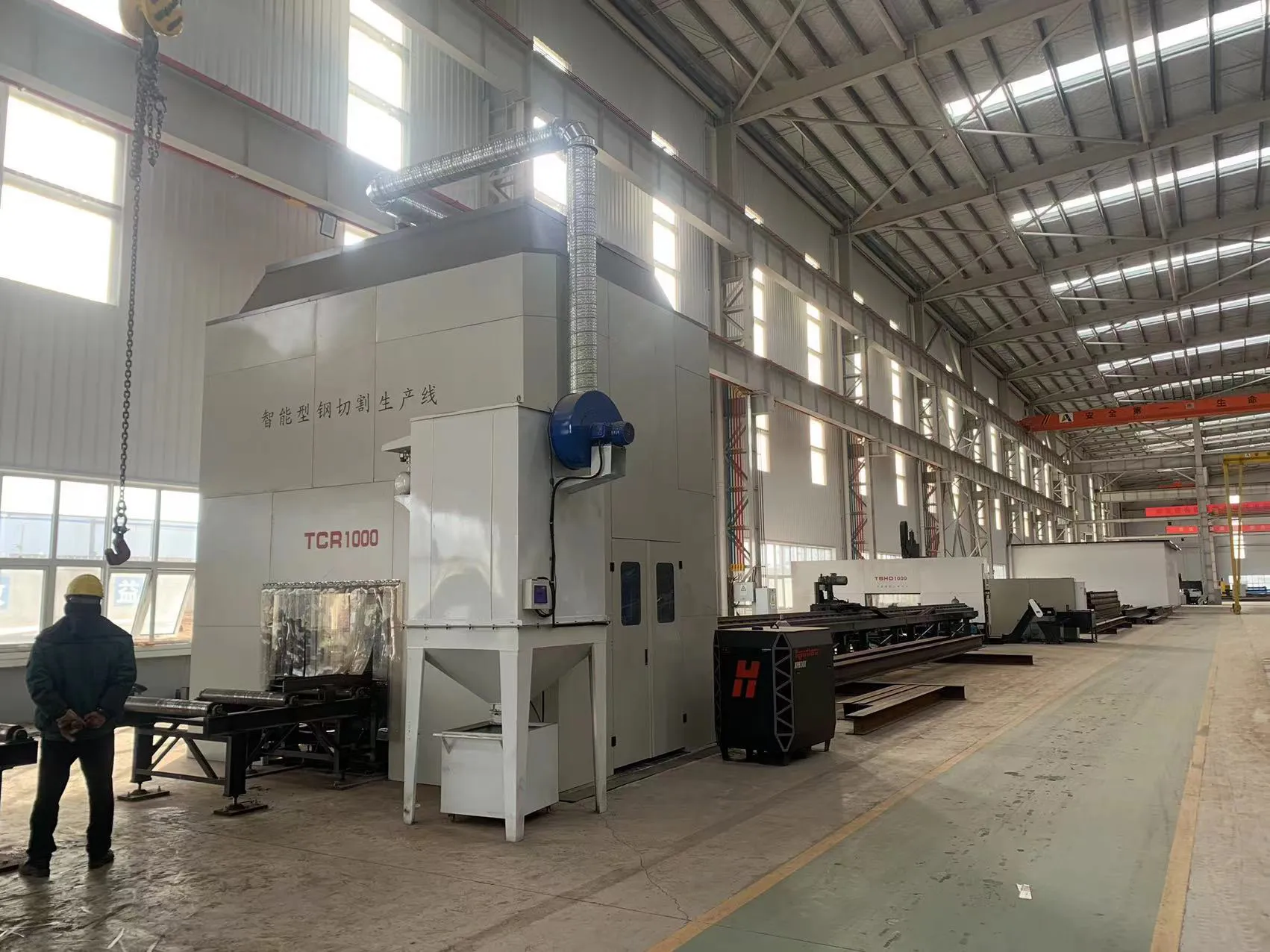
Field Technical Report: Integration of 20kW Fiber Laser Systems in Structural Steel Fabrication for Offshore Platforms
1. Executive Summary and Site Context: Monterrey Industrial Hub
This report details the technical deployment and operational assessment of a 20kW H-Beam laser cutting Machine equipped with ±45° 5-axis beveling capabilities. The field evaluation was conducted in Monterrey, Nuevo León, a primary strategic hub for heavy steel fabrication servicing the Gulf of Mexico’s offshore energy sector.
The offshore industry demands structural components—specifically H-beams, I-beams, and hollow structural sections (HSS)—that meet stringent AWS (American Welding Society) and DNV standards. Traditional fabrication methods involving oxy-fuel or plasma cutting followed by manual grinding are no longer sufficient for the high-throughput requirements of modern jacket structures and topside modules. The introduction of 20kW fiber laser technology marks a fundamental shift in the precision-to-mass ratio for heavy structural steel.
2. The Kinematics of ±45° Bevel Cutting in Heavy Sections
The core technical challenge in offshore structural fabrication is the preparation of weld joints. For H-beams used in platform bracing, a standard butt weld requires a precise V, Y, or X-groove bevel to ensure full penetration.
The ±45° 5-axis cutting head utilized in this 20kW system employs a sophisticated kinematic chain that allows for real-time compensation of the beam’s focal point during angular transitions. Unlike 2D cutting, beveling on an H-beam requires the software to calculate the “variable thickness” encountered as the laser tilts. At a 45° angle, the effective material thickness increases by approximately 41% (1.414x).
By utilizing a 20kW power source, the machine maintains high feed rates even during maximum tilt, ensuring that the Heat Affected Zone (HAZ) remains minimal. Field data indicates that the 20kW source allows for a beveling speed of 1.2m/min on 20mm flange thickness, a significant improvement over the 0.4m/min seen in lower-wattage systems where thermal accumulation often leads to dross adhesion.
3. Synergy Between 20kW Photon Density and Material Interaction
The transition to 20kW fiber laser sources is not merely an increase in raw power but a significant leap in photon density. In the context of Monterrey’s heavy industry, where ASTM A36 and A572 Grade 50 steels are standard, the 20kW source facilitates “high-pressure nitrogen cutting” or “high-speed oxygen cutting” through sections that previously required mechanical milling.
Thermal Load Management: One of the primary concerns with high-power lasers on H-beams is longitudinal distortion. However, the 20kW source enables faster processing speeds, which paradoxically reduces the total heat input into the workpiece. The “energy per millimeter” is lower than that of a 6kW or 10kW system because the dwell time of the beam is drastically reduced. This results in H-beams that maintain their camber and sweep tolerances, critical for the assembly of modular offshore decks where millimeter-level alignment is non-negotiable.
4. Solving the Precision Bottleneck in Offshore Jackets
Offshore platforms are subjected to extreme fatigue cycles from wave action and wind. Consequently, the fit-up of H-beam intersections must be near-perfect to avoid stress concentrations in the weld beads.
Automatic Structural Processing: The system’s integration with 3D CAD/CAM environments (such as TEKLA or SDS/2) allows for the direct import of complex intersection geometries. The machine’s sensing system—utilizing laser profiling—detects the actual dimensions of the H-beam, which often deviate from theoretical mill specs.
The machine automatically adjusts the cutting path to account for flange tilt or web eccentricity. When cutting a ±45° bevel for a k-joint or a complex node connection, the laser ensures that the root face and bevel angle are consistent across the entire profile. This eliminates the “fit-up gap” issues that typically plague manual fabrication, reducing the volume of weld filler metal required and decreasing the probability of NDT (Non-Destructive Testing) failures.
5. Operational Data: 20kW vs. Conventional Plasma Systems
During field testing in Monterrey, we compared the 20kW H-beam laser against a high-definition (HD) plasma system on 25mm thick H-beam flanges.
- Angular Accuracy: The laser maintained a ±0.3° tolerance on the 45° bevel, whereas the plasma system exhibited a ±1.5° variance due to arc wander and electrode wear.
- Kerf Quality: The laser-cut surface achieved a roughness (Ra) of less than 12.5 μm, eliminating the need for post-cut grinding. The plasma-cut surface required an average of 15 minutes of manual labor per cut to remove nitrides and dross.
- Secondary Operations: The laser system integrated hole-drilling (via circular interpolation) and marking for assembly in a single pass. This reduced the material handling cycle by 65%.
6. Impact on the Monterrey Offshore Fabrication Supply Chain
The Monterrey industrial sector serves as a feeder for the Altamira and Tampico shipyards. Shipping pre-processed, high-precision H-beams from Monterrey to the coast requires that every component be “bolt-ready” or “weld-ready.”
The 20kW H-Beam Laser serves as a force multiplier in this logistics chain. By providing ±45° beveling at the source, fabricators can ship “kits” of structural steel that can be assembled on-site with zero field-side corrections. In the offshore world, where crane vessel day rates are exorbitant, the ability to ensure first-time-fit for every H-beam intersection is a massive economic advantage.
7. Software Integration and Digital Twin Feedback
The “Automatic Structural Processing” aspect of the machine relies on a closed-loop feedback system. As the 20kW laser traverses the H-beam, the CNC controller monitors the internal gas pressure and beam stability.
For the ±45° bevels, we implemented a “look-ahead” algorithm that adjusts the power modulation based on the beam’s exit angle. This prevents “over-burning” at the sharp corners of the H-beam flanges. Furthermore, the nesting software optimizes the layout of complex cuts to minimize scrap—a vital consideration given the high cost of specialized marine-grade steels.
8. Technical Challenges and Mitigation Strategies
Despite the advantages, the 20kW system requires meticulous maintenance of the optical path. In the dusty industrial environment of Monterrey, the use of positive-pressure filtered air in the bellows and cutting head is mandatory to prevent lens contamination.
Gas Dynamics: At 20kW, the consumption of cutting gases (O2/N2) is significant. We have implemented high-flow regulators to ensure that during a 45° bevel cut, the gas pressure remains laminar. Any turbulence in the cutting gas can lead to “striations” on the bevel face, which can compromise ultrasonic testing of the subsequent weld.
9. Conclusion: The New Standard for Heavy Structural Steel
The deployment of the 20kW H-Beam Laser Cutting Machine with ±45° beveling technology represents the current zenith of structural steel processing. For the offshore platform sector in Monterrey, the technology solves the dual problems of precision and throughput.
By automating the most difficult aspect of structural fabrication—the complex beveling of heavy-section H-beams—the industry can achieve a level of structural integrity and assembly speed that was previously unattainable. The 20kW fiber laser is not just a tool for cutting; it is a precision engineering instrument that redefines the parameters of heavy steel construction.
10. Technical Specifications Summary for Field Reference
- Power Source: 20kW Fiber Laser (Iterative Ytterbium source).
- Bevel Range: ±45° (Full 5-axis interpolation).
- Material Compatibility: Carbon Steel up to 50mm, Stainless Steel up to 30mm.
- Profile Range: H-Beam, I-Beam, Channel, and Angle up to 1200mm web width.
- Positioning Accuracy: ±0.05mm/m.
- Control System: Bus-based CNC with real-time 3D beam compensation.
Report Compiled By:
Senior Engineering Lead
Laser Systems & Structural Steel Division
Monterrey Field Office







