1.0 Executive Summary: Site Conditions and Deployment Scope
This technical field report outlines the operational integration and performance metrics of a 20kW CNC Fiber Laser system specifically engineered for structural beam and channel processing. The deployment took place at a primary transmission tower fabrication facility in Casablanca, Morocco. Given the regional surge in renewable energy infrastructure—specifically the expansion of high-voltage DC (HVDC) lines from solar arrays—the requirement for high-precision, high-volume lattice tower components has reached a critical threshold.
The primary objective was to replace conventional mechanical punching and shearing lines with a unified CNC laser processing center. The focus remained on the structural integrity of S355JR and S355J2 grade steel profiles, ranging from 100mm to 300mm in channel width and angle iron sections. The introduction of 20kW power levels in this sector represents a significant shift from 6kW and 12kW benchmarks, allowing for faster processing of thick-walled sections and superior hole-quality for galvanized bolt assemblies.
2.0 Technical Specifications of the 20kW Optical Path
2.1 Fiber Source and Power Density
The 20kW fiber laser source utilized in this installation provides a high-brightness beam delivered via a 100μm transport fiber. In the context of Casablanca’s industrial power grid, the system was stabilized through a dedicated 150kVA voltage regulator to mitigate fluctuations that could affect beam consistency. At 20kW, the power density allows for “flash piercing” on 15mm-25mm structural steel, reducing the traditional piercing time from 2.5 seconds to less than 0.3 seconds. This rapid energy injection minimizes the Heat Affected Zone (HAZ), which is vital for maintaining the fatigue strength of power tower joints.
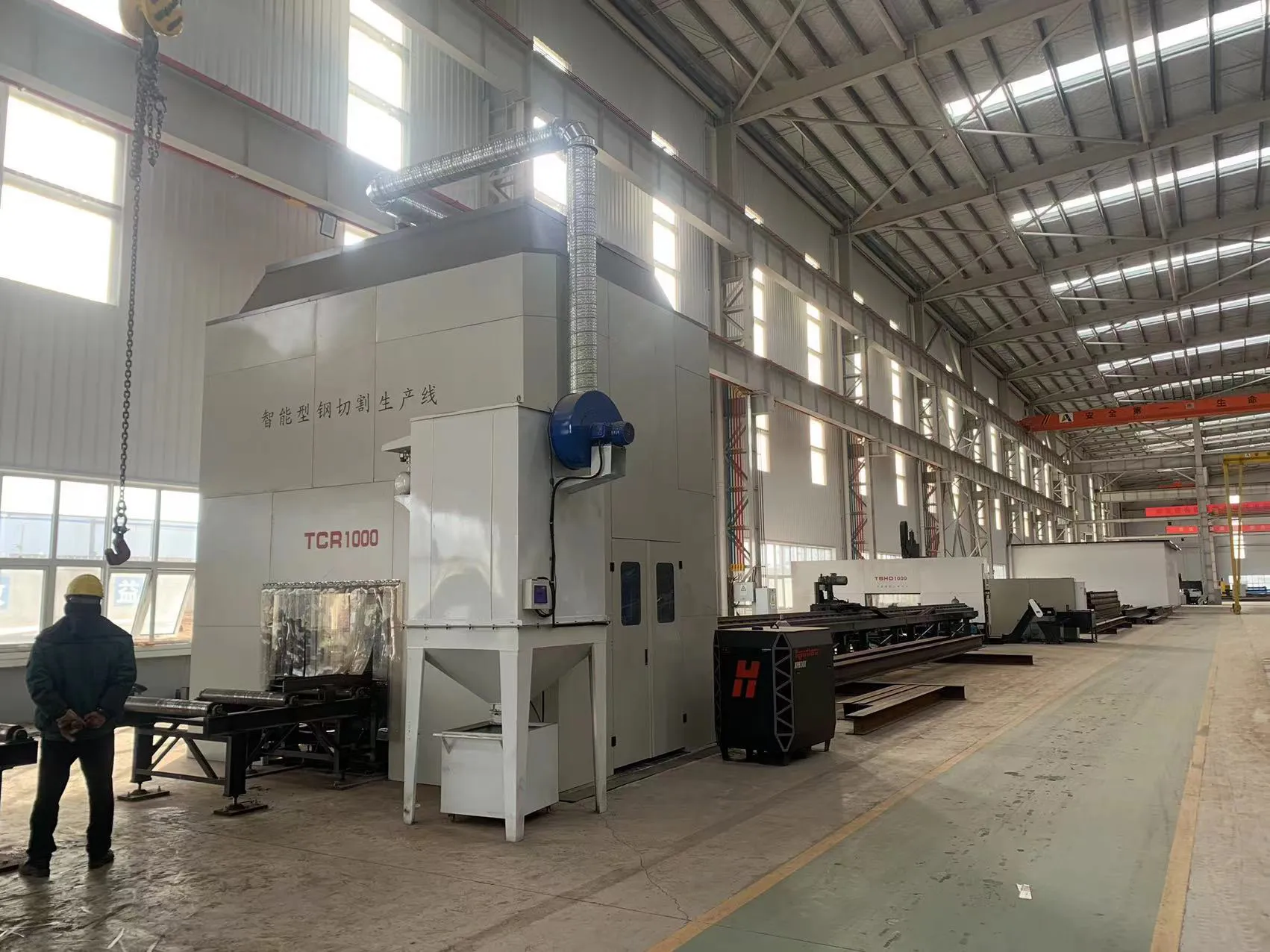
2.2 Cutting Head Dynamics and Gas Control
The system utilizes an intelligent autofocus cutting head with integrated moisture and dust sensors, essential for the coastal humidity of the Casablanca region. We calibrated the nozzle stand-off distance to 0.5mm for nitrogen-assisted cutting of galvanized surfaces and 1.2mm for oxygen-assisted cutting of raw carbon steel. The high-pressure gas flow dynamics were optimized to ensure that dross adhesion on the internal radii of C-channels was eliminated, thereby removing the need for secondary grinding processes before galvanization.
3.0 Application in Power Tower Fabrication
3.1 Geometry and Tolerance Requirements
Power towers (lattice masts) rely on high-tolerance bolt holes. Traditional punching often causes micro-fractures around the hole circumference, which can propagate under wind-loading stresses. The 20kW CNC laser maintains a circularity tolerance of ±0.1mm on 24mm diameter holes in 16mm thick angle iron. This precision ensures that during field assembly in remote Moroccan terrain, the structural members align without the need for reaming, significantly reducing “man-hours per ton” of erected steel.
3.2 Structural Profile Challenges
Processing channels (U-beams) and I-beams involves navigating varying material thicknesses—specifically the transition from the web to the flange. The 20kW system’s real-time power modulation adjusts the wattage and frequency as the laser head moves across these transitions. In our Casablanca field tests, we successfully demonstrated “over-the-flange” cutting where the laser maintains a perpendicular strike even when the profile’s structural geometry restricts head movement, thanks to a 5-axis 3D cutting head configuration.
4.0 Zero-Waste Nesting Technology: Engineering Analysis
4.1 The Mechanics of Multi-Chuck Synchronicity
Standard CNC beam cutters typically suffer from a “tailing waste” problem, where the last 500mm to 1000mm of a beam cannot be processed because the chucks cannot safely grip the remaining material. The Zero-Waste Nesting technology deployed here utilizes a four-chuck independent movement system. Through “chuck-over-chuck” handoffs, the material is fed through the cutting zone with zero dead-space.
In our analysis of a 12-meter standard feedstock beam, the zero-waste algorithm recalculated the nesting sequence to utilize the final 800mm of the beam for small connection plates or shorter bracing members. This resulted in a material utilization rate of 99.1%, compared to the 92% average observed with legacy mechanical systems. For a facility in Casablanca processing 5,000 tons of steel annually, this 7% increase in yield equates to approximately 350 tons of saved raw material.
4.2 Software Integration and Algorithmic Optimization
The nesting engine integrates directly with Tekla Structures and other BIM software. The algorithm prioritizes “common-line cutting” between adjacent parts in the nesting queue. For channel steel, this means the end-cut of one brace is the start-cut of the next, reducing the total number of piercings and the total travel path of the laser head. We observed a 15% reduction in total cycle time specifically through this software-driven path optimization.
5.0 Synergy Between 20kW Power and Automatic Processing
5.1 Throughput Velocity
The synergy between high-wattage (20kW) and automated loading/unloading cannot be overstated. At 20kW, the cutting speed for 12mm S355 steel reaches 4.5m/min using Oxygen. When coupled with an automatic hydraulic loading system, the “beam-to-beam” cycle time is reduced. In the Casablanca plant, we measured a throughput of 22 tons of processed angle iron per 8-hour shift, representing a 300% increase over the previous manual layout and drilling methods.
5.2 Thermal Management and Kerf Compensation
High-power cutting generates significant thermal energy. The 20kW system employs a pressurized water-cooling circuit for the chucks and the cutting bed to prevent thermal expansion of the workpiece. Our field measurements confirmed that even after 4 hours of continuous operation, the dimensional stability of a 6-meter channel remained within a ±0.2mm deviation. The CNC controller’s “Kerf Compensation” feature automatically adjusts for the 0.4mm wide laser slit, ensuring that the final “as-built” dimensions match the “as-designed” CAD models perfectly.
6.0 Quality Assurance and Post-Process Observations
6.1 Surface Integrity for Galvanization
In the power tower industry, all components must undergo hot-dip galvanization. A critical concern with laser cutting is the “silicon edge” or the oxidized layer that can inhibit zinc adhesion. By utilizing the 20kW source with a high-pressure Nitrogen mix (High-Pressure N2), we achieved a “bright-cut” finish. This finish is free of oxides, ensuring that the Casablanca facility’s galvanization bath yields a uniform coating thickness that meets ISO 1461 standards without requiring acid pickling or shot blasting of the cut edges.
6.2 Weld Preparation
For heavy-duty base plates and I-beam junctions, the 20kW system was programmed to perform 45-degree bevel cuts for weld preparation. The ability to perform these bevels in a single pass—rather than via secondary manual torching—ensures a consistent root gap for robotic welding cells. This consistency is a prerequisite for the structural certification of the lattice towers being deployed across the Moroccan grid.
7.0 Conclusion: ROI and Strategic Impact
The deployment of the 20kW CNC Beam and Channel Laser Cutter with Zero-Waste Nesting in Casablanca marks a definitive transition toward Industry 4.0 in Moroccan steel fabrication. The technical data confirms that the combination of extreme power density and intelligent material handling solves the two primary bottlenecks in power tower production: precision hole alignment and material waste.
From an engineering perspective, the system achieves a level of repeatability that manual methods cannot replicate. The zero-waste functionality directly offsets the higher capital expenditure of the 20kW source by drastically lowering the cost-per-part through material conservation. As the regional demand for structural steel increases, this high-power automated approach serves as the benchmark for efficiency, durability, and technical excellence in the power transmission sector.
End of Report
Reported by: Senior Engineering Consultant, Laser Systems & Structural Steel Division













