The Dawn of 20kW Fiber Laser Power in Heavy Industry
For decades, the heavy structural steel industry relied on oxy-fuel and plasma cutting for the thick-walled beams and channels used in offshore platforms. While effective, these methods often left significant Heat Affected Zones (HAZ), required extensive secondary grinding, and lacked the surgical precision needed for complex intersections. The 20kW fiber laser has changed this paradigm.
At 20,000 watts, the laser beam possesses an energy density capable of vaporizing thick carbon steel and stainless steel almost instantly. In the context of Haiphong’s burgeoning offshore sector, this means the ability to cut through heavy H-beams and C-channels with a kerf width measured in microns rather than millimeters. The speed of a 20kW system on 12mm to 25mm structural steel is significantly faster than a 6kW or 10kW counterpart, allowing shipyards to meet aggressive “first oil” deadlines for offshore projects.
Advanced CNC Robotics for Beams and Channels
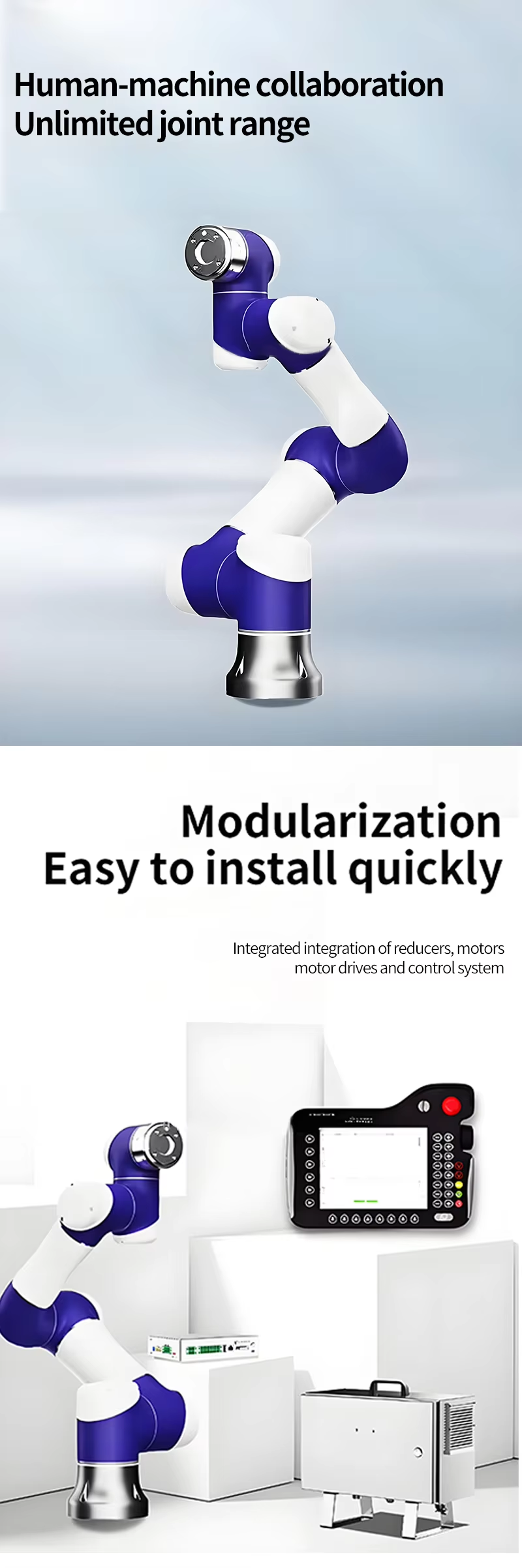
Unlike flat-sheet laser cutters, the 20kW CNC system for beams and channels utilizes multi-axis robotic heads or specialized rotary chucks. These machines are designed to handle the three-dimensional complexity of structural profiles. For offshore platforms, where diagonal bracing and complex tubular junctions are standard, the 3D cutting head is essential.
The CNC system can perform high-precision beveling—creating K, Y, and X-type weld preparations directly on the beam. In traditional fabrication, a worker would have to manually bevel a beam after it was cut to length. With a 20kW laser, the cut and the bevel happen simultaneously. This integrated workflow ensures that when the beams arrive at the assembly site in Haiphong’s Dinh Vu or Lach Huyen ports, they fit together with zero-gap tolerances, which is critical for the high-stress loading of offshore platforms.
The Science of Zero-Waste Nesting
In the offshore industry, material costs—specifically for high-grade marine steel—represent a massive portion of the total expenditure. Traditional “manual” nesting of beams often results in “drops” or offcuts that are too short to be useful, leading to a scrap rate of 10% to 15%.
The Zero-Waste Nesting software integrated into these 20kW machines utilizes advanced heuristics and genetic algorithms to maximize every millimeter of a standard 12-meter structural beam. The software analyzes the entire project’s Bill of Materials (BOM) and “shuffles” parts of varying lengths and profiles to fit together perfectly.
Key features include:
- Common Line Cutting: Two parts share a single cut line, reducing gas consumption and processing time.
- Micro-Jointing: Allowing small parts to remain attached to the main beam to prevent machine interference, later snapped off with a clean finish.
- Remnant Management: The system tracks offcuts in a digital library, prioritizing their use for smaller brackets or gussets in future jobs.
For a large-scale project in Haiphong involving thousands of tons of steel, a 5% reduction in waste can equate to hundreds of thousands of dollars in direct material savings.
Haiphong: The Strategic Hub for Offshore Engineering
Haiphong is not just a port; it is the industrial heartbeat of Northern Vietnam. Its proximity to deep-water shipping lanes and its established network of shipyards makes it the ideal location for 20kW laser technology. Offshore platforms—whether they are for oil and gas extraction or the rapidly growing offshore wind sector—require massive structural components that are difficult to transport overland.
By housing 20kW CNC laser centers within Haiphong’s industrial zones, fabricators can take raw steel directly from the port, process it with zero-waste precision, and move the finished assemblies straight onto barges. This localized “Smart Factory” approach reduces the carbon footprint of the construction process and leverages Haiphong’s skilled labor force, which is increasingly proficient in CNC programming and laser maintenance.
Enhancing Structural Integrity for Extreme Environments
Offshore platforms are subjected to relentless wave action, salt-spray corrosion, and extreme mechanical loads. The quality of the cut surface is a primary factor in the fatigue life of these structures. Traditional thermal cutting methods like plasma can leave microscopic “notches” or a hardened layer on the edge of the steel, which can serve as initiation points for fatigue cracks.
The 20kW fiber laser produces a remarkably smooth surface finish with a minimal Heat Affected Zone. Because the laser moves so quickly, the bulk of the material never reaches high temperatures, preserving the metallurgical properties of the high-strength steel. For the engineering teams in Haiphong, this means fewer failed weld inspections (NDT) and a significantly longer service life for the platform. When a jacket structure is sitting in 100 meters of water, the precision of a 20kW laser cut performed years earlier becomes a vital safety feature.
The Economic Impact on Vietnam’s Energy Sector
The adoption of 20kW laser technology in Haiphong is a catalyst for economic independence in the energy sector. By lowering the cost of fabrication through zero-waste nesting and high-speed CNC processing, Vietnamese fabricators can compete more effectively with international shipyards in Singapore or Korea.
Furthermore, as Vietnam pivots toward offshore wind energy to meet its Net Zero goals, the demand for “monopiles” and “tripod” foundations will explode. These structures require the exact type of high-volume, high-precision beam and channel processing that only a 20kW system can provide. The efficiency gained here allows for a lower “Levelized Cost of Energy” (LCOE), making renewable offshore wind more viable for the Vietnamese power grid.
Future-Proofing with AI and IoT Integration
The 20kW laser systems currently being deployed in Haiphong are more than just cutting tools; they are data-driven nodes in the Internet of Things (IoT). Modern CNC controllers track gas pressure, nozzle wear, and cutting speeds in real-time.
When combined with Zero-Waste Nesting, the system can provide “Predictive Costing.” Before a single beam is loaded onto the conveyor, the AI can tell the project manager exactly how much oxygen or nitrogen will be used and the precise weight of the scrap that will be generated. This level of transparency is transformative for the bidding process of offshore contracts, where margins are often thin and precision in estimating is the difference between profit and loss.
Conclusion: A Precision-Driven Future
The integration of 20kW CNC Beam and Channel Laser Cutters in Haiphong represents the pinnacle of modern structural fabrication. By solving the dual challenges of precision and waste, this technology provides the offshore industry with the tools necessary to build safer, cheaper, and more sustainable platforms.
As a fiber laser expert, I see this not just as a mechanical upgrade, but as a fundamental shift in how we approach heavy engineering. In the shipyards of Haiphong, the roar of the plasma torch is being replaced by the silent, white-hot precision of the fiber laser, signaling a new era of industrial excellence for Vietnam’s offshore horizon.