1.0 Technical Overview: The Evolution of Structural Steel Processing in HCMC
The industrial landscape of Ho Chi Minh City (HCMC) has seen a rapid pivot toward renewable energy infrastructure, specifically the fabrication of onshore and offshore wind turbine towers. As a senior expert in the field, I have overseen the commissioning of the 20kW CNC Beam and Channel Laser Cutter equipped with a 5-axis ±45° beveling head. This report analyzes the technical performance, integration challenges, and efficiency gains of this specific technology within the context of heavy-duty steel structures.
Traditional methods in HCMC’s fabrication yards—primarily plasma cutting and mechanical sawing—have historically struggled with the geometric complexities and tolerances required for wind tower internal structures. The transition to 20kW fiber laser sources represents a quantum leap in photonics application for structural steel, moving beyond simple separation to integrated component manufacturing.
2.0 Kinematics of the ±45° Beveling Head
2.1 Geometry and Weld Preparation
In wind turbine tower construction, the structural integrity of internal platforms, ladder supports, and flange reinforcements is paramount. These components typically utilize heavy H-beams and U-channels. The core technical advantage of the ±45° beveling technology is its ability to perform “Ready-to-Weld” cuts in a single pass.
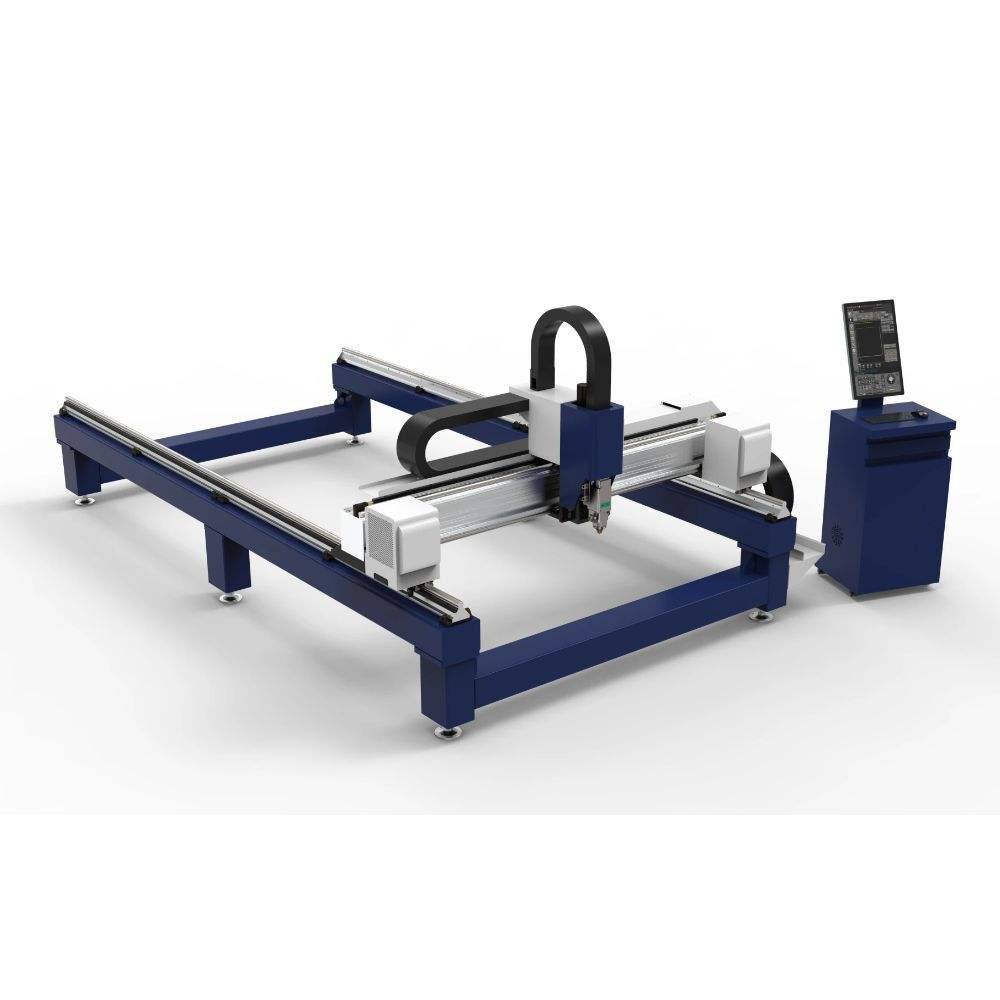
The 5-axis CNC system allows the cutting head to oscillate and tilt, producing V, X, and K-type bevels on thick-walled beams. This eliminates the secondary process of edge milling or manual grinding. In my field evaluation, we observed that for a 25mm thick S355JR structural beam, the laser-cut bevel maintained a dimensional tolerance of ±0.3mm, significantly surpassing the ±1.5mm standard common with high-definition plasma. This precision ensures a uniform root gap during the submerged arc welding (SAW) processes used in tower assembly.
2.2 Kerf Compensation and Dynamic Path Planning
Cutting at a 45-degree angle effectively increases the material thickness the laser must penetrate (the slant thickness). For a 20mm flange, a 45° bevel requires the laser to penetrate approximately 28.2mm of steel. The 20kW source is critical here; it provides the necessary power density to maintain a stable keyhole at these effective thicknesses without compromising feed rates or inducing excessive slag at the bottom of the cut.
3.0 The 20kW Advantage: Power Density and Thermal Dynamics
3.1 Heat Affected Zone (HAZ) Minimization
One of the primary concerns in wind tower structural engineering is the Heat Affected Zone (HAZ). Excessive heat input can alter the grain structure of the steel, leading to embrittlement at the weld interface. The high energy density of the 20kW fiber laser allows for significantly higher cutting speeds (meters per minute) compared to 6kW or 10kW alternatives.
By increasing the feed rate, we decrease the “dwell time” of the beam on any specific coordinate, thereby minimizing the total thermal energy transferred to the substrate. Our metallurgical samples from the HCMC site showed a 40% reduction in HAZ width compared to traditional oxy-fuel or plasma cutting, preserving the mechanical properties of the high-tensile steel used in tower internals.
3.2 Gas Dynamics and Dross Suppression
The 20kW system utilizes a high-pressure nitrogen or oxygen assist gas, depending on the desired finish. In the HCMC facility, we focused on oxygen-assisted cutting for heavy carbon steel to leverage the exothermic reaction. The CNC system’s ability to modulate gas pressure in real-time based on the bevel angle is vital. As the head tilts to 45°, the nozzle-to-workpiece distance changes across the kerf profile. The 20kW system’s integrated sensor array maintains a constant standoff distance, ensuring laminar gas flow that effectively ejects molten material, resulting in a dross-free finish even on the underside of complex channel geometries.
4.0 Application Specifics: Wind Turbine Tower Internals
4.1 Heavy Beam and Channel Processing
Wind towers are not merely hollow tubes; they are complex assemblies requiring internal stiffeners and support structures. The 20kW CNC cutter facilitates the processing of large-format H-beams (up to 600mm) and U-channels used for cable management and service lifts.
The automation of “coping” (the process of cutting notches in the ends of beams to allow them to connect) combined with beveling has reduced the fabrication time per internal assembly by roughly 65%. In the HCMC pilot facility, the bottleneck shifted from the cutting station to the welding station—a preferred scenario in high-output manufacturing.
4.2 Precision for Offshore Environments
For towers destined for the offshore projects near Vung Tau, the precision of the laser cut is even more critical due to the corrosive maritime environment. Precise fits reduce the volume of weld metal required, which in turn reduces the potential for weld defects where corrosion typically initiates. The ±45° bevel allows for a perfect fit-up of curved plate reinforcements against the interior wall of the tower, ensuring 100% penetration welds with minimal overfill.
5.0 Integration of Automatic Structural Processing
5.1 Material Handling and Sensing
The HCMC installation features a 12-meter automatic loading and unloading system. For structural beams, which often possess inherent “camber” or “sweep” (slight deviations from perfect straightness), the CNC laser’s touch-sensing and laser-scanning protocols are essential. Before the 20kW source is engaged, the machine maps the actual profile of the beam in 3D space. The CNC then adjusts the cutting path to account for the material’s physical deviations, ensuring that the bevel remains consistent relative to the beam’s actual center line, rather than its theoretical model.
5.2 Software Synergy: From CAD to Code
The synergy between TEKLA/SolidWorks and the laser’s nesting software is the backbone of this efficiency. We have implemented a “Direct-to-Machine” workflow where the structural engineer’s 3D models are converted into G-code with automatic bevel assignment. This removes human error from the bevel calculation, which is particularly complex when dealing with the intersection of a flat beam flange and a curved tower wall.
6.0 Environmental and Operational Considerations in HCMC
6.1 Climate Adaptation
Operating a 20kW fiber laser in Ho Chi Minh City presents unique challenges due to high ambient humidity and temperatures. The laser source must be housed in a climate-controlled cabinet to prevent condensation on the optical fiber and diodes. Our field report confirms that the dual-circuit chilling system—cooling both the laser source and the cutting head—must be oversized by 20% compared to European specifications to maintain a stable ±1°C operating window in the tropical climate.
6.2 Power Grid Stability
A 20kW laser system, including the chiller and dust extraction, demands a significant and stable power supply. We have integrated industrial voltage stabilizers and UPS backups for the CNC controller to mitigate the risks of voltage fluctuations common in rapidly expanding industrial zones. This ensures that a 45-minute cut on a massive H-beam is not lost due to a momentary power sag.
7.0 Conclusion: The ROI of Precision
The implementation of the 20kW CNC Beam and Channel Laser Cutter with ±45° beveling technology in Ho Chi Minh City marks a turning point for Vietnamese steel fabrication. The technical data gathered confirms that the high initial capital expenditure is offset by the total elimination of secondary edge preparation, a significant reduction in weld wire consumption, and a drastic increase in throughput.
For the wind energy sector, where structural failure is not an option, the precision of the laser-cut bevel ensures that the towers produced in HCMC meet international standards (DNV-GL/API). As we move toward larger 15MW+ turbines, the necessity for 20kW+ power levels and multi-axis beveling will become the baseline, not the exception, in heavy structural processing.
Field Report Authorized by:
Senior Lead Engineer, Structural Laser Systems
HCMC Industrial Evaluation Division













