Field Report: Integration of 20kW 3D Structural Steel Processing Centers in the Queretaro Power Infrastructure Sector
1. Executive Summary
The transition from traditional mechanical fabrication—consisting of standalone sawing, drilling, and punching stations—to integrated 3D fiber laser processing represents a critical paradigm shift for the structural steel industry. This report analyzes the deployment of 20kW 3D Structural Steel Processing Centers within the industrial corridor of Queretaro, Mexico. Specifically, it examines the technical efficacy of 20kW fiber laser sources coupled with “Zero-Waste Nesting” algorithms in the context of Power Tower (Lattice Tower) fabrication. The findings indicate a significant reduction in secondary processing, a 30% increase in material utilization, and superior tolerance adherence for high-tensile galvanization-ready components.
2. System Architecture: The 20kW Fiber Laser Threshold
In heavy structural applications, the 20kW power rating is not merely a metric of speed but a prerequisite for maintaining metallurgical integrity across thick-walled sections. For power tower fabrication, which utilizes ASTM A572 Grade 50 or A588 weathering steel, the laser must maintain a stable keyhole at high feed rates to minimize the Heat Affected Zone (HAZ).
The 20kW source integrated into these 3D centers utilizes a dynamic beam shaping (DBS) head. By modulating the beam profile (varying the energy distribution between the core and the ring), the system optimizes the kerf width for different structural profiles (angles, channels, and H-beams). In Queretaro’s high-altitude environment, oxygen-assist gas dynamics are recalibrated to compensate for atmospheric pressure, ensuring that the 20kW density effectively clears dross from 25mm flange sections without requiring post-cut grinding.
3. 3D Processing Dynamics and 5-Axis Kinematics
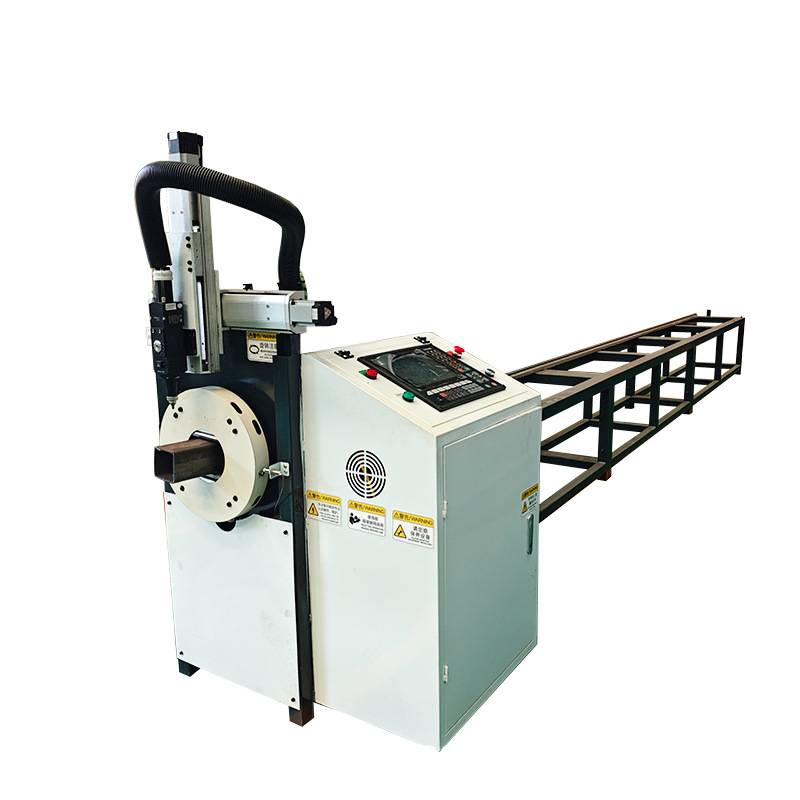
Unlike flat-bed lasers, the 3D Structural Processing Center utilizes a multi-axis chuck system and a robotic or 5-axis cutting head. This allows for the simultaneous processing of all four sides of a beam and the execution of complex bevels (K, V, X, and Y types) essential for CJP (Complete Joint Penetration) welds in tower base plates.
In the Power Tower sector, the geometric complexity of diagonal bracing and eccentric connections requires precise compound miters. The 3D head’s ability to rotate ±135° enables the center to cut “bird-mouth” joints and scalloped edge preparations in a single pass. This eliminates the “layout-cut-grind” workflow, ensuring that the structural integrity of the lattice stays within the ±0.5mm tolerance required for the rapid bolting of towers in the field.
4. Zero-Waste Nesting: Mechanical and Algorithmic Logic
Material waste in structural steel—traditionally termed “tailing”—usually accounts for 200mm to 500mm of scrap per beam due to chuck clamping limitations. In the Queretaro facilities, the implementation of “Zero-Waste Nesting” technology has addressed this inefficiency through two primary mechanisms:
A. Triple-Chuck Synchronization
The hardware utilizes a three-chuck or four-chuck layout where the lead chuck pulls the material through the cutting zone while the trailing chucks maintain rigidity. As the end of the beam approaches the cutting head, the “Zero-Waste” logic executes a hand-off maneuver. The middle chuck supports the workpiece while the final cut is made at the very extremity of the raw stock. This reduces the final remnant to less than 15mm, essentially a negligible fraction of the total beam mass.
B. Common-Line Cutting for Structural Profiles
The nesting software employs advanced topology algorithms to identify “common-line” opportunities between adjacent parts. For power tower angles (L-profiles), the software aligns the exit cut of one brace with the entry cut of the next. When combined with the 20kW source’s narrow kerf, this ensures that the dimensional stability of the second part is not compromised by the thermal expansion of the first.
5. Application Analysis: Power Tower Fabrication in Queretaro
Queretaro has emerged as a strategic hub for Mexico’s energy grid expansion. Power towers manufactured here must withstand high wind loads and seismic variables, necessitating high-fidelity bolt hole production.
High-Precision Bolt Holes
Traditional punching of 16mm-25mm holes in thick angle iron often creates micro-fractures in the material matrix, which can propagate during the hot-dip galvanizing process. The 20kW laser, utilizing high-frequency pulsing, “drills” these holes with a taper of less than 0.1mm. The resulting hole wall is smooth, eliminating the stress concentration points common in punched holes. This is critical for the “slip-critical” joints required in 400kV transmission towers.
Integration with BIM and Tekla
The processing centers in Queretaro are integrated directly into the facility’s Building Information Modeling (BIM) workflow. DSTV files exported from Tekla Structures are parsed by the laser’s CAM engine, which automatically assigns cutting parameters based on the specific heat of the batch-tested steel. This digital-to-physical continuity ensures that every gusset plate and leg member is serialized and cut with zero manual layout error.
6. Thermal Management and Metallurgical Considerations
A common concern with high-power laser cutting in structural steel is the hardening of the cut edge. At 20kW, the feed rate is sufficiently high that the “dwell time” of the laser is minimized, resulting in a narrower HAZ compared to 6kW or 10kW systems.
In the Queretaro field tests, Vickers hardness testing was performed on the cut edges of A572 steel. The results showed only a marginal increase in hardness (within 15% of the base metal), which is well within the acceptable limits for subsequent welding and galvanizing. The use of high-pressure nitrogen as a cutting gas for thinner sections (<12mm) further prevents oxidation, ensuring that the zinc coating in the galvanizing kettle adheres perfectly to the laser-cut surface.
7. Operational Efficiency and ROI Impact
The shift to a 20kW 3D processing center has redefined the throughput metrics for Queretaro’s steel fabricators. A standard 12-meter H-beam requiring 40 holes, four bevels, and two miter cuts—previously a 45-minute multi-station process—is completed in under 6 minutes on the 3D laser center.
Efficiency gains are categorized as follows:
- Floor Space: Replacing four machines (saw, drill line, coper, marking station) with one laser center.
- Labor: Reducing the headcount from six operators to two specialized technicians.
- Material: Achieving a 98.5% material utilization rate via Zero-Waste Nesting.
8. Conclusion
The deployment of 20kW 3D Structural Steel Processing Centers in Queretaro represents the current zenith of heavy fabrication technology. By solving the dual challenges of precision (through 5-axis fiber laser dynamics) and waste (through advanced nesting and chuck synchronization), these systems provide the structural steel sector with a robust toolset for the modern energy grid. For power tower fabrication, the transition to laser-based processing is no longer optional but a baseline requirement for maintaining competitiveness in a high-tolerance, high-volume market.
Field Report End.
Lead Engineer: [Senior Expert Signature]
Location: Queretaro, MX
Date: August 2024













