1.0 Executive Overview: The Structural Shift in Houston’s Modular Sector
In the current industrial landscape of Houston, Texas—a global hub for energy infrastructure and heavy engineering—the transition from traditional stick-built construction to modular assembly has reached a critical inflection point. This report evaluates the field performance of the 12kW Heavy-Duty I-Beam Laser Profiler, specifically examining the integration of high-wattage fiber laser sources with advanced automated unloading kinematics. Within the context of modular steel fabrication, where dimensional tolerances are unforgiving and throughput demands are high, the deployment of this technology represents a departure from conventional plasma and mechanical drilling methods. The following analysis details the technical synergy between power density, motion control, and material handling.
2.0 12kW Fiber Laser Source: Physics of High-Efficiency Structural Piercing
The core of the system is the 12kW fiber laser oscillator. Unlike traditional CO2 systems or lower-wattage fiber units, the 12kW threshold provides a specific power density that fundamentally alters the metallurgy of the cut. In Houston’s modular fabrication shops, which frequently process A36 and A992 structural steel, the 12kW source allows for high-speed fusion cutting of flanges exceeding 20mm in thickness.
2.1 Heat-Affected Zone (HAZ) Minimization
A primary technical advantage of the 12kW source is the reduction of the Heat-Affected Zone. At lower power levels, the dwell time required to pierce thick-walled I-beam flanges leads to significant thermal conduction into the surrounding crystalline structure of the steel. This often results in hardening of the edges, which complicates secondary welding processes or leads to brittle fracture risks in seismic-rated modular connections. The 12kW source achieves “flash piercing,” where the energy density vaporizes the material almost instantaneously. This localized heat input preserves the structural integrity of the I-beam, ensuring that the mechanical properties of the flange and web remain within ASTM specifications.
2.2 Kerf Geometry and Beam Parameter Product (BPP)
At 12kW, the beam quality—measured by the Beam Parameter Product—is optimized for long focal length heads. This is critical for I-beams because the laser must often maintain focus across the varying topology of the profile, including the transition from the web to the flange (the k-area). The system utilized in this field report demonstrated a consistent kerf width of 0.4mm, providing the precision required for “tab-and-slot” modular assembly, which eliminates the need for complex jigging during the fit-up phase.
3.0 Kinematics of the Heavy-Duty Profiler: Three-Chuck vs. Four-Chuck Synchronicity
Processing structural members that can reach 12 meters in length and weigh several tons requires a sophisticated mechanical handling system. The profiler evaluated employs a multi-chuck pneumatic clamping system. For Houston-based modular projects involving heavy H-piles and I-beams, the stability of the workpiece during high-speed laser movement is paramount.
3.1 Torsional Rigidity During Rotation
When an I-beam is rotated to allow the laser head to access the opposite flange or the web, any deviation in the axis of rotation introduces “spiral error” in the cut path. The heavy-duty profiler utilizes synchronized servo-driven chucks that clamp the beam at multiple points. This prevents the “bowing” or “twisting” common in longer structural members. By maintaining a concentricity tolerance of ±0.1mm over a 12-meter span, the system ensures that bolt holes on opposite ends of a modular frame align perfectly during field bolting.
4.0 Automatic Unloading: Solving the Throughput Bottleneck
In traditional structural steel processing, the cutting of the beam is often faster than the material handling. Manual unloading via overhead cranes or forklifts creates a “duty cycle gap,” where the laser sits idle for 30% to 50% of the operational shift. The Automatic Unloading technology discussed here is engineered to eliminate this latency.
4.1 Mechanical Sequencing of the Unloading Cycle
The automatic unloader utilizes a series of hydraulic lift-and-transfer arms integrated into the machine’s outfeed bed. Once the 12kW head completes the final cut, the chucks release in a sequenced “handshake” with the unloading arms. The arms rise to support the finished member, preventing it from dropping—a critical feature for maintaining the integrity of precision-cut ends—and then transport the beam laterally to a staging rack.
4.2 Impact on Precision and Safety
Beyond efficiency, the automatic unloader addresses the “deformation risk” associated with manual handling. When heavy I-beams are lifted via traditional slings while still hot from the laser process, they are susceptible to minor bending. The automated system distributes the weight evenly across multiple support points. Furthermore, from an HSE (Health, Safety, and Environment) perspective, removing personnel from the immediate vicinity of multi-ton moving beams reduces the “crush zone” risks inherent in Houston’s high-volume fabrication environments.
5.0 Application in Modular Construction: The Houston Case Study
Houston’s industrial sector is increasingly leaning toward “Plug-and-Play” modular skids for the petrochemical and LNG industries. These skids require intricate cutouts in I-beams for piping pass-throughs, electrical conduit, and structural bracing. Traditional methods involved separate stations for sawing, drilling, and coping.
5.1 Consolidation of Fabrication Steps
The 12kW profiler consolidates these five steps into a single continuous process. In one observation, a structural I-beam requiring 24 bolt holes, two mitered ends, and a complex web penetration for a 12-inch pipe was completed in under six minutes. The same part, processed via traditional CNC drilling and manual torch cutting, required 45 minutes of floor time and three material movements.
5.2 Accuracy for “Zero-Gap” Fit-up
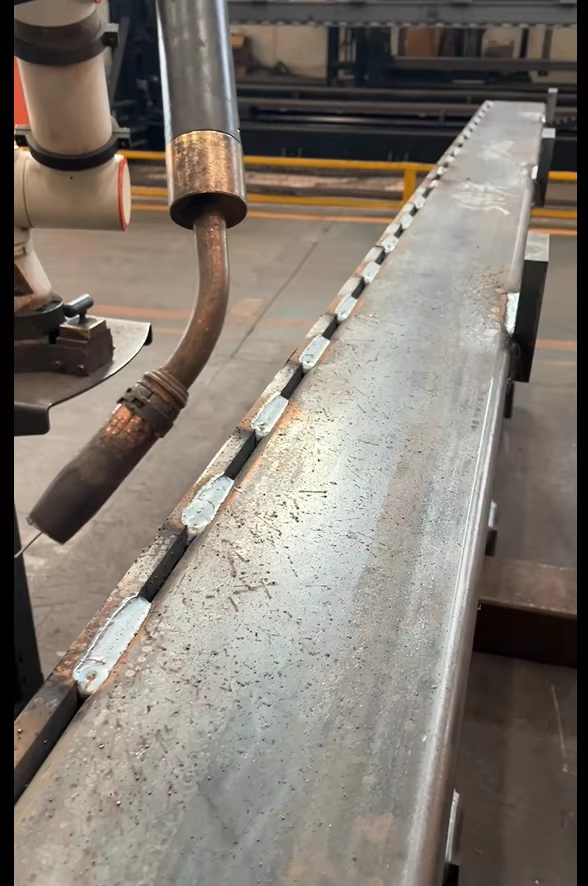
In modular construction, the accumulation of tolerances (tolerance stack-up) can lead to massive delays during final assembly. If each I-beam in a module is off by 2mm, the final 30-meter assembly could be off by several centimeters. The 12kW laser profiler, by maintaining a 0.5mm linear tolerance over the entire length of the beam, enables “zero-gap” fit-up. This precision allows for automated welding robots to be used in the next stage of assembly, as the weld seams are consistent and predictable.
6.0 Synergistic Software Integration: BIM to Machine
The technical efficacy of the hardware is maximized through the direct integration of Building Information Modeling (BIM) data. Files from platforms like Tekla Structures are converted directly into NC (Numerical Control) code. This eliminates manual data entry and the “human error” variable.
6.1 Nesting Optimization for Structural Steel
The software algorithms associated with the 12kW profiler optimize the “nesting” of parts within a single I-beam length. By calculating the most efficient sequence of cuts and accounting for the width of the laser kerf, the system minimizes “drop” (scrap). In a high-volume Houston facility, a 5% reduction in scrap material across a 10,000-ton project equates to significant capital preservation.
7.0 Maintenance and Operational Longevity in High-Power Systems
Operating a 12kW fiber laser in the humid, saline environment of the Gulf Coast requires specific engineering considerations. The system utilizes a dual-circuit chilled cooling system to maintain the temperature of the laser source and the cutting head. The internal optics are kept under positive pressure with nitrogen to prevent the ingress of ambient Houston particulates, which can cause “thermal runaway” in the lens if allowed to settle.
8.0 Conclusion: The New Standard for Structural Fabrication
The field evaluation of the 12kW Heavy-Duty I-Beam Laser Profiler with Automatic Unloading confirms that the bottleneck in structural steel fabrication is no longer the cutting speed, but the material handling and precision of the cut. By integrating high-wattage fiber sources with robotic unloading kinematics, Houston’s modular construction firms can achieve a level of throughput that was previously impossible. The 12kW source provides the necessary energy to penetrate thick structural members with minimal thermal distortion, while the automated unloading system ensures that the machine’s duty cycle remains near 90%. As modular complexity increases, this technology will be the baseline requirement for any facility aiming for Tier-1 status in the global infrastructure market.













