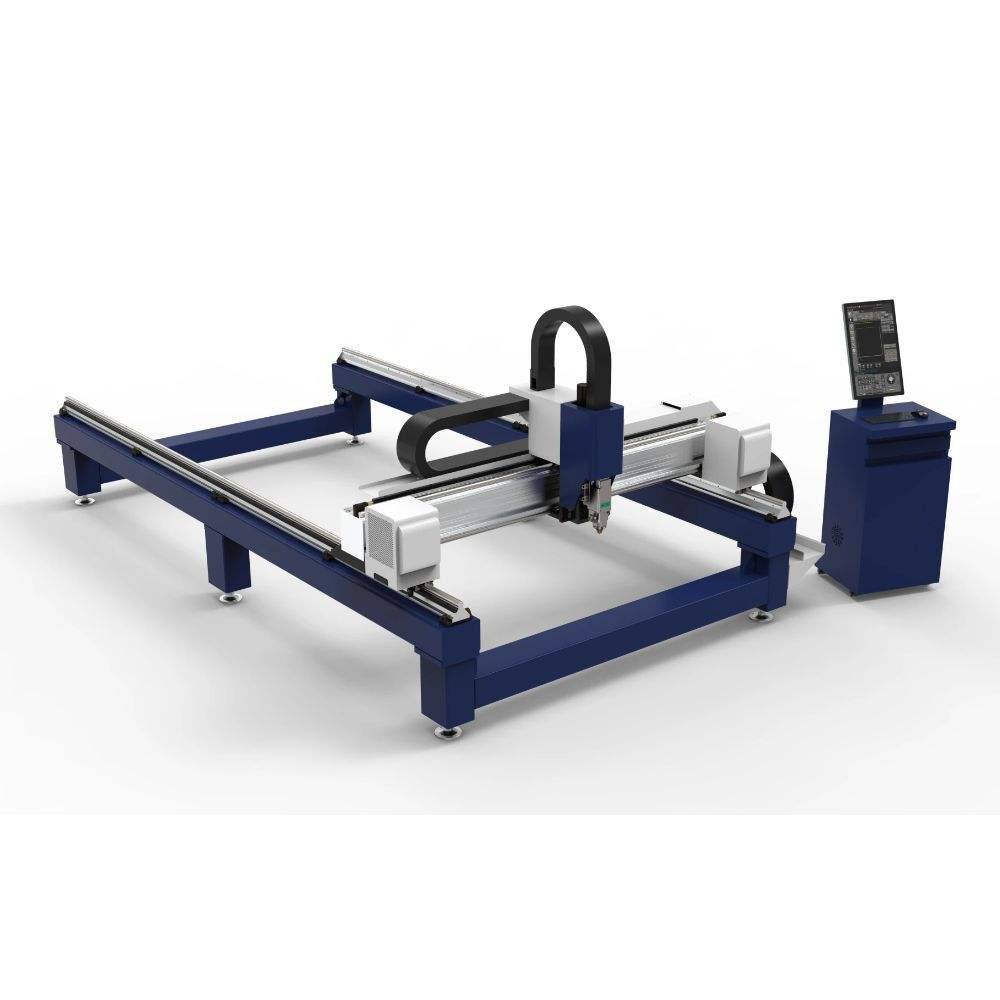
The Dawn of Ultra-High Power in Structural Fabrication
For decades, the structural steel industry relied on plasma cutting, oxy-fuel, and mechanical sawing to process large-scale sections. While functional, these methods lacked the surgical precision required for the evolving modular construction market. The arrival of the 12kW fiber laser has changed the calculus of production. As a fiber laser expert, I have witnessed the transition from 4kW and 6kW systems to the 12kW powerhouse, and the difference is not merely incremental—it is transformative.
At 12kW, the energy density of the laser beam allows for “high-speed vaporization” of thick-walled carbon steel. For a modular construction firm in Hamburg, this means that a 300mm I-beam or a heavy-duty U-channel can be perforated, notched, and cut to length in a fraction of the time required by legacy systems. The fiber laser’s wavelength (typically around 1.06 microns) is absorbed more efficiently by metals than the older CO2 technology, leading to feed rates that can exceed 10 meters per minute even on substantial thicknesses. This speed is the backbone of the “just-in-time” delivery model essential for Hamburg’s bustling construction sites.
Mastering the Geometry: ±45° Bevel Cutting
The most significant hurdle in structural steel fabrication has always been weld preparation. Traditional straight cuts require secondary processing—usually manual grinding or specialized milling—to create the bevels necessary for deep-penetration welds. The 12kW CNC Beam Laser with a 5-axis profiling head solves this natively.
With a ±45° beveling capability, the laser head can tilt dynamically as it orbits the beam or channel. This allows for the creation of V, Y, K, and X-shaped joints in a single pass. In modular construction, where steel frames must be joined with absolute structural integrity to withstand transport and stacking loads, these precision bevels are non-negotiable. The CNC control synchronizes the laser’s focal point with the tilt angle, ensuring that the kerf width remains consistent and the Heat Affected Zone (HAZ) remains minimal. This precision ensures that when two beams meet on a job site in Hamburg, the fit-up is perfect, reducing the amount of filler metal required and significantly lowering welding time.
Hamburg’s Industrial Synergy and Modular Construction
Hamburg is uniquely positioned to lead the modular revolution. As home to one of Europe’s largest ports and a cluster of high-tech engineering firms, the city demands infrastructure that is both robust and rapidly deployable. Modular construction—the process of building large-scale sections of a structure in a factory environment before transporting them to the site—is the answer to the city’s urban density challenges.
A 12kW laser cutter acts as the “engine” of a modular factory. By processing beams and channels with ±0.1mm tolerances, the laser enables the use of interlocking “tenon and mortise” joints in steel. These joints allow structural components to self-align during the assembly of a module. For a contractor working on a new residential complex in the HafenCity district, this means the steel skeleton of a building can be erected with the speed of a mechanical assembly line rather than a traditional construction site. The 12kW laser provides the capacity to handle the high volume of parts required for these massive projects without sacrificing the German standard of “Ingenieurskunst” (engineering excellence).
Processing Complex Profiles: Beams, Channels, and Beyond
The versatility of a CNC beam laser lies in its ability to handle non-flat geometries. Unlike plate lasers, these machines utilize sophisticated chuck systems and rotary axes to manipulate I-beams (HEA/HEB), C-channels, and rectangular hollow sections (RHS).
When cutting an I-beam, the 12kW laser must navigate the transition from the thin web to the thick flanges. The software’s ability to adjust power output and gas pressure in real-time is critical. With 12,000 watts of power, the machine maintains a stable “keyhole” in the molten metal, ensuring clean exits and entries. This is particularly vital for architectural features where the steel might be left exposed. The ±45° beveling head also allows for complex miter cuts and “birdsmouth” notches in circular hollow sections, which are frequently used in the aesthetic modular designs seen in modern German architecture.
Software Integration: From Tekla to the Torch
The hardware is only as capable as the data driving it. In the modern Hamburg fabrication shop, the 12kW laser is fully integrated into the BIM (Building Information Modeling) workflow. Engineers design modular units in software like Tekla Structures or Autodesk Revit. These 3D models are then exported directly to the laser’s CAM (Computer-Aided Manufacturing) software.
The software automatically calculates the nesting of parts to minimize scrap—a crucial factor given the rising costs of raw materials. It also determines the optimal path for the 5-axis head to execute bevels without colliding with the beam’s flanges. This digital thread from design to finished part eliminates manual layout errors. In the context of modular construction, where a 5mm error in a factory can lead to a 50mm misalignment on a multi-story construction site, this digital precision is the ultimate insurance policy.
Environmental Impact and Operational Efficiency
Sustainability is a core pillar of Hamburg’s industrial strategy. Compared to plasma cutting, the 12kW fiber laser is significantly more energy-efficient per meter of cut. The absence of chemical pre-treatments and the reduction in grinding dust contribute to a cleaner factory environment. Furthermore, the precision of the laser reduces material waste through tighter nesting and eliminates the need for rework.
From an operational standpoint, the 12kW system offers a lower cost-per-part than lower-power alternatives. While the initial capital investment is higher, the sheer throughput—often replacing three or four conventional machines—provides a rapid Return on Investment (ROI). For Hamburg-based firms competing on the international stage, this efficiency is a key differentiator.
Technical Challenges and Expert Solutions
Operating a 12kW system with a bevel head requires a deep understanding of laser physics. At these power levels, back-reflection can damage the optical chain if not managed correctly, especially when cutting reflective materials like aluminum or copper components sometimes used in modular MEP (Mechanical, Electrical, and Plumbing) frames. Modern systems use advanced optical isolators and sensors to monitor the health of the protective windows.
Furthermore, maintaining the focal point during a 45-degree tilt requires high-speed processing of the CNC’s look-ahead algorithms. As the head tilts, the distance to the material changes; the “capacitive height sensing” must be lightning-fast to prevent nozzle collisions while maintaining the precise standoff distance required for a clean cut. As an expert, I emphasize the importance of using high-purity nitrogen as a cutting gas for these applications to ensure oxide-free edges that are ready for immediate painting or galvanizing without further treatment.
Conclusion: Building the Future of Hamburg
The 12kW CNC Beam and Channel Laser Cutter is more than just a tool; it is the catalyst for a new era of structural engineering. In Hamburg, where the tradition of heavy industry meets the future of smart city development, this technology is bridging the gap. By enabling ±45° beveling on massive structural sections, we are removing the friction from the construction process.
Modular construction demands a level of accuracy that was previously cost-prohibitive. Today, with 12,000 watts of fiber laser power, we can cut, bevel, and drill with a level of efficiency that makes modular steel buildings not only faster to build but stronger and more sustainable. For the engineers and fabricators of Northern Germany, the message is clear: the future of construction is being cut by light, and it is being built with a precision that was once thought impossible.