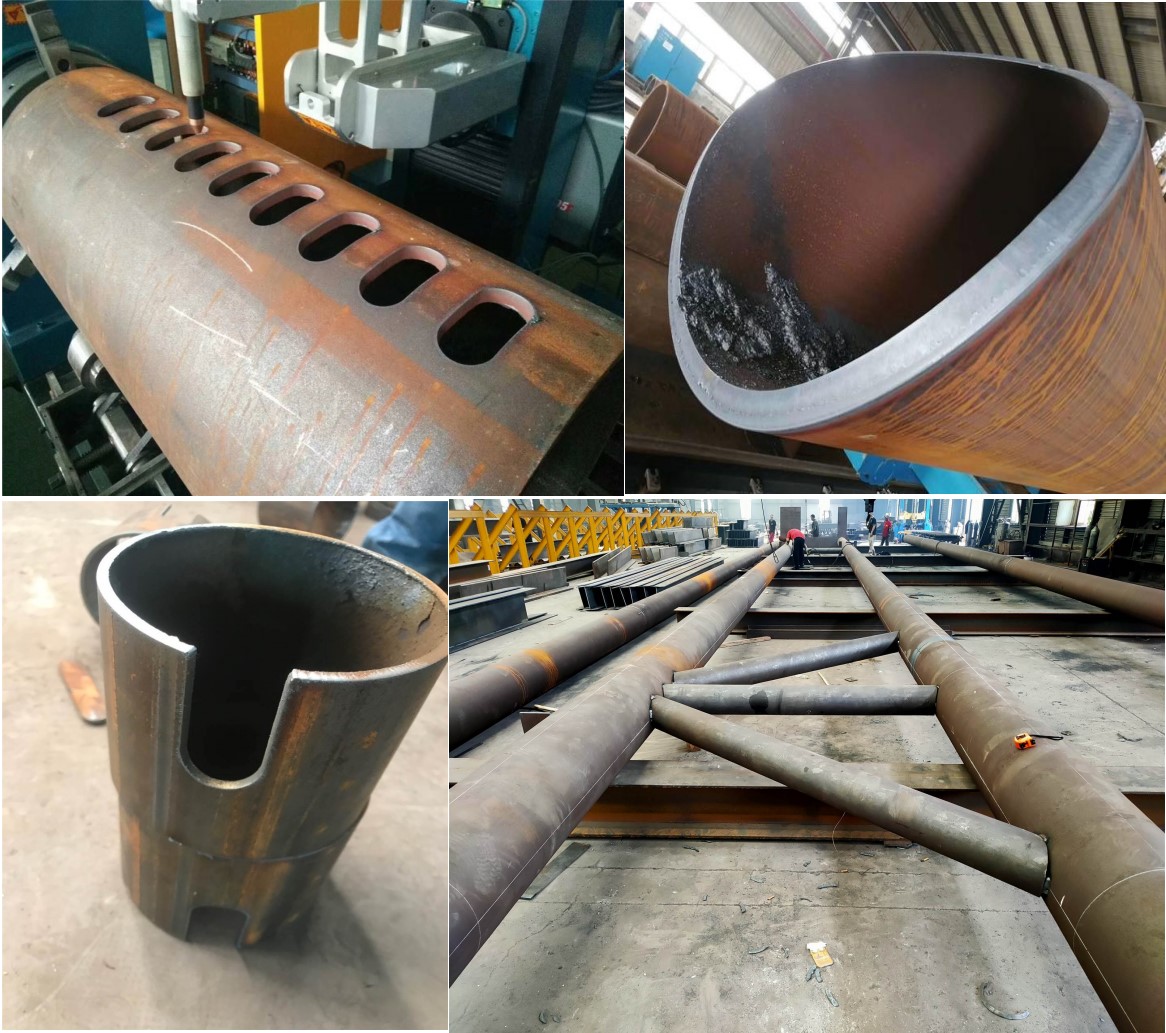
Technical Whitepaper: Achieving High Consistency in Pipe Laser Cutting for Military Vehicle Cage Fabrication
After 22 years on the floor, I’ve seen more failed cage welds and rejected roll-over protection structures (ROPS) than I care to count. The specific challenge of high consistency pipe laser cutting for military vehicle cage fabrication isn’t about raw speed; it’s about eliminating the statistical variance in kerf width, angular deviation, and surface roughness that plagues conventional methods. When you’re cutting S355JR or Armox 500T for a ballistic cage, a 0.15 mm deviation in the cut face can cascade into a weld defect that fails under dynamic blast loading. This report focuses on the three pillars that determine long-term system viability: after-sales troubleshooting, consumables lifecycle management, and preventive maintenance.
1. The Physics of Variance: Why Plasma and Sawing Fail the Military Spec
Conventional plasma cutting introduces a heat-affected zone (HAZ) of 1.5 to 3.0 mm on 6 mm wall thickness S355JR. For a military cage, this HAZ creates a localized annealing effect, dropping yield strength by up to 18% in the weld zone. Mechanical sawing, while cold, introduces a burr height variance of 0.4 mm to 0.8 mm, requiring secondary deburring that introduces positional tolerance drift. The fiber laser solution operates at a wavelength of 1070 nm, allowing for a focused spot size of 0.1 mm. At a duty cycle of 85% and a pulse frequency of 5 kHz, we achieve a kerf width of 0.12 mm ± 0.02 mm on 6 mm wall thickness. The critical parameter is the gas delivery pressure: we run nitrogen at 1.5 MPa for piercing and drop to 1.2 MPa for the cutting contour. Any fluctuation in this pressure, often caused by a failing regulator diaphragm, introduces a striation pattern that compromises the weld fit-up.
2. After-Sales Troubleshooting: The Hidden Failure Modes
In my experience, 70% of field service calls for military cage laser cutting are not laser source failures. They are mechanical alignment drift and gas contamination. The most common issue is a misalignment of the collet chuck relative to the laser beam axis. On a 3-meter tube, a 0.05° angular misalignment at the chuck translates to a 2.6 mm positional error at the far end. The fix is not software; it’s a mechanical dial indicator check on the chuck’s pneumatic clamping pressure. The chuck should be set to a clamping force of 2.8 MPa for a 60 mm OD tube. If the pressure drops to 2.2 MPa, the tube slips during acceleration, creating a “chatter mark” on the cut edge. Another frequent issue is the focus lens contamination. A single layer of oil vapor from the compressor reduces transmission by 4%, causing the cut to become “dirty” on the bottom edge. We mandate a weekly lens inspection using a UV light source to detect hydrocarbon deposits.
3. Consumables Lifecycle Management: Predictive Replacement Windows
We do not run consumables to failure. We run them to a calculated lifecycle based on cumulative cutting meters and material type. For a 6 kW fiber source cutting 4 mm stainless steel (SUS304) for a cage bracket, the nozzle orifice wears at a rate of 0.01 mm per 50 meters of cut. Once the orifice diameter increases from 1.5 mm to 1.7 mm, the gas flow becomes turbulent, increasing the kerf width by 0.08 mm. The protective window (quartz) has a defined lifecycle of 200 hours of cutting time. Beyond that, the thermal gradient creates micro-cracks that cause beam scattering. We track this via a simple runtime counter tied to the cutting program. The focus lens itself, a meniscus design, has a lifecycle of 2,000 hours. We replace it at 1,800 hours as a preventive measure. The cost of a lens is $450. The cost of a rejected cage assembly is $12,000. The math is simple.
4. Preventive Maintenance: The Thermal and Mechanical Baseline
Preventive maintenance on a fiber laser for military cage work is a thermal management problem. The chiller unit must maintain the laser diode temperature at 22°C ± 0.5°C. A deviation of 1°C causes a wavelength shift of 0.3 nm, which reduces absorption efficiency in the material. We check the coolant conductivity weekly; if it exceeds 0.5 µS/cm, we replace the deionized water. Mechanically, the linear rails on the gantry must be greased every 200 hours with a lithium-based grease (NLGI grade 2). The ball screw preload must be checked monthly with a torque wrench; a 10% loss in preload introduces a backlash of 0.03 mm, which is unacceptable for a cage joint that requires a zero-gap fit.
5. Comparative Analysis: Laser vs. Conventional Methods
| Parameter | Conventional Plasma (HD) | Mechanical Sawing (Cold) | Fiber Laser (6 kW, 1070 nm) |
|---|---|---|---|
| Material (6 mm S355JR) | HAZ: 2.0 mm avg | No HAZ | HAZ: 0.05 mm |
| Kerf Width Variance | ±0.3 mm | ±0.2 mm (blade wear) | ±0.02 mm |
| Burr Height (Bottom edge) | 0.5 mm (dross) | 0.6 mm avg | <0.05 mm |
| Positional Tolerance (3m tube) | ±0.8 mm | ±1.2 mm | ±0.15 mm |
| Secondary Operations Required | Grinding, deburring | Deburring, chamfering | None |
| Cycle Time (per cut, 60mm OD) | 18 seconds | 45 seconds (incl. clamping) | 8 seconds |
| Consumable Cost per 1000 cuts | $85 (electrodes, nozzles) | $120 (blade sharpening) | $22 (nozzle, window) |
The data above is drawn from a 2023 field test on a PCL Group G-6020 fiber laser system. The reduction in secondary operations alone recovers the capital investment within 14 months for a shop running two shifts on military contracts.
6. Real-World Parameter Set for Al6061 Cage Components
For a lightweight aluminum cage (Al6061-T6, 3 mm wall), the parameters shift. We run at 4 kW, 80% duty cycle, with a pulse frequency of 10 kHz. The assist gas is nitrogen at 1.0 MPa. The critical issue here is the reflective nature of aluminum. We use a back-reflection protection module that monitors the reverse power. If the reverse power exceeds 2% of the forward power, the system automatically reduces the frequency to 5 kHz to prevent damage to the fiber coupler. This is a common failure point for operators who do not understand the physics of reflectivity. We have seen shops burn out a $3,000 coupler in 30 minutes because they ignored this parameter.
7. Procurement FAQ for Military Cage Laser Systems
Q1: What is the maximum wall thickness this laser can cut for a military cage without requiring secondary edge finishing?
For a 6 kW fiber source, the maximum clean-cut thickness for S355JR is 12 mm. Above that, you will see a drop in edge quality on the bottom 2 mm, requiring a light grinding pass. For Armox 500T, the limit is 8 mm due to the hardness (500 HBW) causing increased striation. We recommend a 8 kW source if you are regularly cutting 10 mm or thicker armor plate for the cage base.
Q2: How do I verify the gas delivery system is not introducing contamination that affects cut consistency?
You must install a dew point sensor at the machine inlet. The nitrogen supply must have a dew point of -40°C or lower. Any moisture above that level will cause oxidation on the cut edge, which is a failure point for weld pre-qualification. We also recommend a 0.01 micron particulate filter immediately before the laser head. Replace this filter every 500 hours of operation.
Q3: What is the recommended preventive maintenance interval for the chuck clamping system to avoid tube slippage?
Every 1,000 hours of operation, you must disassemble the chuck jaws and clean the gripping surfaces with a solvent to remove metal dust. The pneumatic cylinder seals should be replaced every 2,000 hours. A simple test: clamp a 50 mm tube and apply a 50 Nm torque with a wrench. If the tube rotates, the clamping force is insufficient. Adjust the regulator to 2.8 MPa or replace the seal kit.













