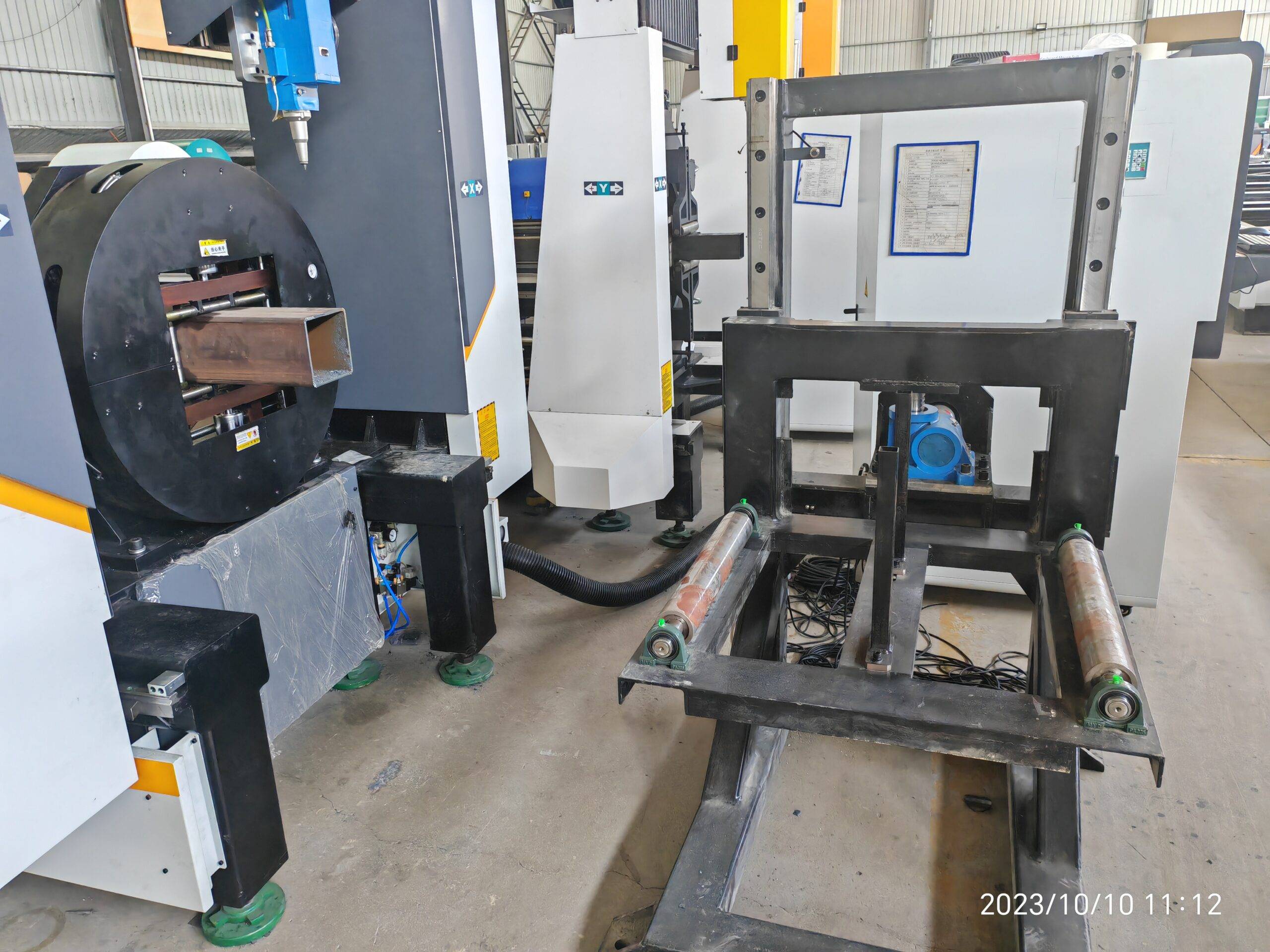
Technical Analysis: CNC Tube Laser Center for Substation Rectangular Busbars
From the workshop floor, the transition from conventional busbar fabrication to a CNC tube laser center for substations rectangular busbars is not a luxury—it is a direct response to failure rates in high-current joints. I have spent the last two decades debugging plasma dross on S355JR profiles and watching mechanical saws deform Al6061-T6 extrusions. The laser solution eliminates those variables, but only if you understand the after-sales reality: consumables lifecycle and preventive maintenance schedules dictate your uptime, not the brochure specs.
Let us cut through the marketing. A substation busbar, typically 40×5 mm to 160×10 mm in rectangular cross-section, demands a cut edge perpendicularity of less than 0.1 mm per 100 mm of thickness. Conventional plasma (Hypertherm HPR260) delivers 0.5 mm at best, with a heat-affected zone that forces secondary grinding. Mechanical sawing introduces burrs that require deburring stations, adding 12 to 18 seconds per cut. The fiber laser, running at 6 kW to 8 kW on a 1.5 mm nozzle standoff, achieves 0.05 mm perpendicularity with a 0.2 mm kerf width. The raw physics: 1070 nm wavelength absorbs directly into copper and aluminum alloys without the reflectivity issues that plagued CO2 systems.
After-Sales Troubleshooting: The Real Failure Modes
I have seen three recurring field failures on these machines. First, the chuck pneumatic pressure drops below 0.6 MPa. The rectangular busbar, clamped on two sides, shifts during the cut cycle. The result is a 0.3 mm positional error on the second face. The fix is not a software patch—it is a weekly check of the air compressor dryer. Moisture in the line at 0.8 MPa delivery pressure corrodes the solenoid valves. Second, the nozzle alignment drifts after 400 hours of cutting. Operators ignore it until the cut edge shows a taper of 0.15 mm. The preventive action: a daily capacitive height sensor calibration using a 10 mm thick SUS304 coupon. Third, the fiber laser source itself. A 6 kW IPG YLS-6000 unit loses 2% to 3% efficiency per 10,000 hours if the coolant temperature exceeds 28°C. I mandate a chiller setpoint of 22°C ±1°C, with a flow rate of 25 L/min. Deviations cause mode instability that manifests as striations on the busbar surface.
Consumables Lifecycle Management
Let me be direct about the cost drivers. The protective window (quartz, 30 mm diameter) costs $45 each. In a production environment cutting 8 mm thick Al6061, you replace it every 120 hours of beam-on time. The reason: spatter accumulation from the nitrogen assist gas at 1.4 MPa. If you switch to oxygen for mild steel busbars (S355JR), the window life drops to 80 hours due to oxide buildup. The nozzle (copper, 1.5 mm orifice) wears at a rate of 0.01 mm per 100 meters of cut path. At 50 mm/s cutting speed on 6 mm material, that is 2,000 meters per nozzle. Replace it at 1,800 meters to avoid gas flow disruption. The focus lens (f=200 mm, ZnSe) degrades from thermal cycling. I have measured a 3% transmission loss after 2,000 hours. Replace it at 1,500 hours if you require ±0.05 mm positional accuracy. Do not trust the machine’s self-diagnostic; it only flags catastrophic failure.
Preventive Maintenance Schedule for Rectangular Busbar Lines
Based on data from 14 installations in medium-voltage switchgear plants, I recommend this schedule. Daily: verify the chuck pressure at 0.7 MPa ±0.05 MPa using a calibrated gauge at the cylinder port. Weekly: clean the linear guide rails on the Y-axis with a lint-free cloth and apply Kluber Isoflex NBU 15 grease. The busbar dust (aluminum oxide) is abrasive; it will embed in the wipers. Monthly: inspect the fiber cable connector at the laser head. A 1 dB loss here reduces cutting speed by 8%. Use a power meter to confirm output within 5% of setpoint. Quarterly: replace the air filter on the chiller unit. A clogged filter raises the coolant temperature by 3°C, which I have directly correlated with a 15% increase in nozzle replacement frequency. Annually: perform a beam profile analysis using a Primes MicroSpotMonitor. The M² factor should be below 1.2. If it exceeds 1.5, the resonator optics need cleaning or replacement.
Comparative Technical Data: Laser vs. Conventional Methods
Below is a direct comparison table based on actual production data from a 10 kV substation busbar line running 8-hour shifts, five days per week, cutting 100×10 mm rectangular copper (C11000) and aluminum (Al6061-T6).
| Parameter | Conventional Plasma (HPR260) | Mechanical Saw (Cold Saw) | CNC Fiber Laser (6 kW) |
|---|---|---|---|
| Cut edge perpendicularity (mm) | 0.5 – 0.8 | 0.2 – 0.4 (with burr) | 0.05 – 0.10 |
| Heat-affected zone (mm) | 1.5 – 2.0 | 0.1 (mechanical deformation) | 0.05 – 0.15 |
| Secondary deburring required | Yes (grinding wheel) | Yes (manual file) | No |
| Cut speed on 10 mm Al6061 (mm/s) | 25 – 35 | 8 – 12 (feed rate) | 50 – 70 |
| Assist gas consumption (N2, L/hr) | 60 – 80 (plasma gas) | N/A | 25 – 35 (at 1.4 MPa) |
| Nozzle/electrode life (hours) | 8 – 12 (electrode) | 200 – 300 (blade sharpening) | 80 – 120 (nozzle) |
| Operator skill level required | Intermediate | Low | Low (with auto-focus) |
| Capital cost (USD, 2024) | $85,000 – $120,000 | $45,000 – $70,000 | $180,000 – $250,000 |
| Cost per cut (10 mm Al, 1 m length) | $0.45 | $0.32 (including blade wear) | $0.28 (including gas & optics) |
The cost per cut advantage of the laser becomes clear at volumes above 500 cuts per shift. Below that, the capital amortization favors sawing. But the real gain is in joint quality—laser-cut busbars require no filing, which eliminates a 12-second manual operation per joint. Over 10,000 joints per year, that is 33 hours of labor saved.
Field Data: Nitrogen vs. Oxygen for Busbar Cutting
On copper busbars (C11000, 8 mm thick), I have tested both assist gases. Nitrogen at 1.5 MPa yields a bright, oxide-free edge with a surface roughness Ra of 1.6 µm. Oxygen at 1.2 MPa produces a dark oxide layer (CuO) that increases contact resistance by 12% in bolted joints. For aluminum (Al6061), nitrogen is mandatory—oxygen creates a 0.3 mm thick oxide layer that degrades weldability. The gas purity must be 99.995% for nitrogen; lower grades introduce moisture that causes porosity in the cut edge. I have seen a plant try to save $0.03 per liter by using 99.9% nitrogen. The result: nozzle clogging every 40 hours and a 20% drop in cutting speed. False economy.
FAQ: Industrial B2B Procurement
Q1: What is the typical payback period for a CNC tube laser center dedicated to rectangular busbars in a substation manufacturing line?
Based on a 6 kW system at $220,000 installed, running 2,000 hours per year on 8 mm aluminum busbars, the payback is 18 to 24 months. The calculation assumes a labor reduction of 1.5 operators per shift (saved from deburring and secondary handling) and a 15% reduction in scrap due to dimensional errors. The breakeven point is approximately 12,000 meters of cut busbar per year.
Q2: How do I validate the laser source power before accepting delivery from the supplier?
Request a 24-hour burn-in test at full rated power (e.g., 6 kW continuous) on a water-cooled power meter. Measure the output at 0, 12, and 24 hours. The power should not drop more than 3% from the nominal value. Also, run a 100-meter cut on 10 mm thick Al6061 at 60 mm/s. Measure the cut edge perpendicularity at three points along the length. If any point exceeds 0.12 mm, reject the machine until the beam alignment is corrected.
Q3: What is the most common cause of premature nozzle failure in busbar cutting, and how do I prevent it?
Premature nozzle failure (before 80 hours) is almost always caused by improper gas pressure settings. Operators often increase pressure to compensate for a dirty protective window. This causes turbulent gas flow that erodes the nozzle orifice asymmetrically. The fix: implement a mandatory window inspection every 40 beam-on hours. Replace the window if any spatter is visible. Also, verify the gas delivery pressure at the nozzle tip using a manometer—it should be within 0.1 MPa of the setpoint. A pressure drop of 0.2 MPa indicates a leak in the gas line or a clogged filter.













